
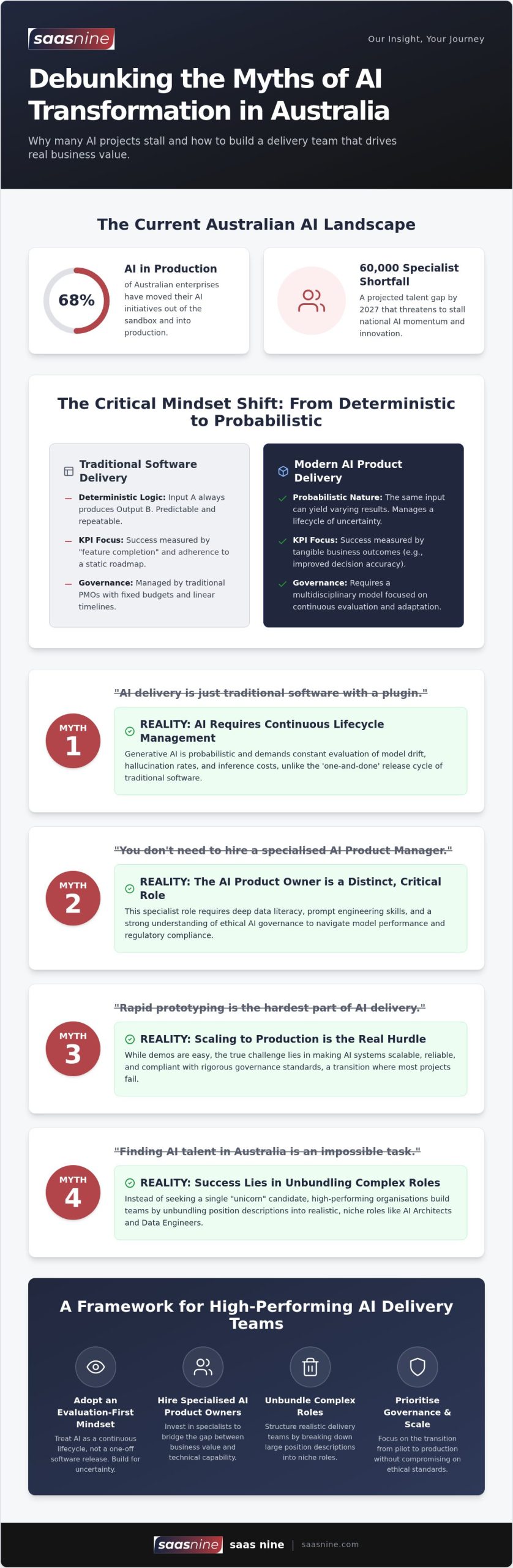
While 68% of Australian enterprises have moved AI initiatives into production, a projected shortfall of 60,000 specialists by 2027 threatens to stall this momentum. You’ve likely felt the friction of projects that look brilliant in a sandbox but struggle to scale or meet rigorous governance standards. It’s frustrating to watch a strategic vision get bogged down by technical debt or a lack of niche expertise. To bridge this gap, many organisations realise they need to hire AI product manager Australia specialists who understand the probabilistic nature of these systems rather than treating them like deterministic software.
This article identifies the four critical myths currently sabotaging Australian AI transformations and provides a clear framework for building a high-performing delivery team. We’ll explore how to unbundle complex roles, differentiate between traditional PMs and AI Product Owners, and align your workforce with the Microsoft ecosystem to ensure your journey leads to tangible business value. At saas nine, we believe in “Our Insight, Your Journey”, helping you navigate these complexities with precision and strategic clarity.
Key Takeaways
- Adopt a probabilistic delivery mindset that treats AI as a continuous lifecycle rather than a static, one-off software release.
- Understand why the strategic decision to hire AI product manager Australia specialists is essential for bridging the gap between business value and technical capability.
- Implement an evaluation-first framework to ensure your AI initiatives survive the transition from pilot to production without compromising on governance.
- Utilise the Agentic Workforce Model to access pre-qualified Microsoft talent through saas nine, helping you unbundle complex roles into realistic delivery teams.
Myth 1: AI Product Delivery is Just Traditional Software with a Plugin
Many Australian leaders assume adding a Large Language Model (LLM) to an existing stack is a standard feature update. It isn’t. While traditional product management focuses on deterministic logic, where input A always leads to output B, generative AI systems are probabilistic. This means identical prompts can yield varying results. Relying on “feature completion” as a KPI often fails because it ignores model drift, hallucination rates, and inference costs. If you want to hire AI product manager Australia talent, you need someone who manages the lifecycle of uncertainty rather than just a static release schedule. This shift demands a new approach to technical governance.
The Probabilistic Shift: Managing Uncertainty in Delivery
Quality assurance in generative AI requires continuous evaluation rather than a final sign-off. Because outputs shift as models evolve, rigid roadmaps often break under the weight of real-world data. High-performing teams prioritise business outcomes, such as reduced customer support latency or improved decision accuracy, over a simple checklist of features. This requires a cultural shift toward “Our Insight, Your Journey”, where the strategy adapts as the data reveals new pathways. It’s about building testing harnesses before the first line of code is written.
Why Traditional Project Management Offices (PMOs) Struggle
Traditional PMOs often clash with AI delivery due to fixed budgets and linear timelines. AI requires a discovery phase that feels experimental to those used to predictable software cycles. To succeed, organisations must unbundle rigid structures and adopt a multidisciplinary governance model. This approach bridges the gap between technical capability and commercial reality. When you decide to hire AI product manager Australia experts, saas nine helps you define these roles to ensure your team is structured for long-term resilience rather than short-term hype.
Myth 2: You Don’t Need to Hire a Specialised AI Product Manager
Assuming a generalist product manager can handle generative systems is a common oversight. It’s a mistake. While traditional roles focus on user experience and feature logic, AI delivery introduces significant challenges behind AI-driven products, specifically regarding model performance and ethical safety. To successfully navigate this, you must hire AI product manager Australia professionals who understand the nuance of probabilistic outcomes. These specialists bridge the gap between high-level business strategy and technical execution. When you hire AI product manager Australia experts, you’re investing in someone who can manage the shifting nature of LLMs rather than just a fixed feature list.
The Rise of the AI Product Owner in Australian Enterprise
The AI Product Owner is a distinct role requiring deep data literacy and an understanding of ethical AI governance. Unlike a standard technical lead or software architect within a Microsoft environment, this role focuses on prompt engineering and model evaluation. They ensure that systems like Microsoft Copilot or custom LLMs align with the Privacy and Other Legislation Amendment Act 2024. This specialised focus is vital for maintaining transparency in automated decision-making, especially as Australian regulations move toward mandatory standards in 2027.
Building Your Squad: AI Architects and Engineers
Structuring a successful delivery team requires unbundling traditional position descriptions into realistic, niche roles. An Intelligent Enterprise needs a squad comprising AI architects, data engineers, and perhaps even Agentic AI consultants. You can explore our saas nine talent portal to discover pre-qualified professionals who are already vetted for these specific Microsoft ecosystem capabilities. By connecting business strategy with technology capability, saas nine helps you avoid the risk of hiring generalists for highly specialised tasks. It’s about “Our Insight, Your Journey”, ensuring you have the right people for the road ahead. If you’re ready to define your ideal team structure, view our workforce planning services today.
Myth 3: Rapid Prototyping is the Hardest Part of AI Delivery
While a flashy demo might win over a boardroom, it rarely survives the transition to a live operational environment. This “Pilot Trap” is where many Australian AI initiatives stall; they lack the rigorous testing needed for enterprise-grade reliability. Success requires an evaluation-first mindset, where testing harnesses and performance benchmarks are established before a single line of code is written. To manage this complex transition, organisations must hire AI product manager Australia specialists who prioritise long-term stability over short-term “wow” factors. Implementing a robust AI Governance framework ensures that these systems remain responsible, compliant, and cost-effective as they scale across the business.
Moving from ‘Applause’ to ‘Adoption’
Transitioning from a prototype to full adoption involves deep integration into existing user workflows. It isn’t just about the technology; it’s about change management and workforce readiness. At saas nine, we help organisations align their technical strategy with actual workforce capability. By unbundling position descriptions into realistic, delivery-focused roles, we ensure you have the right mix of talent to sustain an intelligent enterprise. When you hire AI product manager Australia talent through our advisory, you gain a partner who understands that adoption is the only true metric of success.
The Role of Microsoft Fabric in AI Maturity
A production-ready AI product is only as good as its data foundation. Microsoft Fabric, with its OneLake architecture, provides the non-negotiable governance and integration needed for successful delivery. This platform centralises data assets, making them accessible yet secure for generative models. Leaders should review specific Microsoft Fabric roles to understand the specialised skills required for this data-centric future. If you need help structuring your data and AI squad to avoid the pilot trap, contact saas nine for strategic advisory.
Myth 4: Finding AI Talent in Australia is an Impossible Task
The narrative that finding niche skills is impossible often stems from treating AI roles like traditional IT vacancies. While a projected shortfall of 60,000 specialists by 2027 is a significant hurdle, the solution lies in capability discovery rather than just scanning job boards. To effectively hire AI product manager Australia professionals, organisations must leverage deep market intelligence to find talent already embedded within the Microsoft ecosystem. saas nine acts as a strategic partner, helping you look beyond traditional resumes to identify individuals with the precise technical literacy required for LLM orchestration and responsible AI adoption. For a detailed framework on vetting technical talent across related disciplines, the 2026 strategic checklist for hiring an AI engineer in Australia provides essential guidance on identifying niche Azure skills and structuring production-ready teams.
Leveraging the Agentic Workforce Platform
Our proprietary Agentic Workforce Platform represents a fundamental shift in how we mobilise pre-qualified talent. By using AI-driven discovery, we improve candidate matching and significantly reduce the risk of bad hires for highly specialised roles. This platform automates complex workflows to ensure every candidate is vetted against your specific technical stack and organisational culture. Whether you need a permanent lead or a contract specialist, exploring saas nine services provides a navigational path through a competitive and bifurcated market.
Strategic Advisory: Beyond the Basic Job Description
Successful ERP and AI transformations require more than just filling seats; they require strategic organisational design. We help you unbundle complex position descriptions into realistic roles that ensure your technology capability aligns with your commercial strategy. This methodical approach ensures your delivery team is structured for long-term resilience when you look to hire AI product manager Australia experts. As your expert guide, we remain committed to the principle of “Our Insight, Your Journey”, ensuring your path toward an intelligent enterprise is clear, supported, and successful.
Charting Your Path to AI Maturity
Transitioning from an AI pilot to a production-ready enterprise solution requires a fundamental shift in how you view both software and talent. You’ve seen how treating AI as a deterministic plugin leads to stalled initiatives and why the “Pilot Trap” remains a significant risk for the unprepared. Success in the Australian market depends on unbundling complex roles and adopting an evaluation-first mindset that prioritises long-term governance over short-term hype.
When you are ready to hire AI product manager Australia specialists, saas nine provides the strategic clarity needed to build a high-performing squad. We leverage our specialised Microsoft Ecosystem Capability Map and AI-powered Agentic Workforce Platform to connect your business strategy with pre-qualified talent. By focusing on responsible AI frameworks, we ensure your transformation is both ethical and resilient. Partner with saas nine to build your AI delivery team and move forward with confidence. Our Insight, Your Journey.
Frequently Asked Questions
What is the difference between an AI Product Owner and a traditional Product Manager?
An AI Product Owner manages probabilistic systems where outputs can vary, unlike a traditional Product Manager who oversees deterministic software. While a traditional PM focuses on user journeys and feature completion, the AI Product Owner prioritises model evaluation and ethical safety. This role acts as a navigational guide between business strategy and technical execution. It ensures generative models deliver consistent value while adhering to rigorous organisational standards.
How do we move our AI project from a pilot phase to full production in Australia?
Successful transition requires an evaluation-first mindset that prioritises testing harnesses over initial code. Many Australian projects stall because they lack a robust data foundation, such as Microsoft Fabric, to support real-world scaling. To bridge this gap, you should structure your delivery team with specialised roles that focus on long-term stability. This approach ensures your AI initiatives survive the transition from a flashy boardroom demo to a reliable enterprise application.
What are the most critical roles for a Microsoft-centric AI delivery team?
A high-performing Microsoft-centric team requires a blend of niche technical and strategic expertise. Essential roles include AI Architects for system design, Data Engineers to manage Microsoft Fabric environments, and AI Product Owners for strategic oversight. Many organisations also benefit from Agentic AI Consultants who specialise in autonomous workflows. Defining these specific capabilities helps you avoid the common mistake of hiring generalists for highly specialised tasks within the Microsoft ecosystem.
How does saas nine pre-qualify AI professionals for Australian enterprises?
We use our proprietary Agentic Workforce Platform and a specialised Microsoft Ecosystem Capability Map to identify high-calibre talent. This AI-driven discovery process allows us to match candidates based on specific technical stacks and responsible AI literacy. When you need to hire AI product manager Australia specialists, saas nine provides pre-vetted professionals who understand the nuance of probabilistic systems. Our market intelligence reduces hiring risk and ensures your team is structured for success.
Why is AI governance essential for product delivery?
AI governance is non-negotiable for ensuring transparency and compliance with the Privacy and Other Legislation Amendment Act 2024. It provides the necessary guardrails for automated decision-making and model safety, protecting your organisation from reputational and legal risks. Effective governance also manages inference costs and technical debt, ensuring that your AI products remain sustainable. Without a robust framework, projects often fail to meet the mandatory standards expected in the Australian market.