

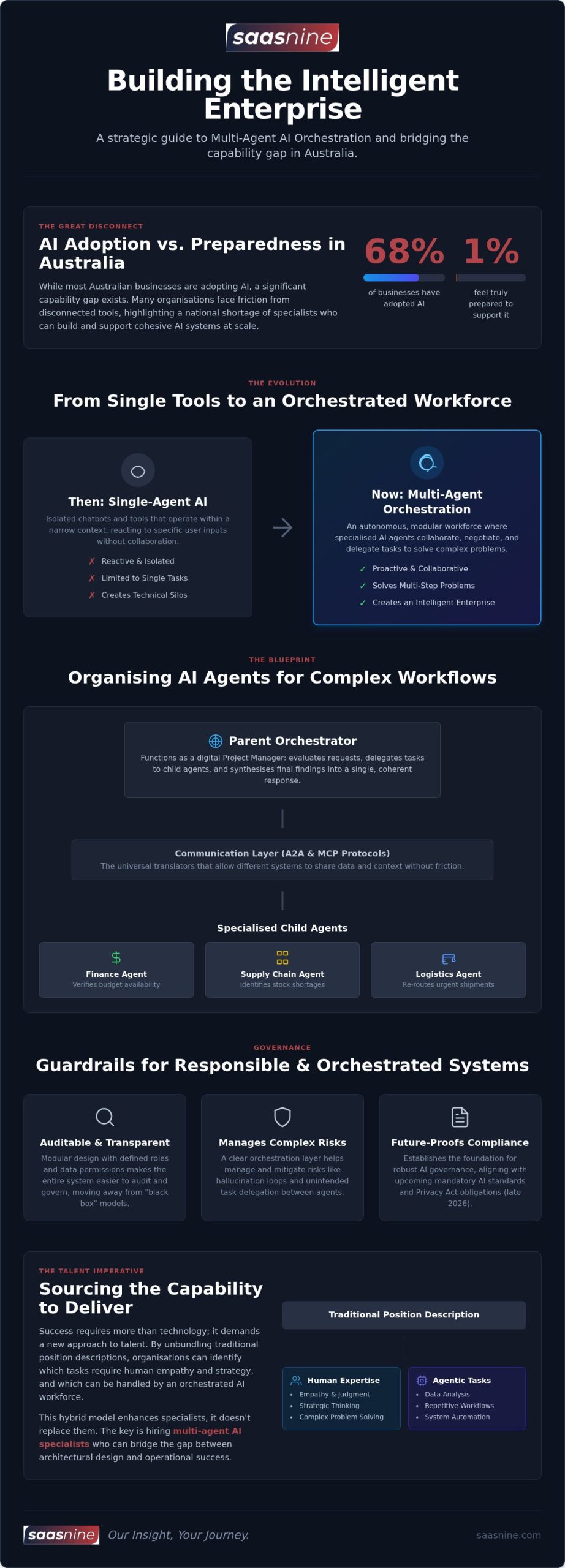
While 68% of Australian businesses have adopted AI, a staggering 1% feel truly prepared to support these systems at scale. You’ve likely experienced this friction first-hand as your organisation grapples with disconnected chatbots that fail to communicate. It’s a common frustration to see strategic potential stalled by technical silos and a national shortage of specialised architects. At saas nine, we recognise that moving from isolated tools to an autonomous, orchestrated workforce requires more than just new software; it requires a structural shift in how you deploy capability.
This guide explores how multi-agent orchestration can transform your operations into a cohesive Intelligent Enterprise. We’ll provide a strategic roadmap for understanding the architectural requirements of agentic AI and offer insights into hiring multi-agent AI specialists Australia needs to bridge the current capability gap. You’ll learn how to unbundle complex roles into realistic delivery teams and find a partner to source pre-qualified talent. Our insight, your journey begins with turning fragmented experiments into a unified, high-performing digital workforce that drives genuine business outcomes.
Key Takeaways
- Transition your organisation toward an Intelligent Enterprise by shifting from reactive chatbots to a modular, autonomous multi-agent workforce.
- Identify the essential architectural components, such as Parent Orchestrators and A2A protocols, that enable disparate AI systems to collaborate effectively.
- Establish responsible AI guardrails to manage complex risks like hallucination loops and unintended delegation within your orchestrated systems.
- Navigate the severe talent shortage by hiring multi-agent AI specialists Australia requires to bridge the gap between architectural design and operational success.
What is Multi-Agent Orchestration? Defining the Intelligent Enterprise
Multi-agent orchestration serves as the strategic coordination layer that manages specialised AI agents to achieve complex, shared objectives. While many Australian organisations began their journey with Microsoft Copilot as a simple assistant, the market is rapidly maturing toward Agentic AI. This shift represents a move from a single tool to a modular, orchestrated workforce. By adopting a multi-agent system, businesses can overcome the limitations of legacy platforms and address local talent shortages through smarter automation. Many leaders are now prioritising hiring multi-agent AI specialists Australia wide to bridge the gap between legacy systems and these new autonomous capabilities.
At saas nine, we view this as the bridge between high-level strategy and technical execution. Our approach ensures your technology capability mirrors your business ambition, focusing on practical outcomes rather than just the latest hype. By connecting strategy with capability, we help you navigate the complexities of this transition with a steady, expert hand.
The Evolution from Single Agents to Orchestrated Collectives
A single-prompt AI operates in isolation, reacting to specific user inputs within a narrow context. In contrast, orchestrated collectives negotiate and delegate tasks autonomously to solve multi-step problems. Consider a supply chain agent identifying a critical stock shortage; it doesn’t just alert a human. It communicates with a finance agent to verify budget availability and a logistics agent to re-route urgent shipments. This level of autonomy is precisely why hiring multi-agent AI specialists Australia has become a priority for leaders seeking to build a truly Intelligent Enterprise. It’s about moving from reactive tools to proactive, collaborative operators.
Why Orchestration is Essential for Responsible AI Adoption
Orchestration provides a modular framework that makes complex autonomous systems easier to audit and govern. Instead of a monolithic “black box” model, each agent has defined boundaries, data access permissions, and specific roles. This structure is foundational for maintaining robust AI Governance, particularly as Australia moves toward mandatory AI standards and stricter Privacy Act obligations in late 2026. By unbundling roles into realistic delivery teams, saas nine ensures that your digital workforce remains transparent and accountable. Our insight, your journey involves building these guardrails early to ensure long-term stability and trust.
The Architectural Blueprint: Organising AI Agents for Complex Workflows
Building a successful agentic ecosystem requires a robust architectural blueprint. This structure consists of a Parent Orchestrator, Specialised Child Agents, and a secure Communication Layer. With Australian organisations currently using an average of 11 AI agents, leaders must understand the risks and controls for multi-agent systems as outlined by the Australian Government. Designing these pathways effectively often requires hiring multi-agent AI specialists Australia businesses can trust to maintain system integrity.
At the heart of this architecture lie the Model Context Protocol (MCP) and Agent-to-Agent (A2A) protocols. Think of these as the universal translators that allow different systems to share data and context without friction. You’ll need to distinguish between Inline Agents, which act as reusable subroutines for simple tasks, and Connected Agents, who serve as domain-specific experts. Clear hand-off criteria are vital here to ensure the system doesn’t lose coherence during task delegation between these specialised units.
The Role of the Parent Orchestrator
The Parent Orchestrator functions as a digital Project Manager. It evaluates user requests, delegates specific tasks to child agents, and synthesises the final findings into a single response. A critical technical requirement is the “no direct reply” directive for subagents. This ensures that only the orchestrator communicates with the user, preventing a chaotic stream of duplicate messages from multiple agents working in the background.
Unbundling Roles into Agentic Tasks
Leaders must learn to unbundle traditional position descriptions into discrete, agentic tasks. This process identifies which parts of a role require human empathy and which are suited for an orchestrated AI workforce. This hybrid model doesn’t replace specialists; it enhances them by removing administrative friction. If you’re looking to define these new roles, saas nine can help you map your ecosystem capability. Hiring multi-agent AI specialists Australia wide allows you to bridge this transition effectively. Our insight, your journey is about creating a workforce that scales with precision.
Governance and Responsibility: Guardrails for Orchestrated Systems
Multi-agent systems introduce unique vulnerabilities such as hallucination loops, where one agent’s error is amplified by another, creating a cycle of misinformation. Unintended delegation also poses a risk, as agents might pass tasks to sub-agents without proper oversight. Managing these complexities requires a mature, responsible AI framework. This is a primary driver for hiring multi-agent AI specialists Australia-wide; organisations need experts who can build these guardrails into the system from day one.
Establishing a single source of truth is the next priority. Using Microsoft Fabric and OneLake ensures agents draw from verified data rather than fragmented silos. At saas nine, we advocate for Human-in-the-loop (HITL) checkpoints within every orchestrated workflow. These mandatory human approvals for high-impact decisions ensure that autonomy never comes at the cost of accountability. Our insight, your journey means providing the technical rigour to keep your digital workforce on the right path.
Security and Access Control in Multi-Agent Systems
Agents must never bypass organisational security restrictions. Implementing strict role-based access ensures that a child agent only sees the data it needs to perform its specific task. We recommend leveraging Microsoft Fabric Roles to manage these permissions at scale. This prevents agents from inadvertently accessing sensitive HR or financial data that sits outside their defined scope.
Monitoring and Observability for Business Value
Building a sustainable system requires continuous oversight. An AI Centre of Excellence (CoE) provides the necessary governance to manage these digital workers effectively. By hiring multi-agent AI specialists Australia, your CoE can log every agent interaction and audit workflows to ensure they deliver measurable ROI. This level of observability allows you to refine agent prompts and protocols based on real-world performance data.
To ensure your agentic workforce is both safe and effective, contact saas nine today for a strategic advisory session.
Building Your Agentic Workforce: Sourcing the Capability to Deliver
The real bottleneck for multi-agent orchestration isn’t the software; it’s the severe scarcity of specialised talent. While 69% of Australian SMBs use AI regularly, 84% of businesses experienced significant skill shortages in 2025. Success depends on hiring multi-agent AI specialists Australia requires to move beyond simple pilots. At saas nine, we bridge this gap by connecting your high-level strategy with the technical capability needed for complex delivery.
To build an Intelligent Enterprise, you need three critical roles:
- Agentic AI Consultants: Professionals who align business processes with autonomous agent workflows.
- AI Architects: Technical leaders who design the orchestration layers and parent-child hierarchies.
- Fabric Architects: Experts who ensure the data foundation in OneLake is structured for agentic discovery.
Vetting for Agentic AI Capability
Identifying the right talent requires looking beyond generic engineering skills. We vet for deep experience with orchestration patterns, the Model Context Protocol (MCP), and Microsoft Copilot Studio. By unbundling traditional roles into realistic delivery tasks, we ensure your project teams are structured for success. Our proprietary Agentic Workforce Platform allows you to discover pre-qualified Microsoft professionals who understand these nuances.
Strategic Advisory and Workforce Planning
We don’t just fill seats; we provide the strategic advisory needed for organisational design. This involves mapping your technology capability to your long-term business goals. Moving beyond traditional recruitment, saas nine uses market intelligence to drive AI-driven workforce discovery. Our insight, your journey is about ensuring you have the right people to navigate the complexity of an agentic future. We help you structure teams that don’t just implement technology but realise its full commercial value. Leaders who need to hire AI engineer Australia specialists will find that applying a structured 2026 checklist is essential to vetting the niche technical capability required for production-ready agentic environments.
Navigating Your Path to an Agentic Future
Transitioning to an Intelligent Enterprise is a strategic shift that requires both architectural rigour and the right people. You’ve seen how multi-agent orchestration moves beyond simple chatbots to create a modular, autonomous workforce that drives complex business outcomes. By establishing clear governance and unbundling roles into realistic delivery tasks, you ensure your AI investment delivers measurable long-term value. The success of this journey ultimately depends on hiring multi-agent AI specialists Australia organisations can trust to execute these sophisticated workflows.
At saas nine, we provide a steady hand in this complex environment. Our proprietary Agentic Workforce Platform gives you immediate access to vetted Microsoft professionals specialised in Agentic AI and Microsoft Fabric. It’s about bridging the gap between high-level strategy and technical delivery capability. Our insight, your journey begins when you partner with saas nine to mobilise your AI project team today. We look forward to helping you build a more intelligent, orchestrated future for your organisation.
Frequently Asked Questions
What is the difference between a single AI agent and multi-agent orchestration?
A single AI agent typically operates as a responsive assistant that handles isolated prompts within a narrow context. In contrast, multi-agent orchestration functions as a modular workforce where a parent orchestrator negotiates and delegates tasks to specialised child agents. This allows for the resolution of multi-step, complex business processes that a single tool cannot manage. It moves your organisation from simple automation to a truly autonomous Intelligent Enterprise.
Do I need to be on Microsoft Fabric to implement multi-agent orchestration?
While you can build orchestration layers using Microsoft Copilot Studio or Azure AI Services independently, Microsoft Fabric provides the essential data foundation for scale. Using Fabric and OneLake ensures your agents access a verified, unified ground truth rather than fragmented silos. This architectural choice improves system reliability and reduces the risk of hallucination by providing a governed environment where data access is strictly managed through role-based controls.
How do I ensure my multi-agent system remains compliant with Australian AI regulations?
Organisations must align with the mandatory Australian AI Standards announced on 15 July 2026 and prepare for Privacy Act updates starting 10 December 2026. You are required to maintain a register of AI use cases and disclose substantially automated decisions that impact individual rights. Implementing a responsible AI framework with human-in-the-loop checkpoints ensures your autonomous systems remain transparent, accountable, and compliant with these evolving local legal requirements.
What are the most common challenges when organising multiple AI agents?
The primary challenges include managing hallucination loops, where errors cycle between agents, and preventing unintended delegation. Technical silos often arise if agents don’t share context effectively through protocols like MCP or A2A. Ensuring that child agents don’t inadvertently bypass organisational security restrictions is also critical. Overcoming these hurdles requires a steady hand in architectural design and a clear strategy for unbundling traditional roles into realistic, manageable agentic tasks.
How do I find specialised talent in Australia to build these agentic systems?
The most effective path is partnering with a talent advisory business that uses market intelligence for hiring multi-agent AI specialists Australia wide. Traditional recruitment often fails to vet for niche skills like Agent-to-Agent protocols or orchestration patterns. saas nine utilises a proprietary Agentic Workforce Platform to connect leaders with pre-qualified Microsoft professionals. We help you define specific roles and build delivery teams capable of executing your AI strategy. Organisations that also need to hire AI product manager Australia specialists will find that addressing common delivery myths is equally critical to ensuring these agentic projects scale beyond the pilot stage.