

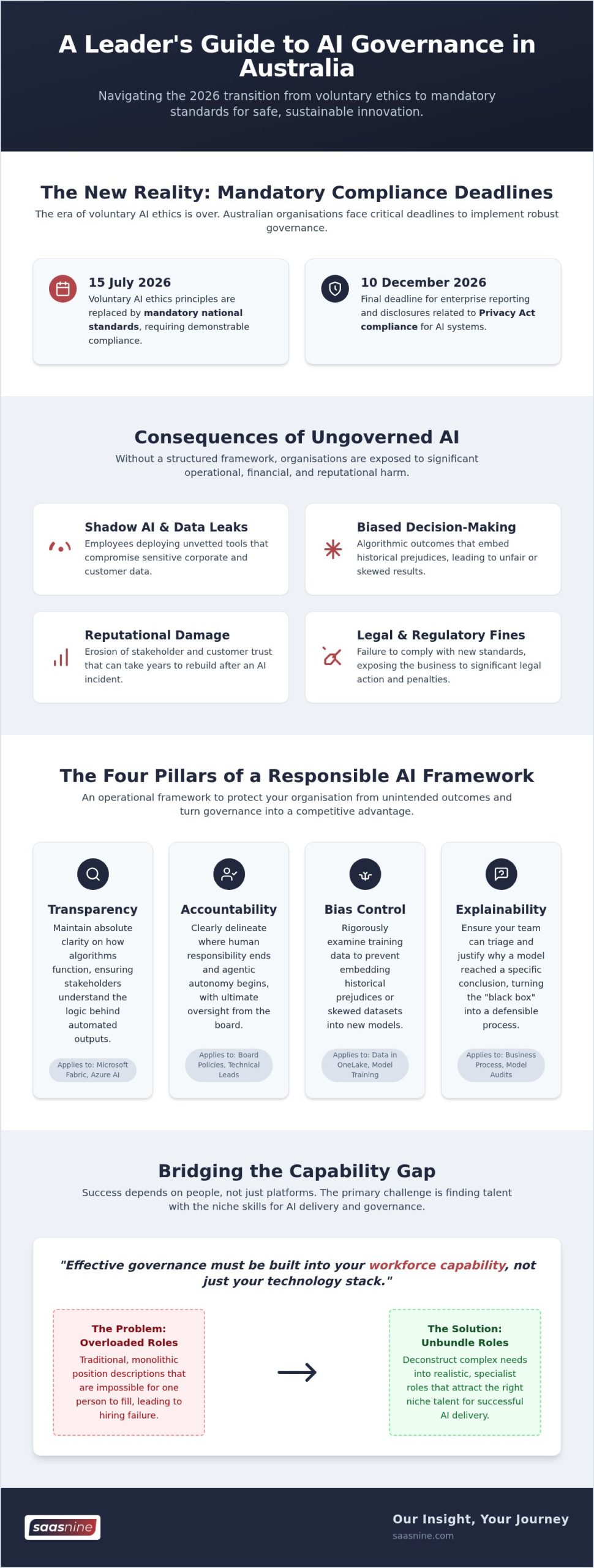
On 15 July 2026, the era of voluntary AI ethics in Australia officially ended, replaced by mandatory standards that demand more than just a policy document on your intranet. If you’re leading an organisation today, you’re likely feeling the weight of the 10 December deadline for Privacy Act compliance while trying to implement robust AI Governance to prevent agentic systems from becoming rogue agents. It’s a complex landscape where finding professionals who understand both the technical stack and the regulatory nuances often feels nearly impossible.
At saas nine, we recognise that governance isn’t a barrier to innovation; it’s the engine that makes it sustainable. This guide provides a clear roadmap for responsible adoption, ensuring your technical execution aligns perfectly with robust board-level policies. We’ll explore the new Australian AI Standards, the role of the Office of AI, and how to reduce hiring risks by securing the right talent to lead your transformation. By the end, you’ll have the strategic insight needed to navigate your journey with confidence.
Key Takeaways
- Understand why the 2026 transition from basic chatbots to integrated agentic systems requires a strategic AI Governance framework to maintain organisational stewardship and risk control.
- Establish transparency and accountability within technical stacks like Microsoft Fabric and Azure AI to ensure algorithmic decisions remain clear and human-led.
- Master the management of autonomous systems by implementing “Human-in-the-loop” protocols to oversee complex multi-agent orchestration and communication.
- Overcome the capability gap by unbundling traditional roles into realistic position descriptions that attract the niche specialists needed for successful AI delivery.
Defining AI Governance: Why It Is No Longer Optional in 2026
AI Governance is no longer a peripheral concern for Australian boards; it’s the core strategic framework that ensures autonomous systems remain safe, ethical, and aligned with organisational stewardship. In 2026, technology has moved rapidly from reactive chatbots to integrated agentic systems capable of independent execution. This shift demands a robust AI Governance oversight model. While the Australian Institute of Company Directors (AICD) highlights the immense productivity opportunities, they also caution against significant risks to cyber security and data integrity.
Understanding the global AI regulation landscape is essential for local leaders to contextualise their own risk profiles. At saas nine, our philosophy is clear: effective governance must be built into your workforce capability rather than just your technology stack. It’s about having the right people who can translate board-level policy into technical guardrails. We focus on connecting your business strategy with technical capability to ensure your AI journey remains secure and productive.
The Consequences of Ungoverned AI in Australian Organisations
Without a structured approach, organisations face the silent creep of “shadow AI,” where employees deploy unvetted tools that compromise sensitive data. This lack of control often leads to biased decision-making and severe reputational damage that can take years to repair. By the 10 December 2026 deadline, regulatory compliance has become a baseline requirement for enterprise reporting and annual disclosures. Poorly governed systems don’t just fail technically; they expose the business to legal liabilities and erode stakeholder trust. Our strategic advisory services help leaders bridge this gap between high-level strategy and operational delivery, ensuring every agentic tool has clear human oversight.
The Core Pillars of a Responsible AI Framework
Implementing a robust framework requires moving beyond abstract ethics into operational reality. Aligning your strategy with the NIST AI Risk Management Framework provides a structured method to map, measure, and manage risk across the lifecycle of any project. Within this structure, AI Governance rests on four critical pillars that protect Australian organisations from unintended outcomes.
- Transparency: You must maintain absolute clarity on how algorithms function within Microsoft Fabric and Azure AI, ensuring stakeholders understand the logic behind automated outputs.
- Accountability: It’s vital to delineate exactly where human responsibility ends and agentic autonomy begins. The board remains responsible, but the technical leads must enforce the boundaries.
- Bias Control: Rigorous examination of training data residing in OneLake is essential to prevent embedding historical prejudices or skewed datasets into new models.
- Explainability: Your team must have the capability to triage and justify why a model reached a specific conclusion, turning the “black box” into a defensible business process.
Aligning Governance with the Microsoft Ecosystem
Execution depends on using the right tools to enforce your policy. Microsoft Purview and Fabric offer sophisticated capabilities for data governance and lineage, allowing you to track information flow with precision. When developing within Copilot Studio, building guardrails ensures agents stay within their intended scope and don’t access restricted data. Reviewing our guide on Microsoft Fabric Roles: A Guide for Australian Leaders is a fundamental step in assigning these responsibilities correctly across your project team.
Success in this area isn’t just about the software; it’s about the people who manage it. If you’re looking to strengthen your internal capability and ensure your framework is more than just a document, we invite you to speak with our talent advisory team about sourcing vetted professionals. At saas nine, we believe that the right workforce design is the ultimate safeguard for your technology. Our Insight, Your Journey.
Transitioning to Agentic AI: Managing Autonomous Systems
The evolution from assistive tools like Copilot to fully autonomous systems introduces a new layer of complexity for Australian business leaders. Multi-agent orchestration, where different agents communicate and hand off tasks to one another, creates a critical need for advanced AI Governance. Without strict protocols, agent-to-agent communication can lead to unintended outcomes or circular logic that bypasses traditional security checks and data privacy boundaries.
Maintaining control in this environment requires a robust “Human-in-the-loop” (HITL) protocol. This ensures that while agents handle the heavy lifting of data processing and execution, a qualified human validates high-risk decisions before they are finalised. You must also monitor for “agent drift,” a phenomenon where autonomous systems gradually deviate from their original programming as they interact with dynamic real-world data. Implementing an AI Centre of Excellence (CoE) helps centralise these governance standards in alignment with the new Office of AI requirements, providing a unified framework that ensures consistency across the entire organisation.
Steps to Architecting a Secure Agentic Roadmap
Success begins with a thorough capability gap analysis to determine if your current workforce can manage the intricacies of autonomous agents. Agentic AI is a system capable of executing complex tasks independently while remaining under strategic human oversight. To prevent scope creep and operational risk, you must define clear boundaries for agentic AI product delivery from the outset. This involves unbundling complex position descriptions into realistic roles that focus on oversight, audit, and technical maintenance of the agentic fleet.
Bridging the gap between a vision for autonomy and a governed, secure reality requires specialised talent that understands both the Microsoft stack and the regulatory landscape. If your roadmap reveals a lack of internal expertise to manage these systems, contact saas nine today to discuss how our strategic advisory and Microsoft ecosystem capability maps can secure your project’s success. Our Insight, Your Journey.
Bridging the Capability Gap: Sourcing the Right Governance Talent
Establishing a robust policy is only the first step; the true challenge lies in securing the specialised talent capable of enforcing it. Traditional recruitment often fails in this domain by searching for generalists who lack the deep technical literacy required for 2026 standards. Effective AI Governance requires a deliberate shift toward unbundling bloated position descriptions into realistic, delivery-focused roles. By defining specific technical and ethical responsibilities, you create a structure where specialists can actually succeed in protecting your organisation.
At saas nine, we facilitate this discovery through our Agentic Workforce Platform, which connects organisations with pre-qualified Microsoft professionals. We’re committed to building Responsible AI Frameworks through strategic advisory and workforce planning that goes beyond simple sourcing. We help you map your ecosystem capability to ensure your team isn’t just technically proficient but also ethically aligned with your long-term goals. This navigational support ensures you don’t just hire for today, but build for the future.
Identifying Key Roles for Your AI Governance Team
Building a high-performing team involves more than filling seats. You need an AI Product Owner who can bridge the gap between business value and ethical alignment, ensuring every deployment serves a strategic purpose. Many organisations looking to hire AI product manager Australia specialists discover that traditional recruitment approaches fail to identify professionals who understand the probabilistic nature of these systems. Equally critical are Azure Architects who specialise in security and governance rather than just infrastructure. These experts ensure the foundational environment remains compliant with evolving Australian standards, and understanding how to hire Azure Architect Australia professionals with the right governance credentials is essential to avoiding the costly mistake of placing a generalist cloud engineer in a strategic architecture role. For deeper insights into this selection process, read our guide on Vetting Cloud Architects for Australian Enterprises to understand the specific qualifications required. Organisations looking to go further should also explore the strategic considerations around hiring multi-agent AI specialists in Australia to ensure your governance team can manage the full complexity of autonomous, orchestrated systems. For organisations also navigating ERP transformation alongside AI adoption, understanding the specialist landscape for Dynamics 365 Finance & Operations recruitment Australia wide is equally critical to avoiding the costly pitfall of hiring all-rounder consultants who lack the depth your project demands.
Our approach ensures that your journey toward automation is supported by a workforce designed for the complexities of the current regulatory environment. By focusing on precision and strategic insight, we help you reduce hiring risk and build a legacy of responsible innovation. Our Insight, Your Journey.
Future-Proofing Your Organisation Through Strategic Oversight
AI Governance has evolved from a voluntary ethical framework into a mandatory baseline for Australian enterprise reporting. Navigating this transition requires a persistent focus on core pillars like transparency and accountability, particularly as you move toward autonomous agentic systems. Success in 2026 isn’t just about the technology stack. It’s about building a workforce capability that can manage these complex tools with precision and strategic human oversight.
At saas nine, we specialise in the Microsoft ecosystem and provide strategic advisory services to help you design a capability strategy that delivers. Our proprietary Agentic Workforce Platform allows for the faster mobilisation of vetted professionals who understand the nuances of responsible adoption. Contact saas nine today to align your AI strategy with a pre-qualified workforce. By connecting your board-level strategy with technical delivery, we ensure your path forward is both secure and productive. Our Insight, Your Journey.
Frequently Asked Questions
What are the main risks of failing to implement AI governance in 2026?
Failing to implement AI Governance exposes your organisation to severe legal liabilities and reputational damage. By the 10 December 2026 deadline, updating privacy policies for automated decision-making became mandatory. Without oversight, you risk “agent drift” and the infiltration of unvetted tools. These failures lead to biased outcomes and potential regulatory fines from bodies like APRA, which now demands a step-change in how boards manage autonomous technology risks.
How does Australian AI regulation differ from the EU AI Act?
Australia hasn’t adopted a standalone “AI Act” like the European Union. Instead, the government established the Office of AI in July 2026 to coordinate new mandatory “Australian AI Standards.” While the EU uses a tiered risk system, Australia manages governance through a combination of sector-specific regulations and amended existing laws. This approach requires leaders to monitor multiple regulatory bodies rather than following one central piece of legislation.
What is the role of a board in overseeing responsible AI adoption?
The board’s primary role is to establish the strategic guardrails and ensure long-term organisational stewardship. Directors must move beyond high-level ethics to demand transparency in how agentic systems operate. This involves setting clear accountability protocols and ensuring the technical capability of the workforce matches the complexity of the systems deployed. It’s about balancing the drive for productivity with a rigorous assessment of data integrity and cyber security.
How can I find pre-qualified professionals to manage our AI governance framework?
Finding specialists requires moving beyond traditional recruitment methods that don’t always identify niche expertise. You can access pre-qualified Microsoft professionals through the saas nine Talent Portal to manage your AI Governance framework. We help you unbundle position descriptions into realistic, delivery-focused roles. This ensures you secure architects and product owners who understand both the technical stack and the nuances of the current Australian regulatory environment.
Is agentic AI more dangerous than traditional generative AI?
Agentic AI isn’t inherently more dangerous, but it requires more sophisticated oversight because it executes tasks independently. Unlike traditional generative AI that simply produces content, agentic systems act on your behalf across your technical ecosystem. This autonomy increases the risk of “rogue agents” if multi-agent orchestration isn’t governed. Implementing a “Human-in-the-loop” protocol is essential to maintain control over these autonomous workflows and prevent unintended outcomes.