
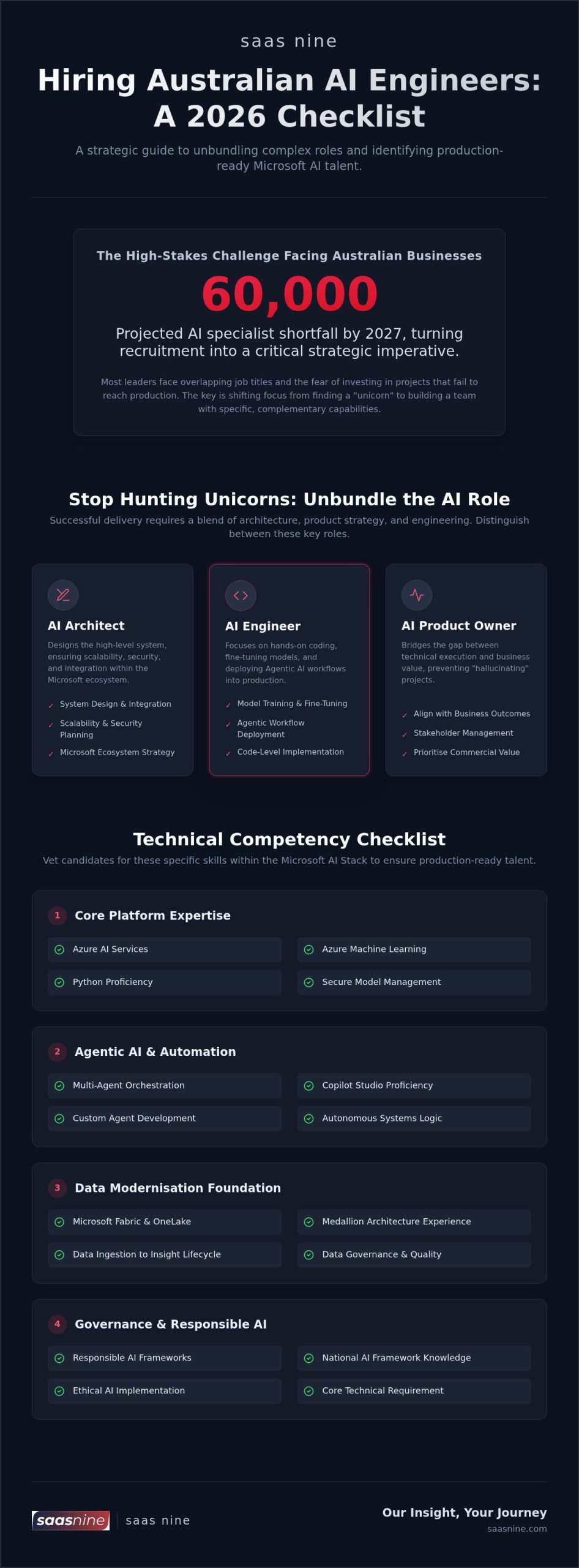
With a projected shortfall of up to 60,000 specialists by 2027, the race to hire ai engineer australia talent has shifted from a standard recruitment exercise into a high-stakes strategic challenge. Most Australian business leaders feel the pressure of overlapping job titles and the genuine fear of investing in “hallucinating” projects that never actually reach production. At saas nine, we recognise that successful delivery isn’t about finding a technical unicorn; it’s about matching specific Microsoft-aligned capabilities with responsible governance and production-ready architecture.
This article provides a comprehensive 2026 checklist to help you unbundle complex roles and identify pre-qualified engineers who can deliver tangible business value. We’ll guide you through vetting niche Azure skills, navigating the new mandatory national AI framework, and leveraging our “Our Insight, Your Journey” approach to build a high-performing Agentic AI workforce. You’ll gain a clear framework for turning technical strategy into successful, responsible delivery.
Key Takeaways
- Learn how to unbundle generic job descriptions into specialised, realistic roles to avoid the common hiring failures that frequently stall Australian AI projects.
- Identify the specific technical competencies required for the Microsoft AI stack, focusing on Azure Machine Learning and the critical integration of Microsoft Fabric.
- Understand why responsible AI is now a core technical requirement and how to vet candidates for governance expertise when you hire ai engineer australia professionals.
- Evaluate the most effective engagement models for your transformation and use the saas nine Talent Portal to streamline the discovery of pre-qualified, production-ready talent.
Defining Your AI Engineering Requirements: Unbundling the Role
Many Australian enterprises fall into the trap of searching for a “unicorn” when they attempt to hire ai engineer australia. The generic title often leads to hiring failure because it bundles disparate skill sets into a single, unrealistic position description. At saas nine, our philosophy focuses on unbundling these roles to ensure each team member has a clear, executable mandate. To understand what is artificial intelligence in a commercial context, one must first recognise that production-ready delivery requires a blend of architecture, product strategy, and technical engineering.
We see many organisations struggle when they ask a single engineer to manage data engineering, model training, and business stakeholder management simultaneously. This lack of role clarity often results in projects that stall in the prototype phase. By unbundling the position description, you can target specific competencies that match your current needs and technical maturity.
The Difference Between Strategic Leadership and Technical Execution
Success depends on distinguishing between those who design the path and those who build the solution. An AI Architect focuses on high-level system design and integration within the Microsoft ecosystem, ensuring scalability and security. Conversely, a hands-on AI Engineer focuses on the code, fine-tuning models and deploying Agentic AI workflows. Bridging this gap is the AI Product Owner; a critical role responsible for ensuring technical execution aligns with actual business value. This role prevents “hallucinating” projects by keeping the focus on commercial outcomes.
Your hiring strategy must also reflect your organisation’s AI maturity. In the exploration stage, you might need a generalist to prove concepts. However, moving toward an “Intelligent Enterprise” requires specialised talent familiar with Microsoft Fabric and Azure Machine Learning. We help you map these requirements to your specific journey, ensuring you don’t over-hire for simple tasks or under-hire for complex transformations. Our Insight, Your Journey ensures your team structure supports long-term outcomes rather than short-term hype.
Technical Competency Checklist: Mastering the Microsoft AI Stack
To effectively hire ai engineer australia talent, you must look beyond generic coding skills. While Python proficiency is common, enterprise success requires deep expertise in Azure AI Services and Azure Machine Learning. These tools allow your team to build, deploy, and manage models within a secure Microsoft environment. Vetting for these specific competencies ensures that your engineers can translate raw data into production-ready solutions that integrate seamlessly with your existing infrastructure. Finding the right talent to hire ai engineer australia professionals requires a focus on platform-specific depth rather than broad generalisations.
Agentic AI and the Future of Workforce Automation
The market has shifted from simple chatbots to autonomous systems. Your next hire needs to demonstrate capability in multi-agent orchestration, where multiple AI agents collaborate to complete complex business processes. Proficiency in Copilot Studio and custom agent development is essential for moving beyond basic automation. Considering CSIRO’s role in Australian AI research and its focus on practical application, local engineers should be well-versed in creating agents that handle real-world logic and reasoning.
Data Modernisation as a Prerequisite
High-performing AI systems rely on structured, high-quality data. Engineers must be comfortable working with Microsoft Fabric and OneLake to centralise information. We recommend vetting for experience with Medallion Architectures, as this structured approach to data processing ensures your AI models remain accurate and reliable. Strategic Microsoft Fabric recruitment is now a non-negotiable step for organisations aiming to become truly data-driven. This expertise allows engineers to manage the entire data lifecycle, from ingestion to insight, within a single, governed platform. If you’re looking to bridge the gap between your data strategy and technical execution, you can contact saas nine to discuss your specific team requirements.
Evaluating Governance and Responsible AI Frameworks
In the current regulatory climate, “Responsible AI” has transitioned from a boardroom policy to a core technical requirement. When you aim to hire ai engineer australia, you must ensure candidates possess the skills to implement guardrails directly within the technical stack. Following the July 2026 announcement of a mandatory national framework, technical talent must now be well-versed in the nuances of Australia’s National AI Plan. This involves more than simple compliance; it requires an engineer who can architect systems for security, data privacy, and transparency within the Azure ecosystem.
Vetting for these competencies involves assessing an engineer’s ability to use tools like Microsoft Purview and Azure Policy to enforce data sovereignty. Your recruitment process should align with the AI Governance 2026 guide to ensure every new hire understands their role in risk mitigation. At saas nine, we view governance as a pillar of production-ready delivery. This approach helps you move beyond fragile prototypes toward stable, enterprise-grade solutions that stand up to regulatory scrutiny. When you hire ai engineer australia, prioritising these governance skills protects your long-term investment.
The Ethics of Agentic AI Delivery
As organisations deploy autonomous agents, the need for auditable systems becomes paramount. You should test an engineer’s approach to bias and transparency through specific interview scenarios. Ask how they would handle a multi-agent orchestration where one agent provides flawed reasoning, or how they ensure a “human-in-the-loop” remains effective without stalling automation. Our Insight, Your Journey focuses on building teams that respect these ethical boundaries while driving performance. If you require assistance in vetting for these sophisticated governance skills, contact saas nine to discuss our strategic advisory services.
Optimising Your Engagement Model for AI Transformation
Choosing the right engagement model is a strategic decision that impacts the speed and stability of your AI journey. While permanent placements are ideal for retaining long-term intellectual property, many Australian businesses find value in contingent recruitment for specific Agentic AI proof-of-concepts. We provide strategic advisory services to help you navigate workforce planning and organisational design. This ensures your team structure supports both niche specialists and internal capability uplift. This hybrid approach allows you to hire ai engineer australia expertise while you’re simultaneously developing your internal talent pool.
To streamline this process, our Talent Portal leverages AI-driven capability discovery to match your specific requirements with pre-vetted professionals. This platform automates workflows and improves visibility, allowing you to mobilise high-performing teams faster than traditional methods. Our Insight, Your Journey is about providing the market intelligence needed to connect business strategy with technical execution.
Reducing Hiring Risk with Pre-qualified Professionals
The complexity of the Microsoft ecosystem means that generic vetting often misses the mark. As a specialised data and AI recruitment partner, saas nine focuses on deep technical qualification. We ensure every professional understands production-ready Azure architecture and responsible AI frameworks before they reach your interview stage. It’s a rigorous approach. This method reduces the risk of project failure and ensures your chosen engagement model translates into successful delivery. By unbundling roles and focusing on pre-qualified talent, you can build a resilient workforce capable of handling the unique demands of the Australian market.
Scaling Your AI Capability with Precision
Success in the Australian market requires a shift from chasing unicorns to building structured, high-performing teams. By unbundling generic position descriptions and focusing on niche Microsoft competencies like Azure Machine Learning and Fabric, you’ve established a foundation for production-ready delivery. Remember that governance is no longer just a policy; it’s a technical safeguard that ensures your projects remain responsible and compliant with the latest national standards. As you look to hire ai engineer australia talent, the focus must remain on connecting business strategy with technical capability.
At saas nine, we act as your trusted talent advisory partner, providing specialist insight for Agentic AI and Microsoft Fabric delivery. You can access pre-qualified Microsoft professionals through our Talent Portal, ensuring your transformation is supported by vetted expertise from day one. Our Insight, Your Journey reflects our commitment to long-term partnerships that prioritise real-world outcomes over technology hype. Take the next step in your digital transformation and connect with saas nine to mobilise your AI workforce today. We’re here to help you navigate the complexities of the evolving landscape with calm assurance.
Frequently Asked Questions
What is the average salary for an AI engineer in Australia in 2026?
In 2026, the average base salary for a mid-level AI engineer in Australia ranges from $130,000 to $165,000 per year, excluding superannuation. Senior-level professionals command between $150,000 and $215,000, while lead roles often exceed $270,000. For those looking to hire ai engineer australia talent on a contract basis, senior daily rates typically sit between $950 and $1,600 depending on their specific niche expertise and the complexity of the project.
How do I distinguish between an AI engineer and a machine learning engineer?
While the roles overlap, an AI engineer focuses on deploying and integrating production-ready systems like Copilot and Agentic AI workflows. They bridge the gap between model logic and software engineering. In contrast, a machine learning engineer typically concentrates on the underlying mathematical models, data science research, and algorithm development. Understanding this distinction is vital for unbundling your position descriptions into realistic, specialised roles that match your specific digital transformation goals.
Do I need to hire a permanent AI engineer or a contractor for my project?
The choice depends on your project’s lifecycle and internal capability goals. Permanent hires are ideal for organisations looking to retain intellectual property and lead long-term strategy as they move toward an Intelligent Enterprise. Contractors offer a lower-risk way to mobilise for specific milestones, such as a Microsoft Fabric implementation. We often recommend a hybrid model to hire ai engineer australia specialists while simultaneously upskilling your core internal team for long-term success.
What specific Microsoft certifications should I look for in an AI engineer?
Look for candidates holding the Azure AI Engineer Associate (AI-102) and the Azure Data Scientist Associate (DP-100) certifications. For organisations prioritising data modernisation, the Microsoft Fabric Analytics Engineer Associate (DP-600) is highly valuable. These credentials signal that a professional understands the technical rigour required for the Microsoft AI stack. However, always complement these certifications with a portfolio of deployed, production-ready projects to ensure they possess practical, real-world delivery capability.
How can saas nine help me find niche AI talent in a competitive market?
saas nine operates as a talent advisory partner rather than a traditional recruitment business. We utilise our proprietary Agentic Workforce Platform to discover niche talent through AI-driven capability matching. By unbundling complex roles and providing strategic advice on organisational design, we help you find pre-qualified Microsoft specialists who align with your business strategy. Our Insight, Your Journey ensures you gain access to vetted professionals who can deliver responsible, production-ready AI solutions.