

By 2026, the success of your data transformation won’t be decided by your Capacity Unit allocation, but by how clearly you’ve defined the human architecture behind the platform. Most Australian leaders already recognise that the transition from legacy Power BI Premium to Fabric F-SKUs is more than a licensing shift; it’s a fundamental change in how teams interact with data. You might be feeling the friction of overlapping duties or the frustration of a tight talent market where Fabric experience remains a vague, elusive requirement. It’s a common challenge to distinguish between technical workspace permissions and the professional job titles needed to drive actual business value.
This guide provides the clarity you need to master microsoft fabric roles and responsibilities for a secure, efficient implementation. We’ll show you how saas nine helps organisations unbundle bloated position descriptions into realistic, high-performing roles. You’ll gain a clear map of professional capabilities and a framework for aligning them with technical accountabilities to close governance gaps. Our insight, your journey starts with defining the right team structure today.
Key Takeaways
- Identify the four core technical workspace permissions to ensure your OneLake environment remains secure while facilitating seamless collaboration across your business.
- Distinguish between technical access levels and professional microsoft fabric roles and responsibilities to align your human architecture with your strategic data goals.
- Learn how to unbundle complex “unicorn” position descriptions into realistic, specialised roles that resonate with high-calibre talent in the competitive Australian market.
- Establish a robust vetting framework to identify pre-qualified Microsoft professionals who can navigate the intricacies of a 2026 Fabric implementation with confidence.
Microsoft Fabric Workspace Roles: The Technical Permission Layer
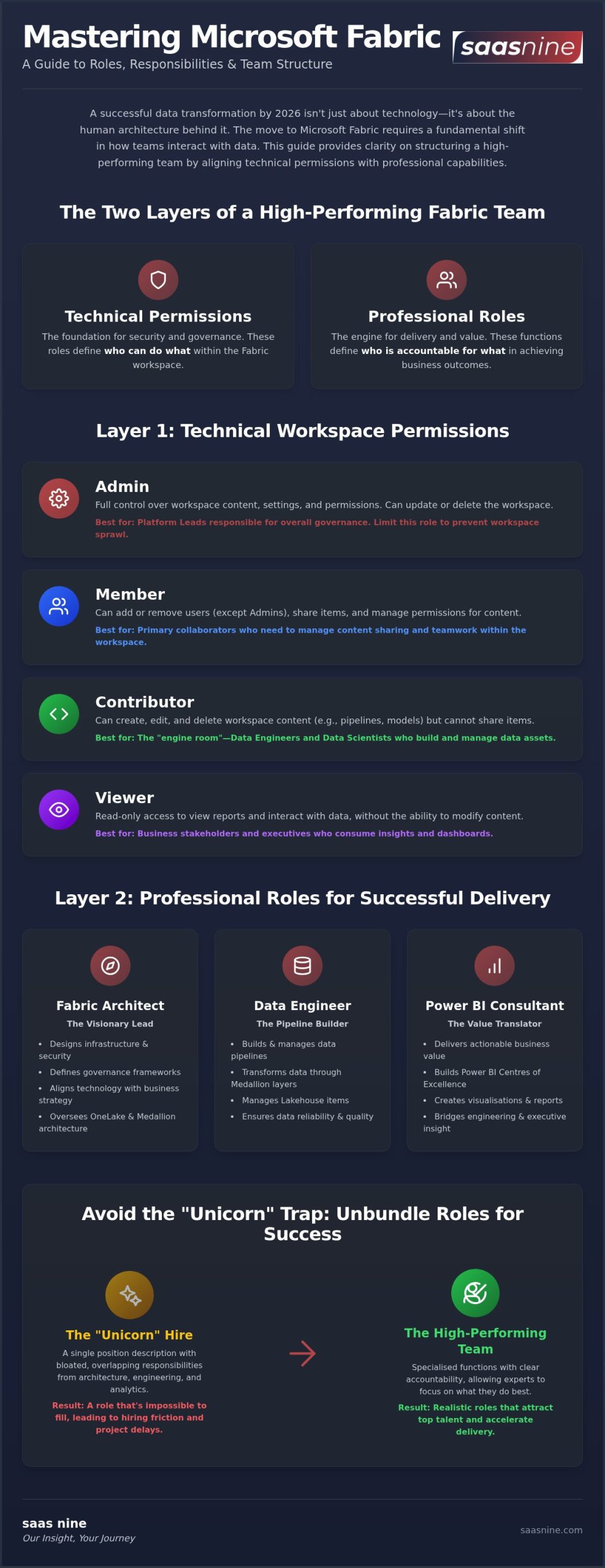
Establishing a robust technical foundation is the first step toward mastering microsoft fabric roles and responsibilities. Fabric builds upon the familiar Power BI permission model, yet it extends these capabilities across the entire OneLake ecosystem. This shift requires a deliberate approach to access management, as permissions now govern everything from raw data ingestion to final report visualisations. Workspace roles divide the data lake into secure, manageable containers that ensure your data remains protected while remaining accessible to those who need it.
In the Australian regulatory environment, adhering to the “Least Privilege” principle is essential for maintaining data integrity and security. By leveraging a Data Mesh Architecture, your organisation can decentralise data ownership across different business units without losing central oversight. This architectural choice allows for four primary permission levels:
- Admin: Full control over workspace content and settings.
- Member: Can add or remove users and share items.
- Contributor: Can create, edit, and delete workspace items.
- Viewer: Read-only access to reports and data.
Admin vs. Member: Managing Governance and Sharing
Limit the Admin role to your platform leads to prevent “workspace sprawl” and ensure your governance standards aren’t diluted. Admins possess the authority to update and delete the workspace itself, making it a high-risk assignment. Members, however, act as your primary collaborators. They can share content and manage permissions for individual items, allowing for fluid teamwork without exposing the underlying capacity or security configurations to unnecessary changes.
Contributor and Viewer: Enabling Delivery and Insight
Contributors represent the technical engine room, encompassing your Data Engineers and Data Scientists who build the pipelines and models. They have the necessary rights to interact with the Medallion architecture but cannot share content with others. In contrast, the Viewer role is strictly for stakeholders who consume insights. This ensures your executive team can access critical Power BI reports without the risk of interfering with the technical workflows that saas nine helps you implement through our specialised talent sourcing.
Professional Roles in a High-Performing Fabric Team
While technical permissions provide the boundaries, professional job functions provide the momentum. Successful delivery requires moving beyond a simple list of Microsoft Fabric admin roles and defining clear professional accountabilities. In the Australian market, many organisations struggle because they attempt to hire a single person to manage the entire stack. True maturity comes from unbundling these microsoft fabric roles and responsibilities into specialised functions that align with your broader Microsoft Ecosystem Capability Map.
The Fabric Architect: The Visionary Lead
The Architect is the steady hand responsible for infrastructure design, governance frameworks, and security standards. They don’t just manage the platform; they align technology capability with your business strategy. By designing the OneLake strategy and Medallion architecture, they ensure that every capacity unit consumed translates into a tangible business outcome. This role is critical for navigating the complexity of 2026 data environments without succumbing to technical debt. They act as the primary navigator for your data journey, ensuring the foundations are scalable and secure.
Data Engineers and Power BI Consultants
Data Engineers are the engine room of your Fabric journey. They focus on the Medallion layers, moving data from Bronze (raw) to Silver (cleansed) and finally Gold (curated). They manage Lakehouse items and build the robust pipelines that ensure data reliability. If you need to hire a Medallion architecture data engineer in Australia who understands this full journey from raw ingestion to business-ready insights, our 2026 guide provides a strategic framework for identifying and vetting these specialised professionals. Once the Gold layer is established, Power BI Consultants step in. Their role is to ensure this curated data delivers actionable business value through Power BI Centres of Excellence. This handoff is where many projects fail, but a clear division of labour ensures the Analytics Lead can bridge the gap between raw engineering and executive insight. If you’re struggling to find this specific blend of talent, our team at saas nine can help you define and source the right capability for your specific project needs.
Unbundling Responsibilities for Successful Delivery
One of the most significant risks for Australian leaders in 2026 is the pursuit of the “Unicorn” candidate. In a competitive talent market, attempting to bundle every aspect of microsoft fabric roles and responsibilities into a single position description often leads to delivery failure and team burnout. Successful implementation requires unbundling these bloated JDs into realistic, specialised roles that reflect the actual work required across the data lifecycle. Organisational design is just as vital as the technology stack because even the most advanced platform can’t compensate for a lack of clear accountability. As highlighted by Forbes on Microsoft Fabric, the platform effectively simplifies data management for AI, but this technical simplicity only translates to business value when the human architecture is equally streamlined and well-defined.
Defining Accountability in OneLake Governance
Clear data ownership is the bedrock of effective governance within the OneLake environment. You must deliberately separate the engineering tasks, such as data ingestion and pipeline management, from the governance tasks that ensure data is fit for purpose. When these boundaries are blurred, data quality inevitably suffers and accountability evaporates. This clarity is especially critical for responsible AI adoption. If no one clearly owns the raw data ingestion layer, your AI models will inherit the biases and inaccuracies of the source, leading to flawed strategic decisions. Establishing these boundaries also positions your organisation to meet the mandatory AI Governance standards now required of Australian businesses in 2026, ensuring your agentic systems operate within clearly defined and auditable parameters.
Strategic Advisory: Planning Your Workforce
At saas nine, we leverage deep market intelligence to help you move beyond generic job titles toward a capability-based hiring model. By mapping your microsoft fabric roles and responsibilities against current Australian market conditions, you can significantly reduce hiring risk and improve long-term project outcomes. This same unbundling principle applies across the broader Microsoft ecosystem — organisations running enterprise ERP transformations can benefit from a structured approach to Dynamics 365 Finance & Operations recruitment Australia wide, ensuring specialist capability is matched precisely to each delivery phase. Our Strategic Advisory services focus on helping you define the right roles and team structures before you go to market. This ensures you’re not just filling seats, but building a delivery team capable of sustained success in a complex ecosystem. If you’re ready to refine your organisational design and secure pre-qualified talent, get in touch with our talent advisory team today.
Sourcing and Vetting Fabric Talent in Australia
Finding pre-qualified Microsoft professionals in 2026 remains a significant hurdle for Australian leaders. The rapid evolution of the platform means traditional recruitment agencies often lack the technical depth to vet candidates effectively. At saas nine, we address this by applying a rigorous vetting framework that maps technical proficiency against specific microsoft fabric roles and responsibilities. Our Agentic Workforce Platform facilitates this capability discovery, allowing for the rapid mobilisation of elite talent who can navigate OneLake complexities from day one. This proactive approach ensures your delivery team is composed of individuals assessed for both technical precision and strategic fit.
Leveraging the saas nine Talent Portal
Our investment in the Talent Portal ensures that candidate matching is driven by data rather than guesswork. By automating workflows, we improve visibility and engagement for both clients and candidates, streamlining the path to discovery. This platform allows you to explore our pre-qualified Microsoft professionals, providing immediate access to niche skills that are often invisible in the broader market. It functions as a centralised hub for capability, ensuring your organisation can tap into a verified talent pool screened for the specific demands of a 2026 Fabric implementation.
Permanent vs. Contract: Choosing the Right Delivery Model
Determining the right delivery model is essential for long-term success. While contingent recruitment serves as an effective tool for rapid scaling and short-term project augmentation, executive search is better suited for securing the strategic leadership required for a Fabric Architect. Building long-term internal capability often requires a hybrid approach, balancing permanent hires for core governance with contractors for peak delivery periods. Our Insight, Your Journey is our commitment to providing the strategic advice necessary to navigate these complex talent pathways. If you’re ready to secure the elite capability your project demands, contact saas nine for a tailored workforce strategy today.
Securing Your Data Future with Clarity and Precision
Mastering microsoft fabric roles and responsibilities requires more than a technical checklist; it demands a strategic alignment of workspace permissions with professional accountability. By unbundling complex position descriptions and focusing on specialised capabilities, your organisation can bypass the common pitfalls of the “unicorn” hire and build a resilient delivery team. We’ve explored how clear governance in OneLake and the right mix of permanent and contract talent form the backbone of a successful 2026 data strategy. Our Insight, Your Journey ensures you don’t have to navigate this complex landscape alone.
As an Australian-based talent advisory, saas nine provides the strategic advisory and specialised Microsoft Ecosystem Capability Map needed to de-risk your implementation. We maintain a vetted pool of Microsoft Fabric and Data Engineering professionals ready to mobilise through our proprietary talent platform. Partner with saas nine to build your Microsoft Fabric capability and turn your data vision into a high-performing reality. We’re here to help you lead with confidence.
Frequently Asked Questions
What are the four main workspace roles in Microsoft Fabric?
The four primary workspace roles are Admin, Member, Contributor, and Viewer. Each provides a distinct level of access within the environment. Admins have full control over workspace settings and permissions. Members can share items and manage users. Contributors are the developers who build Lakehouses and pipelines. Viewers have read-only access to finalised reports. These technical microsoft fabric roles and responsibilities ensure your data remains secure while enabling effective collaboration across the team.
How do Fabric roles differ from standard Power BI permissions?
Fabric roles extend traditional Power BI permissions into the OneLake data layer. In the past, Power BI roles mostly governed report access and dataset management. Now, these roles apply to the entire engineering lifecycle, including Lakehouses, Warehouses, and Spark Notebooks. This unified model simplifies governance by ensuring that a single permission set controls access from raw data ingestion through to the final visualisation layer.
Who should be assigned the Admin role in a Fabric workspace?
Assign the Admin role exclusively to your platform leads or senior data architects. Because Admins can delete workspaces and modify sensitive security settings, restricting this access prevents “workspace sprawl” and governance gaps. Most developers only require Contributor access to perform their daily tasks. By limiting Admin rights to a small group of trusted specialists, you maintain a steady hand over your organisation’s data architecture and capacity unit consumption.
Can I assign Microsoft Fabric roles to security groups or service principals?
Yes, assigning roles to Entra ID security groups or service principals is the recommended approach for scalable governance. This method avoids the complexity of managing individual user permissions and ensures consistency across multiple workspaces. Using security groups simplifies the onboarding process as you scale your microsoft fabric roles and responsibilities. Service principals are particularly useful for automating data pipelines and CI/CD workflows without relying on personal user accounts.
What professional roles are essential for a medium-scale Fabric project in Australia?
A successful medium-scale project typically requires a Fabric Architect, a Data Engineer, and an Analytics Lead. The Architect sets the governance vision, while the Engineer manages the Medallion architecture data engineering across Bronze, Silver, and Gold layers. The Analytics Lead ensures reports provide commercial value through well-governed Power BI Centres of Excellence that align data insights with strategic business outcomes. At saas nine, we help organisations unbundle these functions to ensure every hire has a clear purpose. This structure provides the necessary balance between technical precision and strategic business insight.