

The technical promise of a unified SaaS analytics environment is often eclipsed by the reality of the Australian talent market. While Microsoft Fabric streamlines the stack, the complexity of hiring a microsoft fabric architect who understands the nuances of OneLake governance remains a significant barrier for local enterprise leaders. You’ve likely noticed that legacy data silos are driving up your total cost of ownership; yet, the path to a high-performance delivery team feels clouded by a severe shortage of pre-qualified professionals who can navigate this new landscape.
At saas nine, we understand that your technology strategy is only as strong as the people executing it. This guide provides a clear framework for aligning Fabric’s unified architecture with a structured delivery team to finally unlock your enterprise data value. We will navigate the shift from traditional PaaS models to SaaS analytics, outline the ideal team composition for 2026, and provide a roadmap for a secure, governed migration that respects the latest Australian privacy reforms. Our Insight, Your Journey starts with bridging the gap between architectural potential and workforce capability.
Key Takeaways
- Understand the evolution from fragmented PaaS components to a unified SaaS environment and how OneLake establishes a single source of truth for your organisation.
- Implement the Medallion Architecture framework to maintain data quality and enable decentralised ownership without duplicating effort across business units.
- Identify the specific technical competencies required when hiring a microsoft fabric architect by unbundling bloated position descriptions into realistic, deliverable roles.
- Learn how to bridge the gap between high-level business strategy and technical execution to accelerate your digital transformation and reduce delivery risk.
- Navigate the 2026 Australian regulatory landscape by aligning your SaaS architecture with modern governance and privacy requirements.
Understanding the Microsoft Fabric Architecture: A Unified SaaS Approach
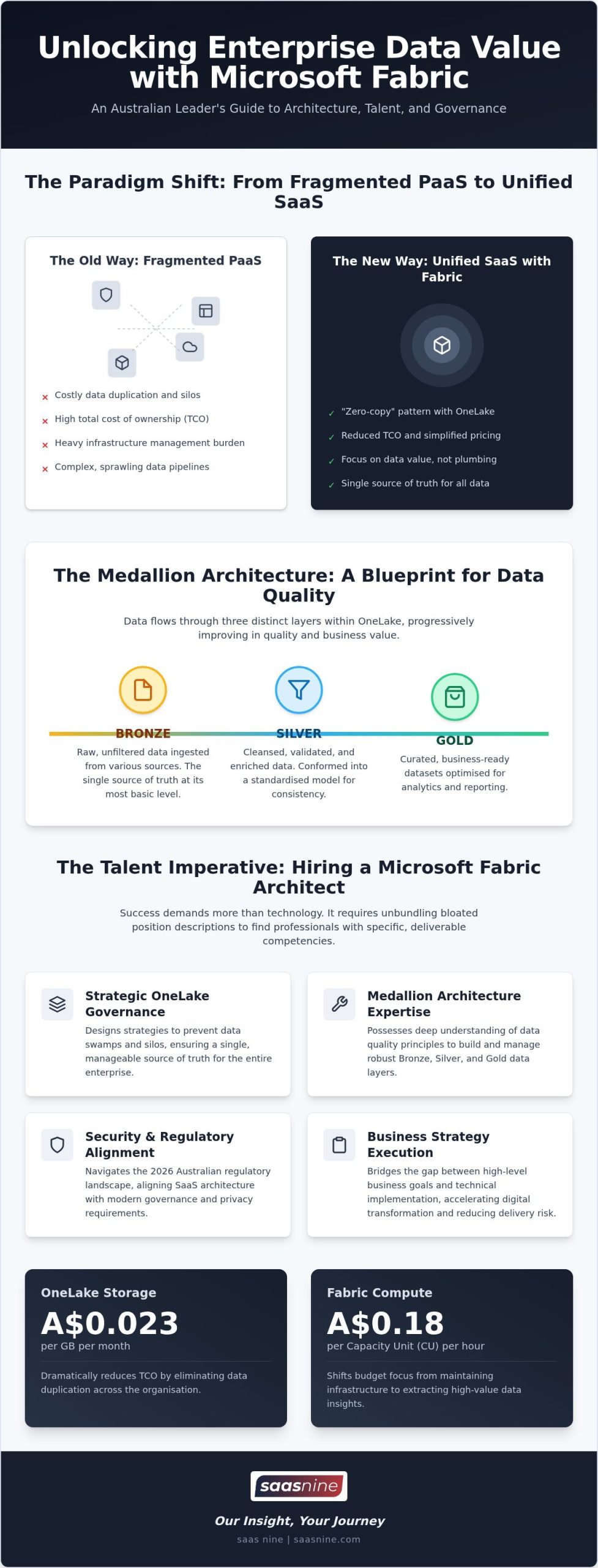
The landscape of enterprise data in Australia is undergoing a fundamental shift. Microsoft Fabric represents the evolution from fragmented Platform-as-a-Service (PaaS) components to a unified Software-as-a-Service (SaaS) analytics platform. For years, Australian organisations managed a sprawl of Azure Synapse workspaces, Data Factory pipelines, and Power BI tenants. Fabric consolidates these into a single, cohesive environment. At the heart of this transformation is OneLake, a unified logical data lake that acts as the single source of truth for the entire organisation. By centralising storage, OneLake eliminates the data duplication that often leads to inconsistent reporting and inflated storage costs.
Adopting a “zero-copy” data pattern is perhaps the most significant architectural advantage. Instead of moving massive datasets through complex ETL pipelines, Fabric allows different engines to access the same data without duplication. This shift directly reduces the total cost of ownership, as OneLake storage is priced at approximately A$0.023 per GB per month. Hiring a microsoft fabric architect is no longer just a technical requirement; it’s a strategic necessity to guide this transition from legacy Synapse environments toward a more agile, value-driven model. This architectural shift aligns closely with the Data Mesh paradigm, allowing for decentralised data ownership while maintaining centralised governance through a unified SaaS layer.
The Core Workloads: From Data Factory to Real-Time Intelligence
Fabric integrates seven core workloads, including Data Factory, Synapse Data Engineering, and Real-Time Intelligence, into a single workspace. This integration enables a “Centres of Excellence” model where Power BI developers and Data Scientists work within the same security and governance framework. It removes the friction between engineering and analytics, ensuring that insights are delivered at the pace of business. By unbundling these capabilities from infrastructure management, teams can focus on refining data quality rather than debugging pipeline connectivity.
SaaS vs PaaS: Why the Shift Matters for Australian Enterprises
The move to a SaaS model significantly reduces the “plumbing” required from internal IT teams. In a traditional PaaS environment, architects spent considerable time provisioning storage accounts and scaling compute clusters. With Fabric, compute is managed through a simplified Capacity Unit (CU) model, billed at approximately A$0.18 per CU per hour. This allows Australian technology leaders to refocus their budgets on extracting data value rather than maintaining infrastructure. At saas nine, we see this as an opportunity for organisations to pivot from being infrastructure managers to becoming data-driven innovators.
OneLake Strategy and the Medallion Architecture Framework
OneLake functions as the “OneDrive for Data”, a single logical storage layer that simplifies the complex web of traditional data lakes. It facilitates decentralised ownership, where different business units manage their own workspaces while the organisation maintains a single copy of the data. This approach is critical for reducing storage costs and ensuring data consistency across your entire Australian operation. When you’re hiring a microsoft fabric architect, their ability to design a strategy that prevents redundant data silos is paramount to your project’s long-term success.
Implementing Lakehouse and Medallion Architectures
The Medallion Architecture is the blueprint for data quality in Fabric. Data enters as raw files in the Bronze layer. It’s then transformed into the Silver layer, where it’s cleansed and standardised. Finally, it reaches the Gold layer as curated, business-ready datasets. Fabric’s SQL analytics endpoint provides a familiar gateway for analysts to access this data without needing to learn Spark. We recommend using a Microsoft Ecosystem Capability Map to ensure this architectural journey integrates seamlessly with your existing Dynamics 365 or Power Platform environments.
Data Governance and Security in a Unified Environment
Governance is the steady hand that prevents OneLake from descending into a data swamp. For Australian enterprises, this involves more than just permissions; it’s about aligning with the latest privacy regulations and ensuring data sovereignty. Organizing data with Fabric domains allows for a logical separation of data by business function, facilitating better stewardship and accountability. A skilled architect will ensure that workspace-level security doesn’t stifle the “zero-copy” benefits discussed in previous sections. If you’re ready to define these roles for your next phase, reach out to our team for a confidential discussion on your workforce planning.
Hiring a Microsoft Fabric Architect: Structuring Your Delivery Team
The success of a Fabric rollout depends less on the software and more on the human capital behind the keyboard. Traditional recruitment often fails here. It relies on generic job descriptions that combine too many disparate skills into a single role. When hiring a microsoft fabric architect, you must look beyond standard SQL or Power BI experience. You need a specialist who understands the interplay between OneLake, Spark engines, and tenant-level governance. This individual acts as the bridge between your commercial goals and technical execution.
At saas nine, we advocate for “unbundling” bloated position descriptions. Instead of searching for a single “unicorn” who manages everything from data ingestion to executive dashboards, we help leaders structure teams around realistic, deliverable roles. This involves separating the architectural vision from the day-to-day data engineering. For those in the early stages of team design, our Strategic Advisory services provide a structured workforce planning template tailored for the Australian market. Our Insight, Your Journey begins with defining exactly what your project needs to succeed.
The Fabric Architect: The Pivot Point of Your Project
The lead Fabric Architect is the central nervous system of your data strategy. They must possess a blend of technical depth in Delta Lake formats and the strategic foresight to manage capacity costs. In 2026, the salary for a high-level architect in Australia ranges from A$170,000 to over A$230,000, reflecting the scarcity of qualified talent. The process of vetting cloud architects in a SaaS environment is uniquely complex. You aren’t just testing for coding ability. You’re evaluating their capacity to manage a unified platform that updates automatically and requires constant governance alignment.
Building a Multi-Disciplinary Delivery Squad
Initial migrations often benefit from a hybrid talent model. Using contract-based talent augmentation allows you to scale quickly for the heavy lifting of Lakehouse setup. Permanent staff can then focus on long-term data ownership and internal capability building. As you leverage Fabric’s Copilot features, your squad will need a mix of Data Scientists and AI Engineers who can ensure models are deployed responsibly and deliver actual business value. Many organisations find that their existing Power BI consultants can transition into these broader roles, provided they are supported by a strong architectural framework. If you need assistance defining these roles or sourcing pre-vetted specialists, reach out to our talent advisory team for a strategy session.
Bridging the Gap: Accelerating Delivery with saas nine
Accelerating your digital transformation requires more than just selecting the right software; it demands a precise alignment between your strategic vision and technical execution. Many Australian firms struggle to find the right balance between high-level architecture and ground-level delivery. The process of hiring a microsoft fabric architect shouldn’t be a gamble based on generic resumes. At saas nine, we act as a strategic talent advisory, ensuring that your workforce capability matches the sophistication of your Microsoft technology stack.
We’ve invested in an AI-driven Agentic Workforce Platform to reduce hiring risk and speed up mobilisation. This platform automates complex recruitment workflows, providing you with visibility and engagement that traditional agencies cannot match. By using our specialised talent portal, you gain immediate access to pre-vetted Fabric professionals who understand the nuances of Lakehouse and Medallion architectures. This intelligence-led approach allows you to move toward an “Intelligent Enterprise” model with confidence, knowing your project is supported by verified expertise.
Talent Augmentation for Fabric Modernisation
Modernising your data estate often requires a surge in capacity that internal teams can’t provide. saas nine offers flexible talent augmentation, supplying individual specialists or full project teams for complex transformations. This is particularly vital when hiring a microsoft fabric architect for short-term, high-impact migrations where speed to market is critical. We use real-time market intelligence to help you navigate the 2026 Australian tech talent landscape. This ensures you aren’t just filling seats, but are instead securing the specific competencies needed for a secure, governed Fabric environment.
Our Insight, Your Journey: A Partnership Approach
Our philosophy is built on the principle of “Our Insight, Your Journey”. We don’t just provide a service; we become a knowledgeable observer and partner in your success. Whether you require executive search for a permanent lead or a contract-based squad for a specific migration, we prioritise long-term outcomes over short-term gains. If you’re ready to bridge the gap between your data strategy and delivery capability, explore our workforce planning services or contact our team to start your journey today.
Navigating the Path to an Intelligent Data Enterprise
The transition toward a unified SaaS analytics environment is the defining shift for Australian enterprises in 2026. Success requires more than just technical migration; it demands a synergy between your architectural framework and your team’s delivery capability. By implementing a governed OneLake strategy and the Medallion framework, you effectively reduce technical debt while refocusing your budget on extracting genuine business value from your data estate.
The complexity of hiring a microsoft fabric architect who can navigate these modern data patterns remains the primary hurdle for most technology leaders. At saas nine, we bridge this gap by acting as a trusted advisor to CIOs and CTOs across the country. Our proprietary Agentic Workforce Platform and deep expertise in the 2026 Microsoft Ecosystem Map allow us to identify the specific capabilities your transformation requires. We help you unbundle bloated roles into a high-performance delivery squad that’s ready to mobilise immediately.
If you’re ready to secure the specialists who’ll turn your data strategy into a commercial reality, our team is prepared to lead the way. Discover pre-qualified Microsoft Fabric talent and start your journey today. Our Insight, Your Journey ensures your organisation is perfectly equipped for the road ahead. A more efficient, data-driven future is well within your reach.
Frequently Asked Questions
What is the primary difference between Azure Synapse and Microsoft Fabric architecture?
The fundamental distinction lies in the shift from a Platform-as-a-Service (PaaS) model to a unified Software-as-a-Service (SaaS) environment. While Azure Synapse requires you to provision and integrate separate SQL pools and Spark clusters, Fabric unifies these workloads into a single workspace. All engines access data from OneLake using a “zero-copy” pattern, which removes the need for complex ETL pipelines and reduces infrastructure overhead for your IT team.
Does Microsoft Fabric require a complete data migration from existing Azure SQL databases?
No, a total migration isn’t necessary thanks to Fabric’s “shortcut” functionality. This feature allows you to virtualise data from Azure SQL, ADLS Gen2, or even external clouds like AWS S3 directly into OneLake without moving the physical files. It enables your team to perform analytics on existing data in real-time while you gradually transition toward a more permanent Lakehouse or Medallion structure at your own pace.
How many specialists do I need to start a Microsoft Fabric delivery programme?
A lean squad of three core specialists is the most effective way to begin a pilot or initial migration. This typically includes a lead Fabric Architect, a Data Engineer, and an Analytics Lead. Hiring a microsoft fabric architect as your first step is critical, as they define the governance and capacity settings that prevent costly architectural mistakes during the early stages of your journey.
Is Microsoft Fabric suitable for Australian organisations with strict data sovereignty requirements?
Yes, Microsoft Fabric is fully compatible with Australian data sovereignty needs. You can specify your data residency at the tenant or capacity level, ensuring that OneLake storage remains within Australian data centres. This is vital for compliance with the 2026 Australian privacy reforms, as it provides the transparency and control required for handling sensitive personal information within local jurisdictions.
How does saas nine vet Microsoft Fabric Architects for technical competency?
saas nine utilises a proprietary Agentic Workforce Platform and our specialised Microsoft Ecosystem Capability Map to evaluate candidates beyond their certifications. We assess their practical experience in Lakehouse design, Medallion architecture, and tenant-level governance. This rigorous process ensures that professionals in our Talent Portal possess the strategic foresight and technical depth required to deliver high-performance analytics solutions for Australian enterprises.