

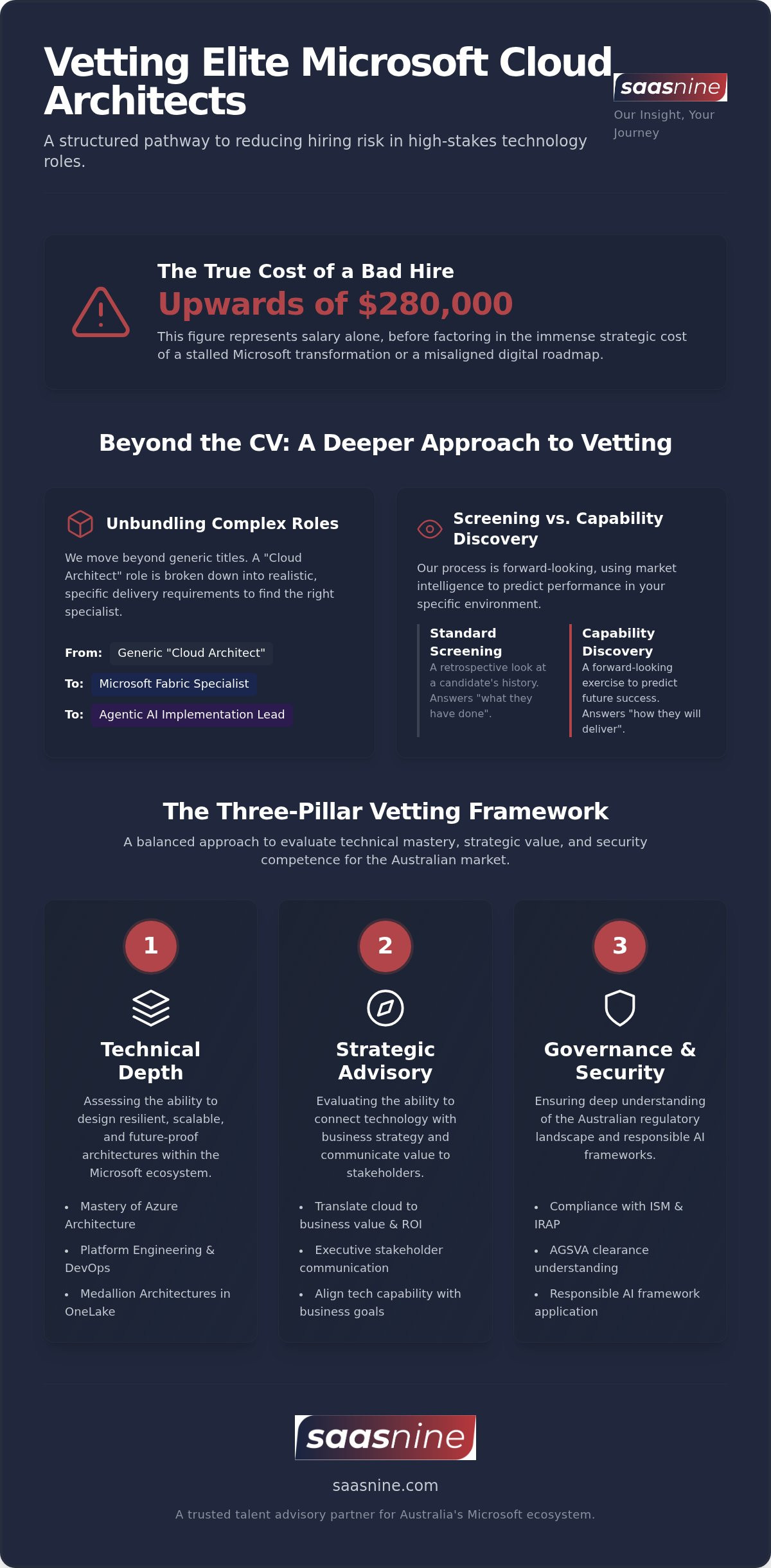
A senior cloud architect hire with the wrong profile can cost an Australian enterprise upwards of $280,000 in salary alone, even before you factor in the strategic cost of a stalled Microsoft transformation. It’s a high-stakes decision where the difference between a practitioner with theoretical knowledge and a delivery-focused expert determines the success of your entire digital roadmap. Most leaders find it difficult to distinguish between those who merely hold certifications and those who can actually navigate the complexities of an IRAP assessment or a Negative Vetting Level 1 clearance.
At saas nine, we understand that finding the right fit requires more than a simple background check. By adopting a rigorous, multi-layered vetting cloud architects process, you can gain the confidence to identify elite talent who align technology with your specific business goals. This article provides a structured pathway to finding pre-qualified cloud professionals while reducing hiring risk through deep capability discovery. We’ll show you how to move beyond the surface level to ensure your next architect is ready to lead your organisation’s journey through the evolving Australian regulatory environment. Our insight, your journey.
Key Takeaways
- Learn why technical certifications are only the baseline and how to assess a candidate’s real-world delivery capability within the complex Microsoft ecosystem.
- Master a rigorous vetting cloud architects process that prioritises three-dimensional assessment across technical mastery, strategic alignment, and organisational fit.
- Discover how to unbundle complex senior roles into realistic position descriptions that connect technology capability directly with your business strategy.
- Move beyond standard interviews by implementing evidence-based screening and scenario-based architectural challenges to verify practical problem-solving skills.
- Understand how leveraging saas nine’s Agentic Workforce Platform can automate capability discovery and improve matching accuracy to mitigate senior hiring risks.
Beyond the CV: What Vetting Cloud Architects Process Actually Entails
Vetting is often mistaken for a standard background check or a simple verification of employment history. For Australian enterprises, a truly rigorous vetting cloud architects process involves a three-dimensional assessment that looks far beyond a list of certifications. We evaluate technical depth, strategic alignment, and cultural fit to ensure the professional can actually deliver on your roadmap. While certifications like the Microsoft Certified: Azure Solutions Architect Expert are valuable indicators of study, they don’t guarantee a mastery of cloud computing architecture in a high-pressure production environment.
Unbundling is a core philosophy at saas nine. Instead of hiring for a generic “Cloud Architect” role, we help you unbundle that position into realistic delivery requirements. Does your project require a specialist in Microsoft Fabric for data sovereignty, or someone to lead an Agentic AI implementation? By defining the specific technical stack and business outcomes first, you avoid the risk of hiring a generalist for a highly specialised transformation. You can see how we apply this through our strategic advisory services.
It’s also vital to distinguish commercial vetting from Australian Government security clearances. While an AGSVA Negative Vetting Level 1 (NV1) clearance confirms a candidate’s integrity and suitability to handle protected data, it says nothing about their ability to design a resilient, cost-effective Azure environment. Our vetting cloud architects process bridges this gap by focusing on technical competency alongside security readiness, ensuring your talent is both cleared and capable.
The Difference Between Screening and Capability Discovery
Standard screening is a retrospective look at where someone has been. In contrast, capability discovery is a forward-looking exercise that uses market intelligence to predict how an architect will perform in your specific environment. We move beyond the “what” of their history to the “how” of their methodology. You can explore our approach to pre-qualified Microsoft professionals to see how this proactive discovery reduces long-term hiring risk.
Aligning Vetting with the Microsoft Ecosystem Capability Map
A one-size-fits-all approach to cloud talent often leads to architectural debt. We categorise architects using a proprietary Microsoft Ecosystem Capability Map, distinguishing between those specialised in Azure infrastructure, Data and AI, or Business Applications. This ensures your vetting process identifies an expert who understands the nuances of your chosen stack rather than a generalist who might struggle with the intricacies of Microsoft Fabric or Copilot integrations.
The Three-Pillar Framework for Technical Screening and Capability Discovery
To move beyond surface-level interviews, we implement a structured three-pillar framework. This approach ensures that every candidate is evaluated against the specific needs of the Australian market and your unique Microsoft roadmap. A successful vetting cloud architects process must balance hands-on technical skill with the commercial acumen required to lead a digital transformation. We break this down into three distinct areas of focus:
- Pillar 1: Technical Depth. Technical Depth is the ability to design resilient, scalable medallion architectures in OneLake. This requires a mastery of Azure Architecture, Platform Engineering, and DevOps to ensure the foundation of your project is robust and future-proof.
- Pillar 2: Strategic Advisory. This pillar evaluates the architect’s ability to connect technology capability with business strategy. They must be able to translate complex cloud concepts into clear business value and ROI for executive stakeholders.
- Pillar 3: Governance and Security. In the Australian context, this involves ensuring the architect understands local compliance standards, including the Information Security Manual (ISM) and IRAP requirements. It also covers their approach to responsible AI frameworks.
By applying these pillars, saas nine helps you identify professionals who aren’t just technically competent but are also strategic partners in your success. If you’re looking to refine your hiring strategy, you can learn more about our strategic advisory services.
Assessing Technical Mastery in Microsoft Fabric and AI
When vetting for modern data and AI roles, we look for specific expertise in Lakehouse strategy and multi-agent orchestration. Ask candidates how they would manage data privacy within a Copilot implementation or how they handle automated decision-making under the updated Privacy Act 2026. A qualified architect must demonstrate a commitment to ‘Responsible AI’ by showing how they govern inferred data and protect personal information within the cloud environment. Architects operating in this space should also be well-versed in the mandatory standards introduced in 2026, and understanding the full implications of AI governance for Australian business leaders is now an essential competency for any senior cloud professional. Understanding the full spectrum of Microsoft Fabric roles and responsibilities is essential context when evaluating whether a candidate can effectively lead your data platform implementation. Our insight, your journey.
Evaluating Strategic Leadership and Workforce Planning
High-calibre architects must understand organisational design. We test for ‘Intelligent Enterprise’ maturity by asking how they plan to move an organisation from AI exploration to full-scale production. This includes evaluating their ability to structure successful delivery teams and unbundle complex roles into realistic tasks. They should be able to guide your workforce planning, ensuring the right skills are in place to support long-term organisational goals.
How to Vet Cloud Architects for Your Organisation
A successful vetting cloud architects process requires a transition from passive observation to active discovery. We follow a structured four-step workflow to ensure every professional we recommend is ready for the rigours of an enterprise-grade Microsoft transformation. This methodical approach removes the guesswork from senior hiring, allowing you to build a team based on proven capability rather than speculative potential.
- Step 1: Role Unbundling. We move beyond generic job titles to define the specific technical stack and business outcomes required. This ensures you’re looking for a specialist in Microsoft Fabric or Power Platform rather than a generalist who might lack the depth for complex delivery.
- Step 2: Evidence-Based Screening. We replace standard interview questions with scenario-based architectural challenges. Candidates must demonstrate how they would resolve a specific bottleneck or design a resilient environment within the Azure ecosystem.
- Step 3: Ecosystem Mapping. By using our proprietary talent portal, we match candidates against a pre-qualified capability map. This aligns their specific skills with your strategic Microsoft roadmap.
- Step 4: Delivery Validation. We verify past performance on similar Microsoft transformation programmes. This involves confirming their role in achieving tangible business outcomes, not just their presence on a project.
Our insight, your journey. If you need assistance structuring your next senior hire, you can contact our talent advisory team to discuss your specific requirements.
Conducting Effective Technical Interviews for Cloud Roles
During the interview phase, we prioritise ‘Problem-Navigation-Resolution’ flows. Ask the candidate to describe a complex architectural failure they encountered, how they navigated the technical and stakeholder challenges, and the final resolution they implemented. Watch for red flags such as an over-reliance on technology hype. An elite architect focuses on practical business value and responsible AI adoption rather than just the latest buzzwords.
Integrating Security Vetting into the Hiring Workflow
For many Australian enterprises, particularly those handling government data, security vetting is a non-negotiable step. It’s essential to identify early whether a Baseline or Negative Vetting Level 1 (NV1) clearance is required. As of July 2026, the cost for an NV1 clearance is $1,724.55; a significant investment that must be factored into your workforce planning. Learn how saas nine manages pre-qualified cloud talent to ensure your candidates meet both technical and security prerequisites before they reach the final interview stage.
Reducing Hiring Risk with an Agentic Workforce Approach
Traditional methods of talent acquisition often rely on manual, paper-heavy processes that struggle to keep pace with the rapid evolution of the Microsoft ecosystem. At saas nine, we mitigate these inefficiencies through our Agentic Workforce Platform. This technology automates the discovery phase, ensuring high matching accuracy by cross-referencing candidate profiles against our proprietary Microsoft Ecosystem Capability Map for Australian enterprise. It allows us to move beyond the limitations of traditional resumes, providing a steady hand for organisations modernising legacy platforms or transitioning to cloud-native architectures.
Our insight, your journey. We recognise that a permanent hire isn’t always the most prudent first step, especially during high-stakes transformations. Talent augmentation offers a lower-risk alternative, allowing you to mobilise pre-qualified professionals on a contract basis. This approach provides the flexibility to validate an architect’s delivery capability in your specific environment before committing to a long-term placement. It’s a strategic way to navigate the current talent shortage while maintaining momentum on your digital roadmap.
The Future of Cloud Recruitment: AI-Driven Capability Discovery
The move toward an ‘Intelligent Enterprise’ requires greater visibility into workforce capability. Our investment in AI-powered recruitment allows us to unbundle position descriptions into realistic, hireable roles with surgical precision. By using advanced models to analyse technical requirements and business outcomes, we ensure the vetting cloud architects process remains objective and data-driven. This level of automation improves workflow efficiency and enhances candidate engagement throughout the matching journey.
Partnering for Long-Term Transformation Success
Strategic advisory is the foundation of a successful vetting cloud architects process. We don’t just fill seats; we help you define the right roles and structure delivery teams that can sustain long-term success. By connecting your business strategy with technical capability, we ensure your organisation is equipped to handle the complexities of Agentic AI and ERP transformations. If your roadmap includes autonomous agents, understanding the full scope of building an agentic AI team alongside your cloud architecture practice is essential for long-term success. Explore our strategic advisory and recruitment services to discover how we can support your organisation’s unique path forward.
Securing the Future of Your Microsoft Roadmap
Master a rigorous vetting cloud architects process to ensure your organisation moves beyond surface-level hiring and toward genuine capability discovery. By unbundling complex roles into realistic delivery requirements and applying a three-pillar framework, you can identify professionals who align technical mastery with your specific business strategy. This methodical approach reduces hiring risk and ensures your team is equipped for the complexities of an enterprise transformation. It’s about finding the right guide for your unique path forward.
Our specialised Australian talent advisory model leverages a proven Microsoft Ecosystem Capability Map to connect you with elite expertise in Azure, Microsoft Fabric, and Agentic AI. We provide the steady hand needed to navigate the talent shortage, ensuring every hire is a strategic asset rather than a liability. Our insight, your journey.
Discover pre-qualified cloud talent via the saas nine platform and begin your transformation with confidence. Your organisation’s path to a successful digital future is within reach when you have the right expertise by your side.
Frequently Asked Questions
What is the typical timeframe for a vetting cloud architects process in Australia?
A comprehensive commercial vetting cloud architects process typically takes between two and four weeks to complete. This duration allows for deep technical screening, scenario-based architectural challenges, and thorough cultural alignment assessments. If the role requires an Australian Government security clearance, such as Negative Vetting Level 1 (NV1), you must factor in additional months as these clearances are managed by the Australian Government Security Vetting Agency (AGSVA) and follow their specific processing timelines.
Do all cloud architects need Australian Government security clearances like NV1?
No, an NV1 or Baseline clearance is only mandatory for architects working with sensitive government data, defence projects, or critical national infrastructure. Most commercial enterprise roles don’t require these specific clearances. However, for organisations governed by the Information Security Manual (ISM) or those handling protected data, hiring a candidate who is already cleared or “clearable” can significantly reduce onboarding risks and ensure compliance with data sovereignty requirements.
How do you distinguish between a Cloud Engineer and a Cloud Architect during vetting?
The distinction lies in the balance between technical execution and strategic design. A Cloud Engineer focuses on the “how,” specialising in the implementation, configuration, and day-to-day maintenance of cloud services. A Cloud Architect focuses on the “why,” prioritising high-level design, cost optimisation, and the alignment of technology with business strategy. During the vetting cloud architects process, we look for a professional’s ability to justify technical decisions based on commercial outcomes and long-term scalability.
What are the most critical Microsoft certifications to look for when vetting architects?
The Microsoft Certified: Azure Solutions Architect Expert (AZ-305) remains the gold standard for foundational cloud architecture. For specialised transformations, you should also look for the Azure Security Engineer Associate (AZ-500) or emerging credentials in Microsoft Fabric and Azure AI. While these certifications prove theoretical knowledge, they should always be verified against real-world delivery experience to ensure the architect can navigate the complexities of a live enterprise environment.
Can the vetting process be outsourced to a talent advisory partner like saas nine?
Yes, partnering with a talent advisory firm like saas nine allows you to leverage specialised market intelligence and technical expertise that traditional agencies often lack. We act as a navigational guide, helping you unbundle generic roles into realistic delivery requirements. This partnership ensures you’re presented with pre-qualified talent who have already been mapped against our Microsoft Ecosystem Capability Map, saving your internal teams significant time and technical resources.
How does saas nine’s Agentic Workforce Platform improve the vetting outcome?
Our Agentic Workforce Platform improves outcomes by using AI-driven discovery to match candidate capabilities with your specific project requirements. It automates the initial screening phase by cross-referencing talent against our proprietary Capability Map, which identifies specific expertise in areas like Azure, Fabric, and Agentic AI. This data-driven approach removes subjective bias, improves matching accuracy, and provides the visibility needed to build a successful, high-performing delivery team. Our insight, your journey.