
What if the biggest hurdle to your 2026 digital transformation isn’t the technology itself, but the way you’ve mapped the people required to run it? Most Australian enterprise leaders feel the weight of a rapidly evolving AI and Data landscape, where the gap between a new feature and a tangible business outcome seems to grow wider every week. It’s often exhausting to keep pace when niche Microsoft specialists are increasingly difficult to secure in a competitive local market. Without a comprehensive Microsoft Ecosystem Capability Map, it’s easy to lose sight of how your technical stack aligns with your actual delivery capability.
At saas nine, we believe clarity is the foundation of execution. This guide delivers a strategic framework designed to help you organise your technology while simultaneously building a robust workforce strategy. You’ll discover how to unbundle complex roles into realistic positions and align your talent acquisition with long-term business goals. We provide a clear blueprint for navigating the transition to Agentic AI with confidence, ensuring your team is structured for sustainable success. Our Insight, Your Journey.
Key Takeaways
- Learn how a Microsoft Ecosystem Capability Map acts as a strategic blueprint to align your technical architecture with your 2026 business objectives.
- Identify high-impact transformation drivers by categorising Microsoft technologies based on their capacity to unlock data and modernise legacy systems.
- Discover the saas nine method for unbundling traditional position descriptions into realistic, capability-led roles to improve hiring and delivery outcomes.
- Prepare for the shift from AI assistance to autonomous systems by mapping the requirements for Agentic AI orchestration and new operating models.
What is a Microsoft Ecosystem Capability Map?
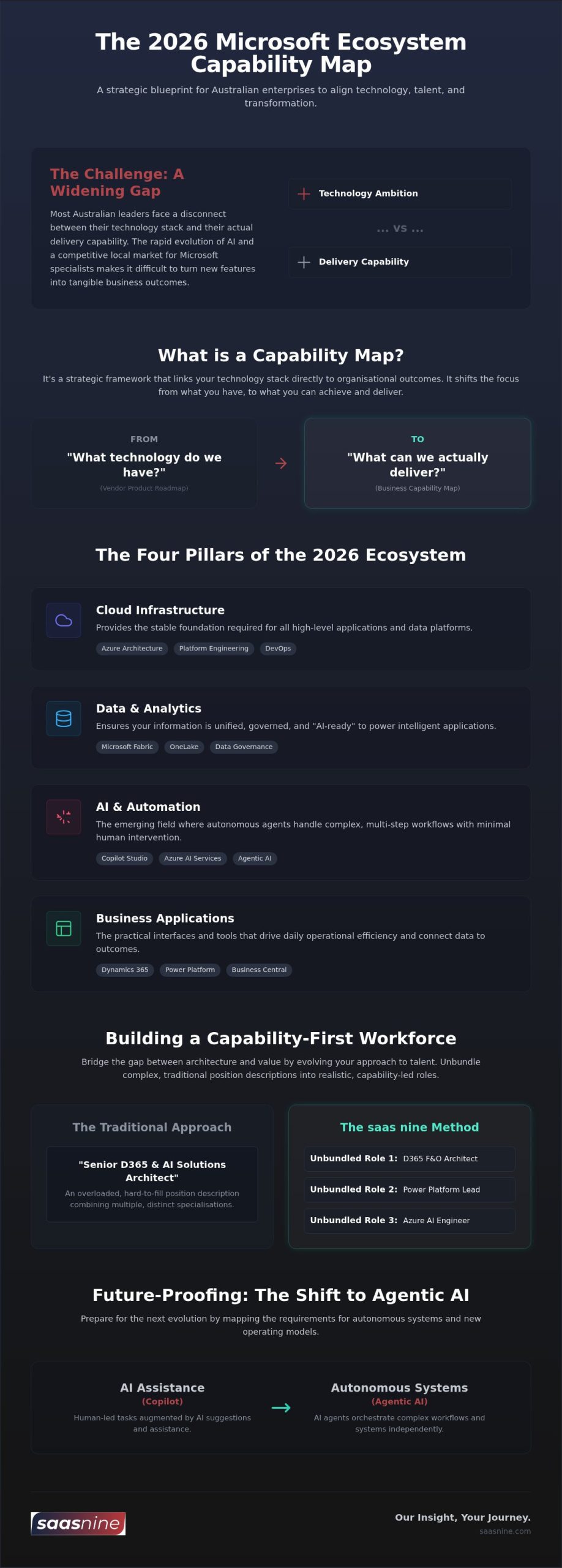
A Microsoft Ecosystem Capability Map is far more than a technical diagram of your software subscriptions. It’s a strategic framework that links your technology stack directly to your organisational outcomes. While a standard product roadmap from a vendor outlines what features are scheduled for release, a capability map defines what your business can actually achieve with those tools. It shifts the focus from “what we have” to “what we can deliver,” providing a navigational guide for executive leaders who need to justify technology spend through measurable performance.
Australian enterprises approaching 2026 face a unique set of challenges as they transition toward the “Intelligent Enterprise.” The complexity of managing multi-agent AI systems and unified data lakes requires a steady hand and a clear vision. You don’t just need the software; you need the right people in the right roles to drive value. At saas nine, our philosophy centres on connecting strategy, technology, and workforce capability. We help you look beyond the hype to see the practical pathways for transformation. Our Insight, Your Journey.
The Four Pillars of the 2026 Ecosystem
To build a functional map, you must categorise your environment into four distinct but interconnected pillars that define modern delivery:
- Cloud Infrastructure: This focuses on Azure architecture, platform engineering, and DevOps. It provides the stable foundation required for all high-level applications.
- Data & Analytics: Centred on Microsoft Fabric, OneLake, and robust data governance, this pillar ensures your information is “AI-ready” and accessible.
- AI & Automation: This includes Copilot Studio, Azure AI services, and the emerging field of Agentic AI, where autonomous agents handle complex workflows.
- Business Applications: These are the practical interfaces like Dynamics 365, Business Central, and Power Platform that drive daily operational efficiency.
By defining these pillars, you can begin to see where your current workforce excels and where you might have critical gaps. This clarity allows you to move away from generic hiring and toward a model that targets specific technical and strategic needs.
Mapping Technical Capabilities to Business Value
Identifying your core business drivers is the primary step in populating your Microsoft Ecosystem Capability Map. For most Australian enterprises, these drivers involve modernising legacy infrastructure, unlocking hidden data value, and adopting AI in a responsible, governed manner. You should categorise these capabilities based on their immediate impact. Some will support daily operational delivery, while others will drive long-term strategic transformation. This distinction helps you allocate resources where they’ll generate the most significant return on investment. Our Insight, Your Journey.
A well-constructed map helps you spot technology gaps before they turn into delivery bottlenecks. If your strategic goal is predictive analytics but your map reveals a lack of unified data governance, you’ve identified a critical risk. Integrating a Responsible AI Framework directly into your capability map ensures that ethics and compliance aren’t treated as afterthoughts. Instead, they become core organisational capabilities that build trust with stakeholders and customers alike.
Modernising Data with Microsoft Fabric
Microsoft Fabric and OneLake represent a fundamental shift from siloed reporting to a unified data foundation. By modernising data with Microsoft Fabric and OneLake, you create the prerequisite environment for advanced AI adoption. This transition often involves moving away from fragmented, department-specific dashboards toward Power BI Centres of Excellence. In these centres, data quality and accessibility are standardised, ensuring that every leader is working from a single source of truth.
The Role of Business Applications
Dynamics 365 Finance & Operations shouldn’t exist in a vacuum. Its true value emerges when it’s integrated across the wider ecosystem. By leveraging the Power Platform, your team can build rapid automations that connect ERP data with customer engagement tools. This connectivity ensures that technology features translate into actual business outcomes. If you’re ready to align your technical stack with your workforce strategy, you can speak with our talent advisory team to begin the process.
Building a Capability-First Workforce Strategy
A technology diagram is only as effective as the people executing it. To bridge the gap between technical architecture and business value, you must evolve your approach to talent. Traditional position descriptions often fail because they attempt to bundle too many disparate skills into a single role. By using a Microsoft Ecosystem Capability Map, you can unbundle these descriptions into realistic, deliverable roles that align with actual market availability. This ensures you aren’t searching for “unicorns” that don’t exist in the local talent pool.
At saas nine, our approach to workforce planning involves deep market intelligence. We help you define exactly what capabilities are required for your specific stage of the journey. This strategic advisory workforce planning ensures your organisational design supports long-term delivery rather than just filling immediate seats. Our Talent Portal serves as a critical tool in this process, allowing for the rapid discovery and mobilisation of pre-qualified professionals who fit your unique capability requirements. Our Insight, Your Journey.
Sourcing Niche Microsoft Specialists
Finding vetted Microsoft professionals in Australia is a constant challenge for enterprise leaders. Traditional recruitment often fails digital transformations because it lacks the technical depth required to assess niche expertise. You need a partner who understands the difference between a generalist and a technical specialist who can navigate complex Fabric or Copilot deployments. For deeper insights into this process, read our guide on vetting cloud architects for Australian enterprises.
Delivery Models for Every Stage
Your workforce strategy must be flexible enough to adapt to different project phases. Whether you need contingent recruitment for a specific project, talent augmentation to bolster an existing team, or executive search for a critical leadership role, the delivery model should match the goal. Building successful project teams requires a mix of permanent and contract specialists, all working toward the same strategic outcomes. If you’re looking to structure a successful delivery team, contact our talent advisory team for a tailored strategy session.
Future-Proofing: From Copilot to Agentic AI
The shift from AI as a reactive assistant to an autonomous driver marks the next major phase of digital transformation. While Copilot has introduced many organisations to generative AI, the transition toward Agentic AI requires a more sophisticated approach to orchestration. In your Microsoft Ecosystem Capability Map, you must now account for multi-agent systems that can execute complex tasks with minimal human intervention. This isn’t about chasing technology hype; it’s about identifying specific workflows where autonomous agents can drive measurable business value. Our Insight, Your Journey.
Successful delivery in this new era depends heavily on the role of AI Product Ownership. Without a dedicated leader to bridge the gap between technical capability and strategic intent, projects often stall at the proof-of-concept stage. These leaders ensure that AI operating models are integrated into the broader business strategy, focusing on outcomes rather than just features. They act as the steady hand required to guide a team through the complexities of autonomous system integration. For a detailed roadmap on building an agentic AI team within your Microsoft ecosystem, our dedicated guide covers the specific roles, architecture, and talent strategies required for success.
The saas nine AI Maturity Model
We’ve developed a five-stage AI maturity model to help you understand your current position on the journey to becoming an “Intelligent Enterprise.” This model allows us to tailor an engagement strategy that matches your organisational readiness, whether you’re in the initial exploration phase or moving toward full-scale autonomous operations. Understanding these stages ensures you don’t over-invest in technology before your workforce is ready to support it. It provides a clear pathway for scaling your capability in a sustainable way.
Governance and Responsible Adoption
As you deploy autonomous agents, implementing robust Agent Governance becomes non-negotiable. You must establish clear standards for agent-to-agent communication and ensure every AI-driven action aligns with your responsible adoption framework. This level of oversight guarantees that AI product delivery remains secure and ethically sound, protecting your organisation as it scales its digital capabilities. By formalising these standards early, you build a foundation for trust and long-term success in an increasingly automated environment.
Aligning Your Strategy for the 2026 Horizon
As the Australian enterprise landscape moves toward 2026, the distinction between technical features and organisational capability will only sharpen. You’ve seen how a Microsoft Ecosystem Capability Map transforms a static software list into a dynamic workforce blueprint. By unbundling traditional roles and focusing on the data foundations provided by Microsoft Fabric, you can navigate the transition to Agentic AI with clarity and purpose.
Success in this era isn’t found in technology hype; it’s found in the precise alignment of your strategy with the specialists capable of delivering it. saas nine remains a dedicated partner for Australian organisations, offering specialised Microsoft ERP, Data, and AI professional sourcing alongside strategic advisory and talent acquisition. We focus on connecting your business goals with the technical talent required to reach them. Our Insight, Your Journey.
If you’re ready to define your path and build a high-performing delivery team, explore our Microsoft Ecosystem Capability Map and Talent Portal to see how we can support your next phase of growth. The future of the intelligent enterprise is within reach when you have the right guide by your side.
Frequently Asked Questions
What is included in a Microsoft Ecosystem Capability Map?
A Microsoft Ecosystem Capability Map includes a structured alignment of technology pillars such as Cloud Infrastructure, Data, AI, and Business Applications with specific business outcomes. It identifies the technical stack required for your 2026 goals while simultaneously mapping the human capabilities needed for execution. This framework helps leaders move beyond software features to understand the actual delivery capacity of their organisation.
How does Microsoft Fabric change my data capability requirements?
Microsoft Fabric requires a shift toward unified data governance and architectural oversight. It moves your needs away from fragmented reporting specialists toward professionals who can manage OneLake and integrated data lifecycles. This change necessitates a workforce that prioritises data quality and cross-functional accessibility over departmental siloes. It’s about building a foundation that makes your data truly AI-ready.
What is the difference between Copilot and Agentic AI?
Copilot functions as a reactive AI assistant that requires constant human prompting to generate output. In contrast, Agentic AI involves autonomous agents that can orchestrate complex workflows and make decisions within a governed framework. While Copilot supports individual productivity, Agentic AI drives broader operational automation through multi-agent systems. Understanding this distinction is vital for future-proofing your workforce strategy.
How do I find pre-qualified Microsoft professionals in Australia?
Finding pre-qualified specialists in a tight local market requires a talent advisory with deep technical literacy. Partnering with a specialist like saas nine provides access to a vetted pool of professionals who’ve been assessed for both technical skill and strategic fit. Our Talent Portal automates matching to ensure you connect with the right expertise for your specific transformation stage, whether you need permanent or contract staff.
Why should I unbundle my job descriptions for Microsoft roles?
Unbundling job descriptions ensures your requirements are realistic and attractable in the local market. Many traditional position descriptions are too broad, combining too many niche specialisations into one impossible role. By breaking these down into capability-led roles, you improve hiring outcomes and ensure your delivery team is structured for practical success. It’s a pragmatic way to bridge the gap between strategy and execution.
How does saas nine support workforce planning for Microsoft transformations?
saas nine provides strategic advisory services that connect your technology roadmap with a robust workforce strategy. We use the Microsoft Ecosystem Capability Map to help you define roles, unbundle bloated position descriptions, and structure teams that can sustain long-term transformation. We focus on delivering market intelligence that improves hiring outcomes and ensures your team is ready for the transition to an intelligent enterprise. Our Insight, Your Journey.