
Your 2026 technology roadmap is likely a masterpiece of architecture and ambition, but without the right hands to build it, it’s just an expensive document. Many Australian tech leaders find themselves staring at a significant gap between their high-level digital goals and the actual capability of their current team. This friction often stems from a lack of Strategic Advisory that connects long-term vision with the granular reality of the talent market.
We understand that unbundling complex ERP or Data and AI roles into realistic position descriptions is a constant challenge, especially when niche Microsoft specialists feel so scarce. At saas nine, we believe that your capability strategy should be as robust as your technical architecture. Our Insight, Your Journey is more than a tagline; it’s a commitment to helping you bridge that gap with precision and confidence.
This article provides a structured workforce planning framework designed to help you align human capability with your future milestones. You’ll learn how to map specific Microsoft competencies to business outcomes and use market intelligence to reduce hiring risk. We’re moving beyond the hype of digital transformation to give you a clear, actionable roadmap for building a delivery-focused team.
Key Takeaways
- Align your 2026 technology roadmap with organisational design through Strategic Advisory, ensuring your vision is supported by a realistic human capability strategy.
- Execute a thorough gap analysis by mapping your team’s current skills against the Microsoft Ecosystem Capability Map to identify critical talent shortages before they impact delivery.
- Prepare for the shift toward Agentic AI by defining specialised roles like AI Product Owners to manage the transition from basic Copilot use to multi-agent orchestration.
- Improve hiring outcomes by unbundling unrealistic “unicorn” position descriptions into structured, deliverable roles that attract pre-qualified Microsoft specialists.
- Optimise your project delivery by choosing the right mix of permanent and contract talent to support both long-term stability and specific transformation milestones.
What is Strategic Advisory in the Context of Digital Transformation?
Many Australian leaders associate Strategic Advisory with financial planning or real estate assets. In the context of digital transformation, it represents the vital alignment between your organisational design and your technology roadmap. It’s the process of ensuring that every architectural decision you make is supported by the human capability required to execute it. Without this alignment, even the most sophisticated Microsoft stack remains underutilised.
This is where our “Bridge the Gap” philosophy becomes essential. We often see a disconnect between ambitious 2026 business goals and the actual technical capacity of a workforce. Strategic Advisory identifies where your current team sits today and defines the exact talent pathways needed to reach your future state. For Australian organisations, this frequently involves the complex task of modernising legacy platforms while simultaneously adopting the Microsoft Intelligent Enterprise stack. Our Insight, Your Journey ensures that this transition is grounded in realistic workforce data rather than optimistic projections.
Traditional recruitment often fails because it treats hiring as a reactive transaction. Without a preceding advisory phase, you risk hiring for the wrong roles or failing to unbundle complex position descriptions into realistic, deliverable tasks. At saas nine, we believe that Strategic Advisory is the foundation of successful delivery. It allows you to move beyond the CV and look at how a specific capability cluster fits into your long-term journey.
The Shift from Headcount to Capability Strategy
We’re seeing a fundamental change in how successful teams are built. Instead of simply filling seats, leaders are now focusing on capability clusters. This approach is particularly critical within the Microsoft ecosystem, where expertise in Dynamics 365, Fabric, or Power Platform often overlaps. By mapping these clusters, you ensure your team remains agile enough to handle shifting project demands without constant re-hiring. It’s about building a versatile core that can scale with your technology needs.
Transformation Governance and Responsible AI
Strategic Advisory also plays a critical role in AI governance. As you move toward Agentic AI, your workforce planning must include structured oversight to ensure responsible adoption. This means defining roles that focus on practical business value and ethical implementation. A structured framework ensures that your team has the oversight required to manage automated workflows safely, keeping a human-in-the-loop for critical decision-making processes within your Microsoft environment.
The saas nine Workforce Planning & Capability Template
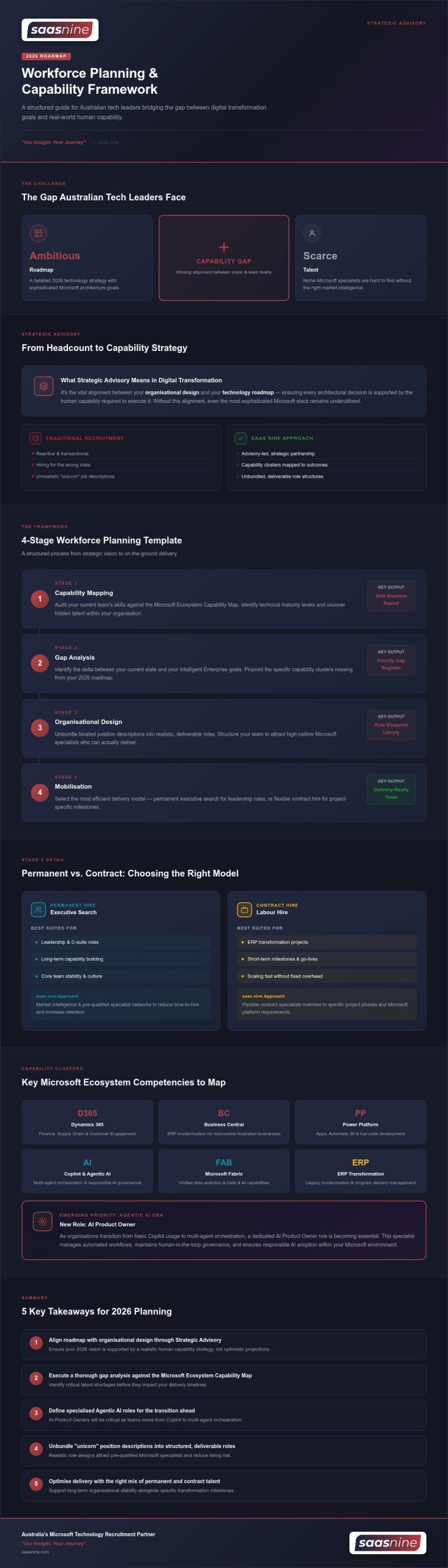
Effective Strategic Advisory requires a structured approach to transition from high-level strategy to on-the-ground execution. We’ve developed a four-stage framework to help Australian tech leaders navigate this complexity without the typical friction of talent acquisition. Our template focuses on precision, ensuring your workforce is built for delivery rather than just filling seats.
- Stage 1: Capability Mapping – Begin by auditing your current team’s skills against our Microsoft Ecosystem Capability Map. This provides a clear baseline of your existing technical maturity and identifies hidden talent within your organisation.
- Stage 2: Gap Analysis – Identify the delta between your current state and your “Intelligent Enterprise” goals. This step highlights the specific capability clusters missing from your 2026 roadmap.
- Stage 3: Organisational Design – Focus on unbundling bloated position descriptions into realistic, deliverable roles that attract high-calibre specialists.
- Stage 4: Mobilisation – Select the most efficient delivery model, whether that’s permanent executive search for leadership roles or flexible contract labour hire for project-specific needs.
Implementing this template ensures that your Strategic Advisory phase leads directly to reduced hiring risk and improved project outcomes. If you’re ready to start mapping your 2026 capability, you can enquire about a formal assessment to see where your gaps currently lie.
Unbundling the ‘Unicorn’ Position Description
One of the biggest hurdles in the Australian market is the “unicorn” job description. Many organisations try to pack Azure architecture, Dynamics 365 functional consulting, and AI governance into a single role. It’s an impossible ask. At saas nine, we help you break these down into functional project teams. By refining these descriptions, we make them realistic for the market while ensuring every technical requirement is still covered by the wider team structure.
Mapping Microsoft Fabric and Data Architecture
Data modernisation is often the cornerstone of digital transformation. For organisations adopting Microsoft Fabric, you need specific capability clusters for OneLake and Medallion architectures. We help you identify and source the right data architects who understand these specific technical stacks, and our guide to hiring a Microsoft Fabric architect for Australian enterprise delivery provides a detailed framework for building the right team. It’s about finding specialists who can lead your programme rather than generalists who might struggle with the nuances of modern data governance and AI readiness.
Organisational Design for the Agentic AI Era
The Australian technology landscape is moving rapidly beyond the initial excitement of Copilot adoption. While many organisations have successfully integrated basic generative AI assistants, the next phase of digital transformation involves multi-agent orchestration. This transition requires a fundamental shift in your organisational design. In this era, Strategic Advisory must pivot toward defining AI Operating Models that allow for autonomous agentic workflows while maintaining strict human-in-the-loop governance.
Structuring your team to support this shift involves more than just upskilling existing developers. You need specific roles, such as Agentic AI Consultants and orchestration specialists, who can manage the interaction between various AI agents and your core Microsoft stack. To help leaders navigate this complexity, we have developed a comprehensive guide on building an agentic AI team. This resource outlines the necessary team composition for moving from experimental AI to scalable, production-ready agentic systems.
Successful Strategic Advisory ensures that your AI journey remains focused on practical business outcomes rather than technology hype. It provides the framework for responsible adoption, ensuring that as agents take on more autonomous tasks, your workforce structure remains resilient and accountable. If you need help defining your future team structure, contact our advisory team for a capability workshop.
The Role of the AI Product Owner
The AI Product Owner is the linchpin of any successful AI programme. This individual must possess a rare mix of commercial acumen and technical AI literacy to ensure that agentic workflows deliver genuine business value. They are responsible for vetting use cases and managing the lifecycle of AI agents within the enterprise. Finding leaders who can balance these competing priorities is a core focus of our executive search capability at saas nine.
Leveraging the Agentic Workforce Platform
At saas nine, we practice what we teach. We utilise our proprietary Agentic Workforce Platform to enhance our capability discovery process. This AI-driven approach allows us to reduce hiring risk by matching pre-qualified Microsoft professionals to your specific technical requirements with extreme precision. This intelligence doesn’t just fill current gaps; it helps us predict your future talent needs based on your 2026 roadmap, ensuring you stay ahead of the curve. Our Insight, Your Journey is built on this foundation of predictive data and market intelligence.
Delivering Strategic Outcomes: Our Insight, Your Journey
Strategy is only valuable when it leads to successful execution. While the workforce planning template provides your blueprint, mobilisation is what actually builds your delivery capability. At saas nine, we bridge the transition from Strategic Advisory theory to practical talent acquisition. We ensure that the capability clusters identified in your planning phase are filled by professionals who don’t just have the right certifications, but the delivery experience your roadmap demands.
Choosing the right engagement model is a critical decision for transformation governance. Permanent placements are generally best for roles that require deep institutional knowledge and long-term cultural alignment, such as your AI Product Owners or internal platform leads. Conversely, contract labour hire offers the agility needed for specific project milestones, such as a Dynamics 365 migration or a Power Platform rollout. This flexible approach allows you to scale your team up or down based on the immediate needs of your 2026 roadmap.
Securing senior leadership requires an even more rigorous approach to risk reduction. Our vetting cloud architects process ensures that your technical leads possess the architectural depth and commercial maturity to guide complex programmes. We’re committed to long-term partnership, ensuring that your Strategic Advisory phase evolves into a sustainable governance model that supports your organisation well beyond the initial go-live date.
Tailoring Your Engagement Model
Not every role can be filled using the same sourcing method. We utilise Executive Search and headhunting for niche Microsoft specialists, particularly when you need leaders with expertise in specialized areas like Fabric or Agentic AI orchestration. For rapid capability-uplift initiatives, our talent augmentation model provides pre-qualified professionals who can integrate into your existing team immediately. This ensures you maintain momentum without the delays typically associated with traditional recruitment cycles.
Accessing the saas nine Talent Portal
You don’t have to wait for a specific vacancy to start understanding the market’s capability. Tech leaders can engage with pre-qualified and vetted Microsoft professionals today through our Talent Portal. This platform automates workflows and improves candidate matching, providing you with enhanced visibility into the available talent pool. It’s a proactive way to manage your workforce planning and start your capability discovery journey. You can register for workforce insights and explore current talent by visiting saasnine.com/talent.
Building Your 2026 Capability Today
Success in the Microsoft ecosystem requires more than just a technical roadmap; it demands a precise alignment between your vision and your workforce’s actual capability. By moving from reactive hiring to proactive Strategic Advisory, you ensure that your organisation is structured for delivery rather than just filling seats. This shift involves unbundling complex roles and preparing your team for the orchestration of Agentic AI.
At saas nine, we provide the navigational support needed to bridge the gap between high-level strategy and technical execution. We’re trusted by Australian CIOs for transformation governance, offering deep expertise across the entire Microsoft technical stack. Our proprietary Agentic Workforce Platform allows us to discover and vet specialists with a level of precision that traditional agencies simply cannot match.
Your journey toward an Intelligent Enterprise doesn’t have to be a solitary one. We’re here to provide the market intelligence and strategic guidance required to build a resilient, high-performing team. Book a Strategic Advisory Consultation with saas nine to begin mapping your future capability. Our Insight, Your Journey.
Frequently Asked Questions
What is the difference between traditional recruitment and strategic advisory?
Traditional recruitment is a reactive response to a vacancy, whereas Strategic Advisory is a proactive alignment of your people strategy with your long-term technology roadmap. It moves away from simple transactions to focus on building capability clusters that support specific project delivery. By evaluating your organisational design first, you ensure every new hire contributes directly to your 2026 digital goals rather than just filling a temporary gap.
How do I start workforce planning for a Microsoft Fabric migration?
Begin by auditing your existing technical skills against a structured framework like the Microsoft Ecosystem Capability Map. For a Microsoft Fabric migration, you need to identify specific expertise in OneLake and Medallion architectures rather than general data engineering. Once you’ve mapped your current state, you can perform a gap analysis to determine whether you require permanent leadership through executive search or flexible support via contract labour hire. Our Australian leader’s guide to Microsoft Fabric architecture and delivery provides a detailed breakdown of the team composition and hiring considerations for 2026.
What roles are essential for a responsible AI framework in Australia?
Successful AI governance in Australia relies on the AI Product Owner, a role that balances commercial acumen with technical AI literacy. You also need Agentic AI Consultants to manage multi-agent orchestration and ensure responsible adoption. These roles act as the human-in-the-loop, providing the oversight required to manage automated workflows safely while delivering practical business value across your Microsoft environment.
How does saas nine unbundle complex position descriptions?
We use deep market intelligence to strip away unrealistic “unicorn” job requirements that often lead to failed searches. Our team breaks these bloated descriptions into functional roles that align with how specialists actually work in the Australian market. This unbundling process makes positions more attractive to pre-qualified Microsoft professionals and ensures your delivery team has a realistic structure for success.
What are the benefits of an Agentic Workforce Model for SMEs?
An Agentic Workforce Model provides SMEs with the ability to scale their delivery capability through multi-agent orchestration. It moves your business beyond basic task automation toward a more sophisticated AI Operating Model. By structuring your team to manage autonomous agents, you can achieve higher productivity and better transformation governance without the overhead of a massive headcount, ensuring your digital journey remains efficient and outcome-focused.