

If your 2026 AI strategy still relies on fragmented legacy silos, you aren’t just falling behind. You’re building on a foundation that will likely fail Australian privacy audits by the December deadline. Most data leaders recognise that implementing Lakehouse & Medallion Architectures is the only way to ensure the promise of Agentic AI is supported by a robust data refinement process. It’s a common frustration to see complex architectural roles remain unfilled while your existing infrastructure struggles to keep pace with the demands of Microsoft Fabric.
At saas nine, we understand that this transition is as much about people and governance as it is about technology. This guide provides a clear roadmap to move beyond the hype and deliver real business value. You’ll learn how to structure your Fabric ecosystem for ROI, unbundle unrealistic position descriptions into high-performing teams, and secure the niche talent required for a successful modernisation. Our Insight, Your Journey ensures you have a steady hand to guide your digital transformation through this complex environment.
Key Takeaways
- Understand how to unify disparate legacy silos into a high-performance environment that supports the latest Microsoft Fabric updates and Australian privacy standards.
- Master the design patterns of Lakehouse & Medallion Architectures to logically refine raw data into high-value, gold-standard assets for strategic decision-making.
- Develop a clear roadmap that connects technical execution with workforce capability to ensure your digital transformation remains focused on delivering measurable ROI.
- Learn how to unbundle complex architectural roles into realistic position descriptions to secure pre-qualified talent and build a sustainable delivery team.
The Evolution of Data Storage: Why Lakehouse Architecture Wins in 2026
Australian businesses are rapidly abandoning the rigid divide between data lakes and warehouses. Historically, leaders had to choose between the vast scale of a lake and the structured performance of a warehouse. What is a Data Lakehouse? It’s the strategic convergence of these two worlds. By 2026, Lakehouse & Medallion Architectures have become the standard for organisations wanting to dismantle legacy silos that frequently hinder AI adoption. This unified approach provides a single source of truth, which significantly lowers the economic burden of data movement and egress fees across cloud environments.
Bridging the Gap Between Data Lakes and Warehouses
Traditional bi-modal setups forced teams to manage two sets of security protocols, governance frameworks, and technical talent. A Lakehouse architecture solves this by enabling ACID (Atomicity, Consistency, Isolation, Durability) transactions directly on top of low-cost storage. This ensures data reliability and governance without the overhead of expensive proprietary warehouses. At saas nine, we help organisations modernise these legacy platforms to unlock hidden value. Our data & AI recruitment services focus on finding specialists who understand how to implement these modern standards effectively.
The Role of Microsoft Fabric and OneLake
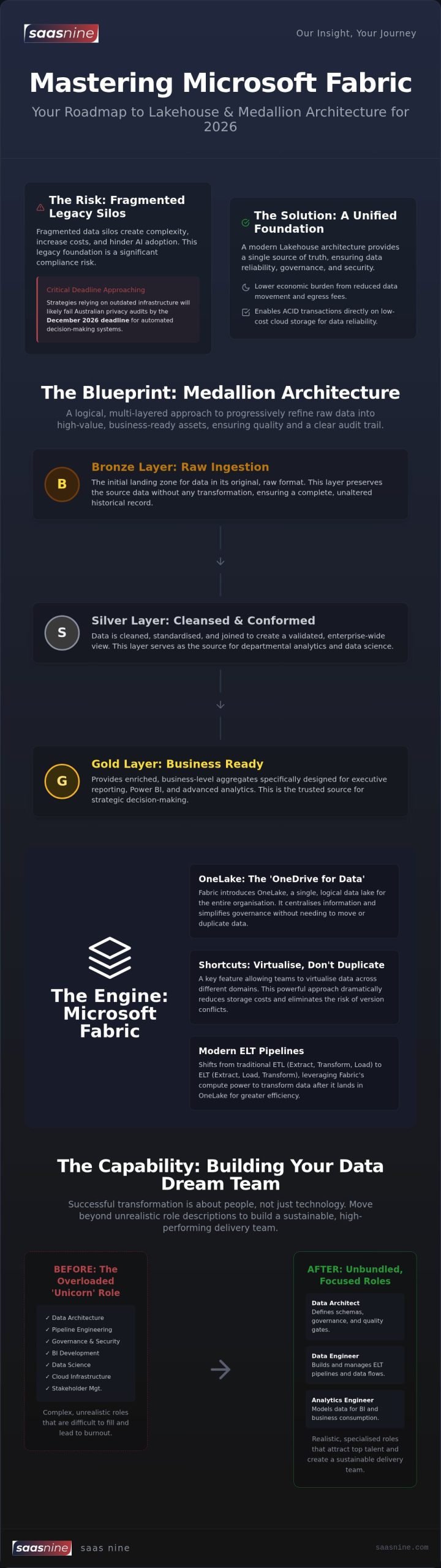
Microsoft Fabric introduces OneLake, a logical “OneDrive for data” that centralises information across a national enterprise. It simplifies governance by providing a single location for all data assets. One of the most practical features within Fabric is the use of “shortcuts”. These allow teams to virtualise data across different domains without physical duplication. This approach reduces storage costs and minimises the risk of version conflict. Our Insight, Your Journey provides the roadmap to navigate these changes, ensuring your workforce capability matches the technical sophistication of the Fabric ecosystem.
Unpacking the Medallion Architecture: Bronze, Silver, and Gold Standards
The Medallion Architecture serves as the structural blueprint for modern data engineering. It organises information into three logical layers, ensuring that Lakehouse & Medallion Architectures deliver consistent, high-quality insights across the enterprise. This design pattern allows organisations to maintain a clear audit trail while progressively refining raw data into valuable business assets.
The Bronze layer acts as the initial landing zone; it ingests data in its original, raw format without any transformation. Moving to the Silver layer involves cleaning, standardising, and joining these datasets to create a validated enterprise view. Finally, the Gold layer provides enriched, business-level aggregates specifically designed for Power BI and executive reporting. This progression ensures that decision-makers rely on data that has been rigorously vetted for accuracy.
From Raw Ingestion to Business-Ready Insights
Modern data pipelines have shifted from traditional ETL to an ELT (Extract, Load, Transform) approach. This change allows engineers to leverage the massive compute power of Microsoft Fabric to transform data after it lands in OneLake. Successfully managing this flow requires a precise mix of technical skills. You can explore our guide on Microsoft Fabric roles and responsibilities to understand how to structure your delivery team for this specific pipeline.
Governance and Data Quality in the Medallion Flow
Implementing this layered structure naturally supports rigorous data governance frameworks. It provides a transparent lineage from raw ingestion to the final report, which is essential for meeting the December 10, 2026, Australian privacy requirements regarding automated decision-making systems. Data Architects play a critical role here by defining the schemas and quality gates for each transition. They ensure that “Gold” data is not just fast, but fundamentally reliable.
If you are struggling to find specialists who can bridge the gap between architectural design and practical execution, contact our talent advisory team for a strategic discussion. Our Insight, Your Journey ensures your architecture remains robust as you scale.
Implementing Medallion Architectures: A Strategic Roadmap for Australian Leaders
Successful implementation of Lakehouse & Medallion Architectures starts in the boardroom, not the server room. For C-suite leaders, the first step involves a candid assessment of current data maturity and workforce capability. Transitioning to Microsoft Fabric requires more than just a platform shift; it demands a cultural alignment where technical design mirrors business strategy. Without this link, organisations risk investing in technology for technology’s sake rather than driving measurable commercial outcomes. High-quality, clean data serves as the non-negotiable prerequisite for responsible AI adoption, particularly as Australian regulations tighten around automated decision-making.
At saas nine, our Strategic Advisory services assist leaders in workforce planning during these complex transformations. We help you map out the specific skills required to move from legacy environments to modern structures while ensuring your team is equipped for long-term delivery. Our Insight, Your Journey focuses on connecting your strategic goals with tangible technology capability.
Avoiding Common Implementation Pitfalls
A frequent error is over-engineering the Silver layer, which can inadvertently create “data swamps” where complexity outpaces utility. To avoid this, leaders must unbundle traditional, bloated position descriptions into realistic, specialised roles. It’s vital to follow a rigorous vetting cloud architects process to identify technical red flags before they derail your project. Clear role definition ensures each layer of the Implementing Medallion Architecture in Fabric remains functional and governed.
Aligning Architecture with Agentic AI Goals
The true value of the Gold layer becomes apparent when feeding Agentic AI and Copilot Studio. These autonomous systems require highly governed, aggregated data to perform multi-agent orchestration effectively. If your data foundation is fractured, your AI output will be unreliable. Building a robust Medallion structure ensures your AI agents operate on a single source of truth that respects both business logic and privacy. To ensure your workforce is ready for this shift, contact saas nine for a strategic talent consultation today.
Building Your Data Dream Team: Sourcing Capability for Fabric Delivery
Constructing Lakehouse & Medallion Architectures requires a level of specialisation that traditional recruitment models often struggle to identify. Many organisations face delays because they search for generalist cloud talent rather than niche experts who understand the nuances of Microsoft Fabric. At saas nine, we act as a strategic talent advisory, ensuring your delivery team is structured around realistic roles that align with your technical roadmap. Our Agentic Workforce Platform enables faster mobilisation by connecting you with pre-vetted professionals who possess the specific literacy required for modern data estates.
Defining the Roles: Fabric Architects vs. Data Engineers
Success hinges on the distinction between those who design the OneLake strategy and those who build the physical pipelines. Fabric Architects define the governance and cross-domain shortcuts, while Data Engineers focus on the technical execution of the Bronze, Silver, and Gold transitions. Finding individuals with the right Microsoft certifications is a baseline; the real challenge is sourcing talent with practical delivery experience. If you are looking for specialists who can bridge this gap, explore our expertise in data and AI recruitment in Australia.
Partnering with saas nine for Strategic Talent Discovery
We provide more than just a list of candidates. Our Talent Portal offers improved workforce visibility, allowing you to track candidate matching and engagement through a transparent, AI-powered platform. This investment in technology ensures that we connect your business strategy with the exact technical capability needed for a successful transformation. Our Insight, Your Journey is a commitment to building long-term partnerships that extend beyond a single hire. To map your specific data capability requirements and secure the talent your project demands, organise a consultation with saas nine today.
Future-Proofing Your Data Strategy for 2026 and Beyond
Transitioning to a unified data environment is a strategic necessity for Australian organisations looking to lead during the rise of Agentic AI. By mastering Lakehouse & Medallion Architectures, you create a foundation where raw data is systematically refined into gold-standard business assets. This journey requires alignment between technical design and workforce capability. It’s about defining the right roles and securing niche talent to navigate the complexities of Microsoft Fabric.
At saas nine, we support your modernisation through our specialised Microsoft Ecosystem Capability Map and AI-driven workforce discovery. We provide access to vetted Microsoft professionals who turn architectural theory into delivery reality. Whether you’re unbundling position descriptions or planning your next transformation phase, Our Insight, Your Journey ensures you have a steady hand at every step.
Discover pre-qualified Microsoft Fabric talent on the saas nine platform to begin mapping your data capability requirements today. Your path to scalable data value starts with the right partner.
Frequently Asked Questions
What is the primary difference between a Data Lakehouse and a traditional Data Warehouse?
A Data Lakehouse combines the cost-effective, flexible storage of a data lake with the high-performance management and ACID transactions of a traditional warehouse. While warehouses often rely on proprietary formats and rigid schemas, Lakehouse & Medallion Architectures utilise open standards. This allows organisations to run diverse workloads, from machine learning to business intelligence, on a single, unified platform without the need for expensive data duplication across disparate legacy environments.
How does Medallion architecture improve data governance in Microsoft Fabric?
Medallion architecture establishes a clear audit trail by refining data through logical stages. In Microsoft Fabric, this structure ensures every piece of information has a documented lineage from raw ingestion to final report. This transparency is essential for meeting the December 10, 2026, deadline for Australian privacy compliance. It allows your Data Architects to implement robust security protocols and quality gates within a single, governed environment that supports responsible AI adoption.
Do I need to hire a full team of Fabric Architects to implement a Lakehouse?
Successfully implementing a Lakehouse requires a balanced mix of specialised capability rather than a team of generalists. While a Fabric Architect is essential for the design, you also need Data Engineers to build pipelines and Analytics Leads to drive value. saas nine helps you unbundle complex position descriptions into realistic roles. Our Insight, Your Journey ensures you secure pre-vetted talent who possess the niche technology skills required for your transformation.
What are the three layers of Medallion architecture, and why are they necessary?
The three layers include Bronze for raw data, Silver for validated data, and Gold for business-ready aggregates. These stages are necessary to ensure data quality and reliability across the enterprise. By progressively refining data, organisations avoid the risk of “data swamps” and ensure that executives make decisions based on a single source of truth. This structured approach allows teams to maintain a high-quality foundation that supports both operational reporting and advanced analytics.
How does Lakehouse architecture support the adoption of Agentic AI?
Agentic AI requires governed, high-quality data to function effectively without manual intervention. A Lakehouse architecture provides the structured Gold-layer datasets that autonomous agents and Copilot Studio need for multi-agent orchestration. Without this foundation, AI agents may produce unreliable outputs or fail to navigate complex business logic. Implementing Lakehouse & Medallion Architectures ensures your AI strategy is built on a reliable foundation that delivers tangible commercial value for your organisation.