

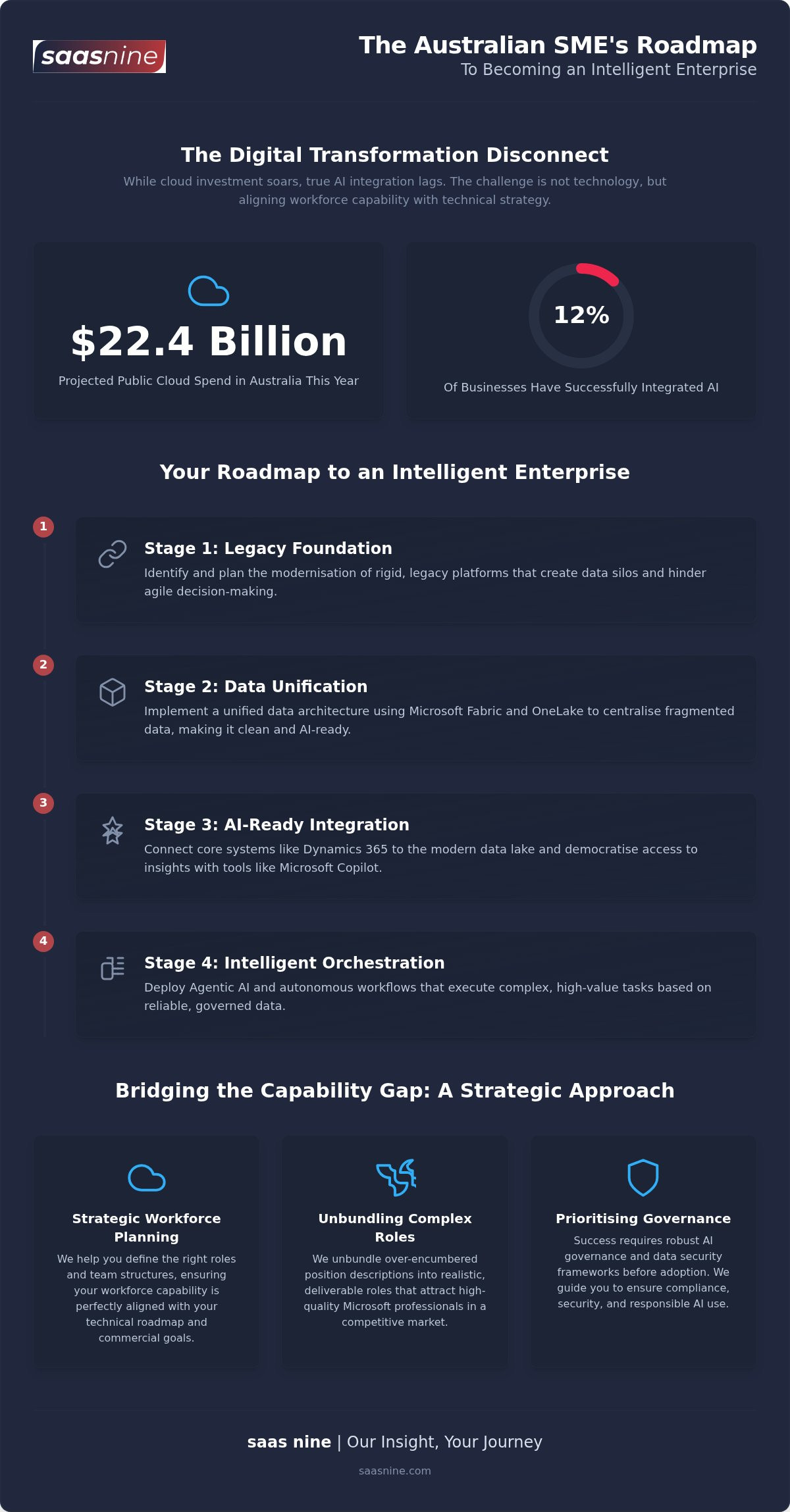
Did you know that while public cloud spending in Australia is set to reach $22.4 billion this year, official ABS data shows only 12% of businesses have successfully integrated AI into their core operations? This gap highlights the primary challenge of Digital Transformation for SMEs; it’s rarely about the software you buy, but how you align your workforce capability with your technical strategy. You’re likely feeling the strain of legacy platforms that refuse to communicate with modern tools, compounded by the difficulty of finding niche Microsoft professionals in a tightening Australian market.
At saas nine, we understand that your journey to becoming an Intelligent Enterprise shouldn’t be stalled by data governance risks or the looming December 10 Privacy Act deadline. We’ll show you how to bridge the gap between legacy systems and modern AI-ready capability to drive measurable business value. This guide provides a practical roadmap for unbundling complex roles and securing the right talent to ensure your technology delivers on its promise. Our insight, your journey.
Key Takeaways
- Identify how to modernise legacy platforms through the integration of Microsoft Fabric and Copilot to transition your organisation into an “Intelligent Enterprise”.
- Develop a strategic roadmap for Digital Transformation for SMEs that ensures data governance and responsible AI adoption are prioritised over technology hype.
- Learn how to unbundle complex position descriptions into realistic, deliverable roles to bridge the capability gap and secure high-quality Microsoft talent in Australia.
- Leverage the strategic advisory and workforce planning expertise of saas nine to ensure your technical execution remains perfectly aligned with your commercial journey.
Defining Digital Transformation for Australian SMEs in 2026
Modern Digital Transformation has evolved beyond the simple adoption of cloud software. In 2026, the concept of Digital Transformation for SMEs represents the strategic integration of AI, unified data architectures, and cloud infrastructure to modernise legacy platforms. For Australian organisations, this marks the transition into the “Intelligent Enterprise,” where business decisions are driven by real-time insights rather than historical guesswork. Digital transformation serves as the essential bridge connecting an organisation’s commercial strategy with its technical execution capability.
The shift is palpable. We’ve moved from basic automation to the era of Agentic AI and autonomous workflows. These sophisticated systems don’t just follow static rules; they execute complex tasks and adapt to changing conditions. This evolution requires a steady hand to ensure that technology serves the business, rather than creating new layers of complexity.
The 2026 SME Landscape: Beyond the Hype
The current market reveals a significant move away from rigid legacy ERPs that create data silos and hinder growth. SME leaders now prioritise agility and resilience over massive, all-encompassing software suites. Realising this vision requires more than just new tools; it demands a structured approach to technology workforce planning Australia. Without aligning your team’s skills with your technical roadmap, even the most sophisticated systems fail to deliver tangible ROI.
Critical Drivers for Modernisation
Unlocking data value is the primary driver for transformation this year. By leveraging Microsoft Fabric and OneLake architectures, organisations can centralise fragmented data for AI readiness. However, the local talent shortage remains a persistent hurdle. At saas nine, we observe that success often hinges on unbundling traditional, over-encumbered position descriptions into realistic roles that reflect the modern Microsoft ecosystem. This approach reduces hiring risk and ensures your Digital Transformation for SMEs is supported by the right expertise. Our insight, your journey starts with defining these roles accurately to ensure long-term delivery capability.
The Roadmap to an Intelligent Enterprise: A Maturity Framework
Transitioning to an Intelligent Enterprise involves a methodical journey through five distinct stages of maturity: from ad-hoc exploration to full autonomous orchestration. In the Australian market, The Digital Journey of SMEs in Australia highlights that while many are digitising, fewer are truly transforming. For Digital Transformation for SMEs to succeed, governance must precede adoption. Establishing robust AI Governance ensures that data remains secure and compliant before deploying Agentic AI. This navigational approach prevents the common pitfall of technology for technology’s sake.
Technical foundations rely on Lakehouse and Medallion architectures. By organising data into Bronze, Silver, and Gold layers, businesses ensure their AI tools access clean, verified information. This structure allows for meaningful Agentic AI orchestration, where autonomous agents perform high-value tasks based on reliable data. This creates a clear path from simple automation to strategic business value.
Strategic Advisory and Workforce Planning
Moving from “buying software” to “building capability” requires a fundamental shift in mindset. saas nine facilitates this through strategic advisory that aligns executive stakeholders with the necessary organisational design. We help you define the right roles rather than just filling seats, ensuring your workforce can support your long-term roadmap. If you’re ready to map your organisation’s capability, you can speak with our advisory team to begin your assessment.
Modernising the Core: Dynamics 365 and Fabric
Integrating Dynamics 365 Finance & Operations with modern data lakes is essential for real-time visibility. Microsoft Fabric democratises this data, allowing SME decision-makers to access insights without needing deep technical expertise. This integration ensures the core of your business is AI-ready and capable of scaling as your Digital Transformation for SMEs matures.
Bridging the Capability Gap: Aligning Workforce Strategy
The primary reason Digital Transformation for SMEs fails isn’t usually the technology itself; it’s the gap between strategic intent and the team’s ability to execute. Many Australian organisations attempt to hire “unicorns”, individuals expected to handle everything from legacy ERP migration to complex AI ethics. This approach often leads to project stagnation. At saas nine, we advocate for unbundling traditional position descriptions into realistic, deliverable roles. By structuring successful delivery teams with pre-qualified Microsoft professionals, you significantly reduce project risk.
Practical support for these initiatives is often available through the Digital Solutions program for small business, which provides a starting point for digital adoption. However, executing a complex roadmap requires deeper technical literacy and a balanced workforce strategy. Balancing permanent placements with talent augmentation allows you to scale during project-based peaks without inflating long-term overheads.
Sourcing Niche Capability in a Tight Market
Traditional recruitment agencies often lack the technical depth required to vet specialists like Fabric Architects or Data Engineers. We use a Microsoft Ecosystem Capability Map to ensure every candidate is technically qualified for your specific stack. This involves vetting cloud architects for Australian enterprises through rigorous technical capability mapping. This precision ensures you aren’t just filling a seat, but securing a steady hand for your complex environment.
The Role of Executive Search in Transformation
Successful transformation requires leaders who can navigate the Microsoft ecosystem with commercial precision. Market mapping allows saas nine to identify hard-to-find specialists and C-suite executives, like CIOs and CTOs, before they ever hit the open market. This proactive approach connects your business strategy with high-level technical capability. If you need to secure niche Microsoft talent to de-risk your project, contact saas nine today to discuss our sourcing and advisory strategies. Our insight, your journey.
Executing Your Strategy: The saas nine Approach
Executing a successful roadmap requires a partner who understands the subtle intricacies of the Microsoft ecosystem. At saas nine, we connect your business strategy directly with technical capability through our proprietary Agentic Workforce Platform. This system uses AI-driven discovery to mobilise specialist teams faster while significantly reducing hiring risk. By automating complex workflows and improving candidate matching, we ensure your Digital Transformation for SMEs moves from a conceptual plan to a delivered reality with measurable commercial value.
The Agentic Workforce Model
Visibility is the cornerstone of effective workforce planning. Through the saas nine talent portal, our clients gain immediate access to deep market intelligence and a pool of pre-qualified Microsoft professionals. This platform enhances engagement by providing a transparent view of available capability in real-time. It allows us to unbundle complex, unrealistic position descriptions into deliverable roles, ensuring your delivery team is structured for success from the very first day of the project.
Tailoring Your Engagement Model
Every organisation’s path to becoming an Intelligent Enterprise is unique. We provide a range of flexible services, including contingent recruitment, executive search, and strategic advisory. Whether you require a permanent lead for Dynamics 365 or contract specialists to handle project-based peaks in data engineering, we tailor the engagement to your specific maturity stage. This approach avoids the high-pressure tactics of traditional agencies, focusing instead on a collaborative partnership that values long-term outcomes.
Your next steps involve moving from broad workforce planning to precise project delivery. By aligning your organisational design with your technology roadmap, you can de-risk your transformation and build lasting resilience. Our insight, your journey starts with a clear understanding of your current capability and a structured plan to bridge the gap. We remain committed to guiding you through every stage of this complex environment.
Securing Your Position as an Intelligent Enterprise
Navigating the complexities of Digital Transformation for SMEs requires a shift from simple software acquisition to building deep organisational capability. We’ve explored how modernising legacy platforms through Microsoft Fabric and Dynamics 365 creates the foundation for Agentic AI. However, the true differentiator remains your people. By unbundling traditional roles and prioritising integrated strategic advisory, you ensure your technology roadmap is supported by pre-qualified and vetted Microsoft professionals who can actually deliver on your vision.
At saas nine, we’re committed to helping you bridge the gap between technical strategy and workforce execution. Our unique approach ensures that your journey is guided by market intelligence rather than industry hype, de-risking your transformation in an increasingly competitive Australian landscape. If you’re ready to take the next step, you can mobilise your transformation journey with the saas nine talent portal and begin mapping your organisation’s future capability. Our insight, your journey. Your path to a resilient, data-driven business starts with the right partner at your side.
Frequently Asked Questions
What are the main stages of digital transformation for an Australian SME?
The journey of Digital Transformation for SMEs typically follows a five-stage maturity framework, moving from initial exploration to becoming a fully integrated Intelligent Enterprise. This progression involves modernising legacy platforms, establishing robust data governance, and eventually orchestrating autonomous workflows. By aligning your workforce strategy with these stages, your organisation can transition from reactive technology adoption to a proactive, data-driven culture that delivers sustainable commercial value.
How much does digital transformation cost for a mid-sized business?
Investment levels for modernisation vary significantly based on your current technical debt, the complexity of your legacy systems, and your specific delivery goals. Rather than focusing on a single figure, Australian businesses should consider the cost of inaction, such as cybersecurity risks or lost productivity. Strategic advisory can help you define a phased roadmap that leverages government incentives like the permanent instant asset write-off to manage your capital expenditure effectively.
Why is the Microsoft ecosystem preferred for SME modernisation in 2026?
The Microsoft ecosystem is the preferred choice because it offers a unified stack that bridges the gap between ERP, CRM, and modern AI capability. Tools like Microsoft Fabric and Copilot allow organisations to unlock data value without the need for fragmented, third-party integrations. This cohesion ensures that as you modernise, your systems remain secure, compliant, and ready to support the rapid deployment of responsible AI across all business functions.
How do I find pre-qualified Microsoft professionals in a competitive market?
Securing niche talent requires moving beyond traditional recruitment methods toward a platform that uses AI-driven discovery and technical capability mapping. You can find pre-qualified Microsoft professionals by accessing the saas nine talent portal, which provides visibility into a vetted pool of specialists. This approach focuses on unbundling traditional position descriptions into realistic roles, ensuring you hire the exact skills needed to de-risk your Digital Transformation for SMEs and ensure successful project delivery.
What is the role of Agentic AI in SME digital transformation?
Agentic AI represents the shift from basic automation to autonomous agents that can execute complex tasks and adapt to changing business conditions. These agents perform high-value functions such as data analysis or customer engagement with minimal human intervention. Adopting this technology responsibly allows your team to focus on strategic initiatives while autonomous workflows handle repetitive processes, significantly increasing your overall operational resilience and helping your organisation reach the final stage of digital maturity.