

What if your most productive team members weren’t people, but a coordinated network of autonomous digital agents working across your Microsoft ecosystem? Most Australian executives have moved past the initial “chatbot” novelty and are now searching for genuine business value. You’ve likely realised that simply deploying a large language model isn’t enough to drive transformation. The real challenge lies in building an agentic AI team that can execute complex workflows without constant human hand-holding. At saas nine, we view this as a workforce transformation challenge rather than a simple software implementation.
This guide provides a clear roadmap to help you transition from basic automation to a high-performing workforce of autonomous agents. You’ll discover the specific roles needed for a successful AI Centre of Excellence and how to bridge the gap between technical potential and actual workforce capability. We’ll examine the architecture required for responsible agent design and the specialist talent necessary to lead these initiatives. Our Insight, Your Journey; let’s explore how to organise your talent strategy for the intelligent enterprise.
Key Takeaways
- Differentiate between fixed-path automation and agentic orchestration to understand how autonomous systems use reasoning loops to achieve complex business goals.
- Explore the strategic architecture needed for building an agentic AI team, focusing on secure agent-to-agent communication protocols within your Azure environment.
- Identify the essential roles for a successful AI Centre of Excellence, including AI Product Owners and Architects who bridge the gap between strategy and execution.
- Learn how to mobilise project teams by mapping your Microsoft ecosystem capability and implementing a structured, responsible AI operating model.
What is an Agentic AI Team and Why Does it Matter?
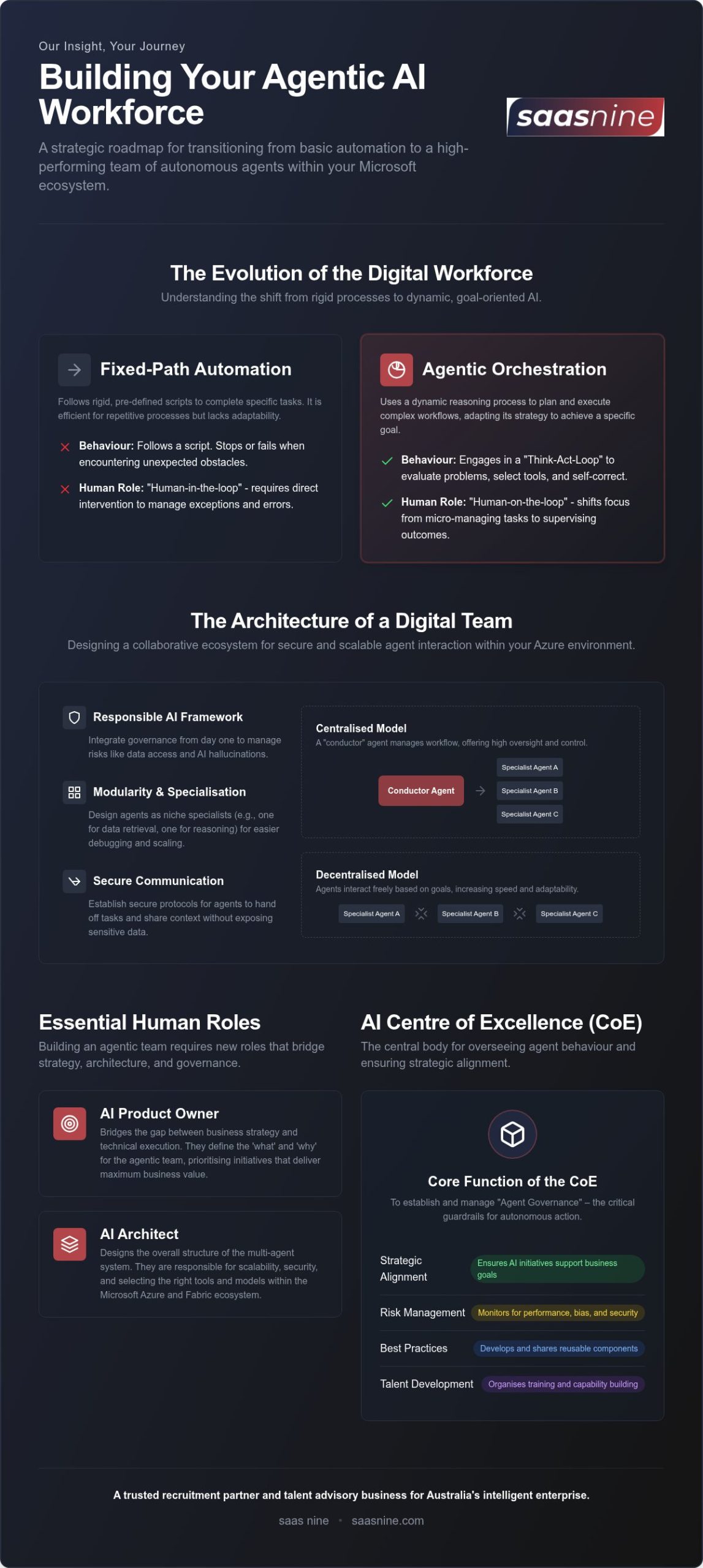
Agentic AI represents a fundamental shift in how we perceive digital capability. Unlike traditional automation, which follows rigid, pre-defined paths, agentic systems dynamically direct their own processes and tool usage to achieve complex goals. When we talk about building an agentic AI team, we are describing a network of autonomous agents that can reason, plan, and execute tasks with minimal intervention. This isn’t just about faster software; it’s about creating a digital workforce that understands intent.
The core mechanism of an effective agent is the “Think-Act-Loop”. While a standard bot might stop if it hits an unexpected error, an agentic system evaluates the obstacle, searches for a different tool or data source, and adjusts its strategy. This move from “Human-in-the-loop” to “Human-on-the-loop” allows Australian business leaders to shift their focus from micro-managing tasks to supervising outcomes. It’s a strategic evolution that transforms AI from a basic utility into a proactive partner in your operations.
The Evolution from Chatbots to Autonomous Agents
The transition toward the “Intelligent Enterprise” model is accelerating, with many industry observers pointing to 2026 as a critical tipping point for mainstream adoption. We’ve moved far beyond the era of simple FAQ bots. Tools like Microsoft Copilot Studio are democratising agent design, allowing organisations to build sophisticated agents that can access enterprise data and take action across multiple platforms. At saas nine, we see this as the moment where technology finally aligns with strategic workforce planning.
Business Value: Beyond Simple Task Completion
Building an agentic AI team offers a practical way to modernise legacy platforms without the need for a total system overhaul. Agents act as intelligent integration layers, navigating complex environments to retrieve and process information. By leveraging Microsoft Fabric and OneLake, these agents can unlock deep data value that was previously trapped in silos. They don’t just find information; they interpret it within the context of your specific business goals, providing a level of insight that traditional automation simply cannot match.
The Architecture of Multi-Agent Orchestration
Successful orchestration is less about individual bot performance and more about how these digital entities communicate. When building an agentic AI team, you aren’t just deploying software; you’re designing a collaborative ecosystem. Multi-agent orchestration involves multiple specialised agents working together on a single, complex mission. One agent might focus exclusively on data retrieval from Dynamics 365, while another performs advanced reasoning before a third agent executes a transaction. This modularity ensures that if one component fails, the entire system doesn’t collapse.
Building an agentic AI team requires a disciplined approach to architecture, especially regarding secure communication protocols within a protected Azure environment. Agents must be able to hand off tasks and share context without exposing sensitive data. Your choice between centralised and decentralised control will define your AI operating model. Centralised models provide a “conductor” agent to manage the flow, offering high oversight. Conversely, decentralised models allow agents to interact more freely, which can increase speed but requires more robust guardrails. Integrating a Responsible AI Framework into this core architecture allows you to manage risks like hallucination or unauthorised data access from day one.
Agent Design Principles for Scalability
Effective agents should be niche specialists. Rather than building a generalist tool that handles everything poorly, design agents for modularity. Azure AI Services provide the necessary “senses” for these agents, such as vision, speech, and advanced search capabilities. This allows each agent to focus on a narrow domain, making the entire team easier to debug and scale as your requirements evolve. It’s about creating a suite of precise digital instruments rather than a single, blunt tool.
Governance and AI Operating Models
At saas nine, we recommend establishing an AI Centre of Excellence (CoE) as a vital step in overseeing agent behaviour and ensuring alignment with business strategy. This body manages the “Agent Governance” which is the critical guardrail for autonomous action. If you’re unsure how to structure these new technical roles within your organisation, reach out to our advisory team to discuss your workforce roadmap and delivery capability.
Essential Roles for Your Agentic AI Workforce
Building an agentic AI team requires a fundamental shift in how we structure technical departments. It isn’t simply a matter of adding “AI” to existing job titles; it involves defining roles that manage the intersection of reasoning, data, and business logic. AI Product Owners serve as the vital bridge, translating commercial strategy into agentic execution. They ensure that every autonomous action aligns with broader organisational goals and delivers measurable value.
Behind the scenes, AI Architects and Engineers design the underlying logic and “medallion architectures” that power these systems. They create the structured data environments where agents can operate safely and effectively. Meanwhile, Data Governance Leads ensure that agents access clean, verified data within Microsoft Fabric. Without this oversight, even the most sophisticated agent will produce unreliable results. Agentic AI Consultants further support this by specialising in the nuances of Microsoft Copilot adoption, helping teams integrate these tools into their daily workflows.
The Talent Gap in the Australian Market
Traditional job descriptions often fail to attract the right talent because they try to bundle too many disparate skills into a single role. To succeed, you must unbundle these position descriptions into realistic, niche roles that reflect the true complexity of the technology. This strategy allows you to access specialised skill sets that a generalist might lack. If you are struggling to find the right expertise, saas nine specialises in sourcing pre-qualified Microsoft professionals who understand the agentic landscape. For organisations looking to build out their data platform capability, understanding the challenges of hiring a Microsoft Fabric Architect in the Australian market is an essential part of closing that talent gap.
Vetting for the “Expert Guide” Mindset
The interview process must go beyond basic coding tests. Technical red flags include a candidate’s inability to explain the reasoning loops or “Think-Act-Loops” discussed earlier. You need professionals who possess an “Expert Guide” mindset; those who can facilitate progress rather than just write code. For more insights on evaluating high-level talent, see our guide on vetting Cloud Architects for Australian enterprises. If you need help defining your roadmap, contact our talent advisory team for strategic support.
Implementing Your Agentic AI Operating Model
Transitioning from conceptual design to a functional operating model requires a methodical, step-by-step approach. The first phase involves mapping your existing Microsoft ecosystem capability against your primary business goals. This ensures your technology stack actually supports your strategic intent rather than just adding complexity. Once the foundation is set, you can use an Agentic Workforce Platform to discover hidden talent within your organisation and mobilise project teams with the right technical literacy for autonomous systems.
The next stage is to pilot a “multi-agent” workflow in a controlled, low-risk environment. Customer Engagement is often the ideal starting point, as it provides clear metrics for success and immediate feedback loops. After validating the model, you can scale the initiative through talent augmentation. This allows you to bridge immediate capability gaps while building an agentic AI team that is sustainable for the long term. It’s a process of steady refinement rather than a single, high-risk leap.
Our Insight, Your Journey: The saas nine Approach
Successful AI program delivery depends on the seamless connection between strategy, technology, and workforce capability. saas nine uses deep market intelligence to improve hiring outcomes, ensuring you find the specific expertise required for complex agentic environments. Our Insight, Your Journey; we guide you through the complexities of organisational design so your digital transformation remains on track and delivers genuine commercial value.
Next Steps for Transformation Leaders
Leaders should begin by conducting a thorough workforce planning audit to identify the skills needed for the “Intelligent Enterprise” era. This proactive step ensures your team is ready for the shift toward autonomous agents and reasoning loops. For tailored support, consider engaging saas nine for Strategic Advisory on workforce planning for Australian tech leaders. We help you structure your delivery teams to turn AI potential into practical business value.
Navigating the Path to an Intelligent Enterprise
The shift from simple automation to autonomous reasoning loops is no longer a futuristic concept; it’s a present-day workforce requirement. We’ve explored how multi-agent orchestration and a clear governance framework form the bedrock of this transition. By unbundling traditional roles, you can identify the niche technical talent required to lead these sophisticated systems. Building an agentic AI team is a strategic journey that requires aligning your Microsoft ecosystem capability with a robust talent roadmap.
At saas nine, we act as your expert guide, leveraging our proprietary Agentic Workforce Platform to provide precise talent matching across the full Microsoft ecosystem. Our trusted Strategic Advisory services for Australian technology leaders help C-suite leaders bridge the gap between AI strategy and delivery capability. Discover how saas nine can mobilise your Agentic AI team and ensure your organisation is positioned for long-term success. Our Insight, Your Journey; we look forward to supporting your path toward a more intelligent enterprise.
Frequently Asked Questions
What is the difference between an AI agent and a standard chatbot?
An AI agent differs from a standard chatbot through its ability to reason and execute multi-step tasks autonomously. While a chatbot typically follows a pre-defined decision tree to provide answers, an agent uses a “Think-Act-Loop” to evaluate a goal, choose the appropriate tool, and adjust its strategy based on the results it receives. This capability allows agents to navigate complex enterprise workflows across your Microsoft environment rather than just providing static information.
How do I ensure my agentic AI team follows Responsible AI Frameworks?
Responsible adoption is achieved by integrating guardrails directly into your multi-agent architecture and establishing an AI Centre of Excellence (CoE). Your team should focus on data privacy, bias mitigation, and transparency within the Azure environment. By setting clear parameters for autonomous action, you ensure that building an agentic AI team aligns with ethical standards and Australian regulatory expectations while maintaining operational safety.
Does building an agentic AI team require a full cloud migration first?
You don’t always need a complete cloud migration to start, but having a unified data foundation like Microsoft Fabric is essential. Agents require access to clean, real-time data to function effectively. Many Australian organisations begin by building an agentic AI team to manage specific hybrid workflows, connecting on-premises legacy systems with cloud-based reasoning engines as a first step toward broader transformation.
What are the most critical skills to look for when hiring an AI Product Owner?
A successful AI Product Owner must possess a blend of commercial strategy and technical literacy. They need to understand how to translate business problems into agentic logic and manage the “reasoning budget” of autonomous systems. Look for candidates who can unbundle complex processes and demonstrate a deep understanding of data governance and the Microsoft ecosystem, specifically Dynamics 365 and Power Platform.
How can saas nine help us find niche Agentic AI Consultants in Australia?
saas nine assists by using our proprietary Agentic Workforce Platform to match your specific requirements with pre-qualified professionals. We specialise in sourcing niche Agentic AI Consultants and Engineers who possess verified expertise in Microsoft Fabric architecture and delivery and Copilot Studio. Our focus on talent advisory means we help you define the right roles and structure a delivery team that bridges the gap between your strategy and technical execution. Our Insight, Your Journey.