

What if the “expert” Power BI developer you just hired is actually the primary architect of your future technical debt? In the current market, it’s common to find candidates who can build a visually appealing dashboard but struggle to manage the complexities of Microsoft Fabric or Direct Lake architectures. You’ve likely felt the frustration of sifting through CVs of “dashboard builders” who lack the engineering depth required for modern data environments. At saas nine, we understand that securing the right talent for Power BI recruitment Australia requires looking beyond the surface of a portfolio.
This guide provides a clear framework for vetting high-calibre professionals who align with your long-term business strategy. You’ll discover how our Talent Portal identifies pre-qualified Microsoft experts who can mobilise project teams quickly and reduce the high cost of a technical mis-hire. Our Insight, Your Journey. We’ll examine the shifting role of the analytics engineer in 2026 and how our talent advisory approach helps you unbundle complex roles to ensure your data ecosystem remains robust, compliant, and ready for the next phase of digital transformation.
Key Takeaways
- Understand why the shift to Microsoft Fabric and OneLake in 2026 requires a transition from simple report building to sophisticated data orchestration and semantic modelling.
- Master the art of Power BI recruitment Australia by unbundling position descriptions into realistic, deliverable roles that maximise your return on investment.
- Implement a strategic vetting framework to identify senior consultants who possess the deep technical literacy needed for complex DAX and Direct Lake architectures.
- Discover how saas nine utilises its Agentic Workforce Platform to rapidly mobilise pre-qualified professionals who align with your long-term business strategy.
The Evolution of Power BI Recruitment: Navigating the 2026 Australian Data Landscape
The Australian data market has undergone a fundamental shift. By 2026, the Microsoft Power BI platform has moved from being a standalone visualisation tool to the front-end of a deeply integrated ecosystem. This change means that traditional job boards often struggle to surface the right talent. They frequently focus on surface-level skills while ignoring the technical depth required to manage modern Medallion Architectures. saas nine leverages market intelligence to find professionals who prioritise data governance and responsible AI adoption over simple aesthetic dashboards.
Why Microsoft Fabric Has Changed the Hiring Rulebook
The transition to Microsoft Fabric has effectively unified data storage and analytics. With OneLake acting as the single source of truth, the boundaries between data engineering and reporting have blurred. This is a core focus of our Microsoft Fabric Recruitment strategy. Your next Power BI lead must now possess a working knowledge of Lakehouse architecture and data orchestration. Hiring for these roles requires a partner who understands how to bridge the gap between technical infrastructure and business value.
The Scarcity of Specialist Data Talent in Australia
Qualified professionals who can navigate this unified Microsoft stack are in short supply. Demand has outpaced the growth of the local talent pool, making Power BI recruitment Australia a significant hurdle for many organisations. We help you navigate these complexities through our commitment to “Our Insight, Your Journey.” By acting as a talent advisory partner, saas nine ensures you aren’t just filling a seat, but are instead building a sustainable team capable of delivering long-term strategic outcomes.
Unbundling the Power BI Role: Why ‘Generalists’ Are a Risk to Your ROI
Hiring a “unicorn” who manages everything from data ingestion to dashboard design is a high-risk strategy. In the complex 2026 landscape, these generalist roles often lead to project bottlenecks and single points of failure. Successful Power BI recruitment Australia requires a strategic shift toward unbundling position descriptions into realistic, specialised roles. By separating data engineering from report storytelling, saas nine ensures your workforce capability directly supports your return on investment and long-term digital transformation goals. This approach prevents the “Shadow BI” trap, where departments create fragmented, ungoverned reports that compromise data integrity.
Data Architect vs. Power BI Developer: Knowing the Difference
Clarity in role definition is the cornerstone of a high-performing team. A developer typically excels in report UX and complex DAX, while an architect focuses on the structural integrity of the data lakehouse. Utilising Microsoft’s Power BI implementation planning framework allows leaders to map these technical requirements precisely. For more context on how these functions interact within a unified environment, explore our guide on Microsoft Fabric Roles: A Guide for Australian Leaders.
| Role Category | Strategic Focus | Core Technical Skills |
|---|---|---|
| Data Architect | Foundation & Governance | OneLake, Medallion Architecture, Security |
| BI Developer | Visualisation & UX | DAX, Power Query, Data Storytelling |
| Analytics Lead | Insight & Strategy | AI Adoption, Stakeholder Management |
Building a Power BI Centre of Excellence (CoE)
A Centre of Excellence provides the necessary governance to scale analytics safely across your organisation. It acts as a navigational hub for standards, ensuring that every report adheres to your security and responsible AI policies. saas nine assists organisations in scaling these CoEs by identifying pre-qualified talent that fits your specific organisational design. If you’re ready to refine your team structure, reaching out for a capability map can clarify your requirements. Our Insight, Your Journey is about building teams that don’t just deliver reports, but drive genuine business value.
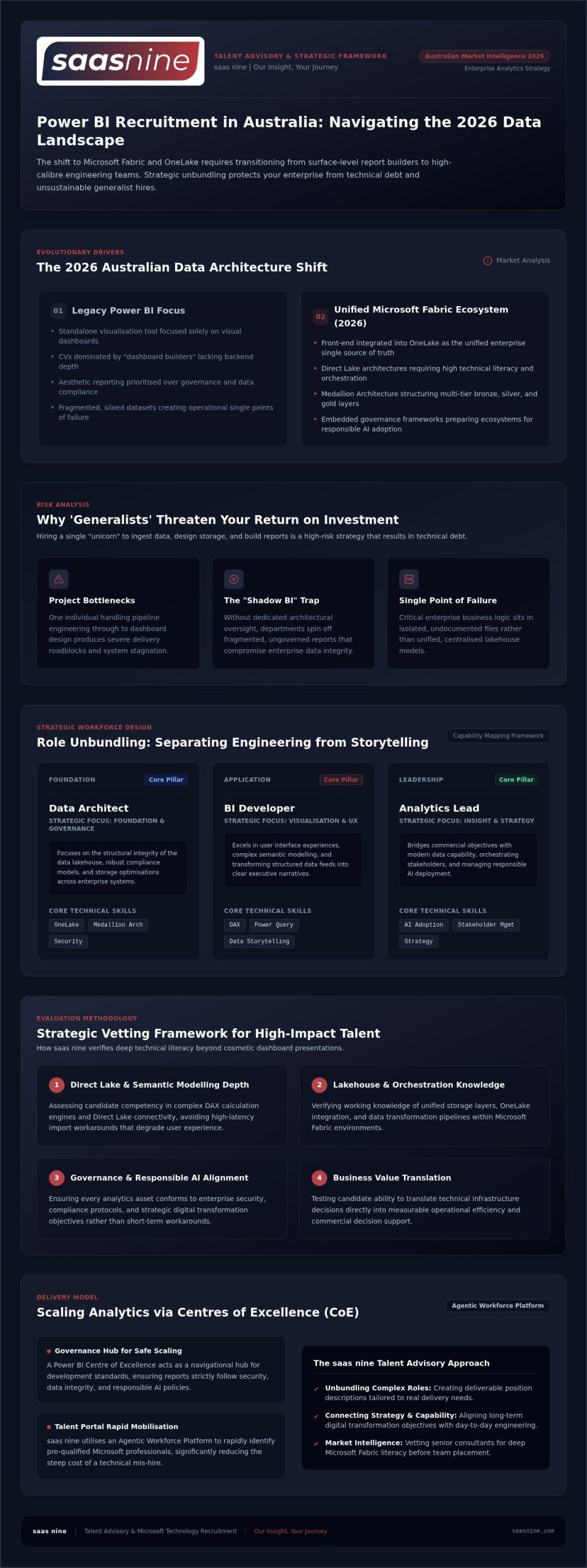
Vetting for Impact: Strategic Power BI Talent Framework
Relying on certifications alone is a common mistake in Power BI recruitment Australia. While badges show a baseline, they don’t guarantee delivery capability. Technical Vetting is a process of validating real-world problem-solving over theoretical knowledge. This distinction is vital as the Australian Data and Digital Government Strategy pushes for higher standards in our national analytics workforce. saas nine moves beyond keyword matching to evaluate how a candidate’s technical choices impact business outcomes.
Our five-step framework includes portfolio reviews of semantic models, scenario-based DAX testing, and architectural interviews. Red flags often appear when a candidate can’t explain the “why” behind a specific calculation or lacks knowledge of row-level security. We look for professionals who understand how their work fits into the broader organisational strategy. This ensures that every hire is ready to contribute to your journey from day one.
Assessing DAX and Power Query Proficiency
Separating report “beautifiers” from true engineers requires deep technical probing. Ask candidates to explain how they’ve optimised slow-loading reports or managed complex many-to-many relationships. For insights on similar rigorous processes, see our guide on Vetting Cloud Architects for Australian Enterprises. True specialists should demonstrate a mastery of data transformation that goes beyond simple drag-and-drop visuals.
Soft Skills: The Ability to ‘Bridge the Gap’
A senior lead must translate complex data into business-ready insights. Communication and stakeholder management are critical because the most sophisticated report is useless if it doesn’t solve a business problem. We evaluate whether a candidate can articulate technical bottlenecks to non-technical executives clearly and concisely. Access our pre-vetted talent network today to secure professionals who possess this rare blend of skills.
Building High-Performance Data Teams: The saas nine Strategic Advantage
Traditional recruitment often focuses on filling immediate gaps, but saas nine operates as a talent advisory partner. We ensure that your Power BI recruitment Australia strategy aligns with your broader technology roadmap. By utilising our Agentic Workforce Platform, we automate the discovery of professionals who possess the exact technical stack required for your delivery goals. This reduces hiring risk by providing access to a pre-qualified pool of Microsoft experts who’ve already been vetted for both technical literacy and cultural fit.
We offer flexible engagement models tailored to your project requirements. Whether you need contingent recruitment for a rapid turnaround or talent augmentation to support a multi-year transformation, our focus remains on business value. This strategic alignment ensures that your data team isn’t just a cost centre, but a driver of real-world business outcomes.
Beyond Recruitment: Strategic Workforce Planning
Successful delivery requires more than just sourcing; it requires intelligent organisational design. We assist leaders with long-term capability mapping to ensure your team structure remains resilient. Our approach to Data and AI Recruitment Australia focuses on future-proofing your operations against AI disruption. We help you define roles that balance human insight with automated capabilities, ensuring your journey remains on track.
Accessing the Talent Portal
The Talent Portal serves as a modern alternative to traditional job boards, offering a direct pathway to pre-vetted Microsoft professionals. This platform leverages AI-driven discovery to enable faster mobilisation for Australian enterprises. By automating workflows and improving candidate matching, we provide the visibility needed to secure elite data specialists quickly. Our Insight, Your Journey is about providing the tools you need to build a high-performance team with confidence.
Future-Proofing Your Data Capability
Securing the right technical lead requires a shift from traditional hiring to a strategic talent advisory model. Success in 2026 depends on your ability to unbundle complex roles and align them with the unified Microsoft Fabric architecture. By moving beyond simple certifications and focusing on technical literacy, you can build a team that drives real business value. saas nine supports this journey through our proprietary Agentic Workforce Platform and a specialist Microsoft Ecosystem Capability Map, ensuring your organisational design is robust and scalable.
Our advisory-led approach bridges the gap between your strategy and workforce capability. Navigating the complexities of Power BI recruitment Australia doesn’t have to be a solo endeavour. Our Insight, Your Journey. We invite you to explore pre-qualified Power BI talent on the saas nine Talent Portal to discover how we can mobilise your project teams with precision and speed. With the right partners and a clear framework, your organisation is well-positioned to lead in the data-driven landscape.
Frequently Asked Questions
What is the average lead time for Power BI recruitment in Australia for 2026?
Lead times for Power BI recruitment Australia vary based on role complexity, but our Agentic Workforce Platform significantly accelerates the discovery phase. While traditional methods often take several weeks to filter unqualified CVs, our AI-driven discovery identifies pre-vetted specialists in a matter of days. This allows for faster mobilisation of project teams, ensuring your digital transformation milestones aren’t delayed by talent scarcity. We focus on providing high-calibre professionals ready to deliver value.
How does saas nine vet Power BI candidates for technical proficiency?
Our approach to Power BI recruitment Australia involves a multi-layered framework that combines our proprietary Agentic Workforce Platform with deep technical validation. We assess real-world problem-solving through DAX testing and architectural reviews of semantic models. We don’t just check for certifications; we verify a candidate’s ability to manage complex Medallion Architectures. This rigorous vetting ensures every professional we recommend possesses the technical literacy required to thrive in your Microsoft environment.
Should I hire a permanent Power BI specialist or a contract consultant?
The choice depends on your long-term strategic goals and current project roadmap. Permanent specialists are ideal for building internal capability and maintaining a Power BI Centre of Excellence. Conversely, contract consultants provide the agility needed for rapid migrations or specialised Fabric implementations. saas nine supports both models, offering strategic advice to help you determine which engagement type best aligns with your organisational design and transformation delivery requirements.
What is a Power BI Centre of Excellence and do I need one?
A Power BI Centre of Excellence is a centralised governance hub that defines reporting standards, security protocols, and best practices. You need one if your organisation is scaling analytics across multiple departments to prevent fragmented “Shadow BI.” It ensures data integrity and responsible AI use while empowering business units to create their own insights. We assist in structuring these teams to ensure your data ecosystem remains secure, compliant, and strategically aligned.
How does Microsoft Fabric change the requirements for Power BI roles?
Microsoft Fabric fundamentally shifts the requirement from standalone reporting to integrated data orchestration. Power BI professionals now need to understand OneLake, Lakehouse architectures, and Direct Lake storage modes. This evolution means your next hire must possess deeper data engineering knowledge to manage the unified Microsoft stack effectively. We use our Microsoft Ecosystem Capability Map to identify specialists who have mastered these new requirements, bridging the gap between raw data and actionable intelligence.