
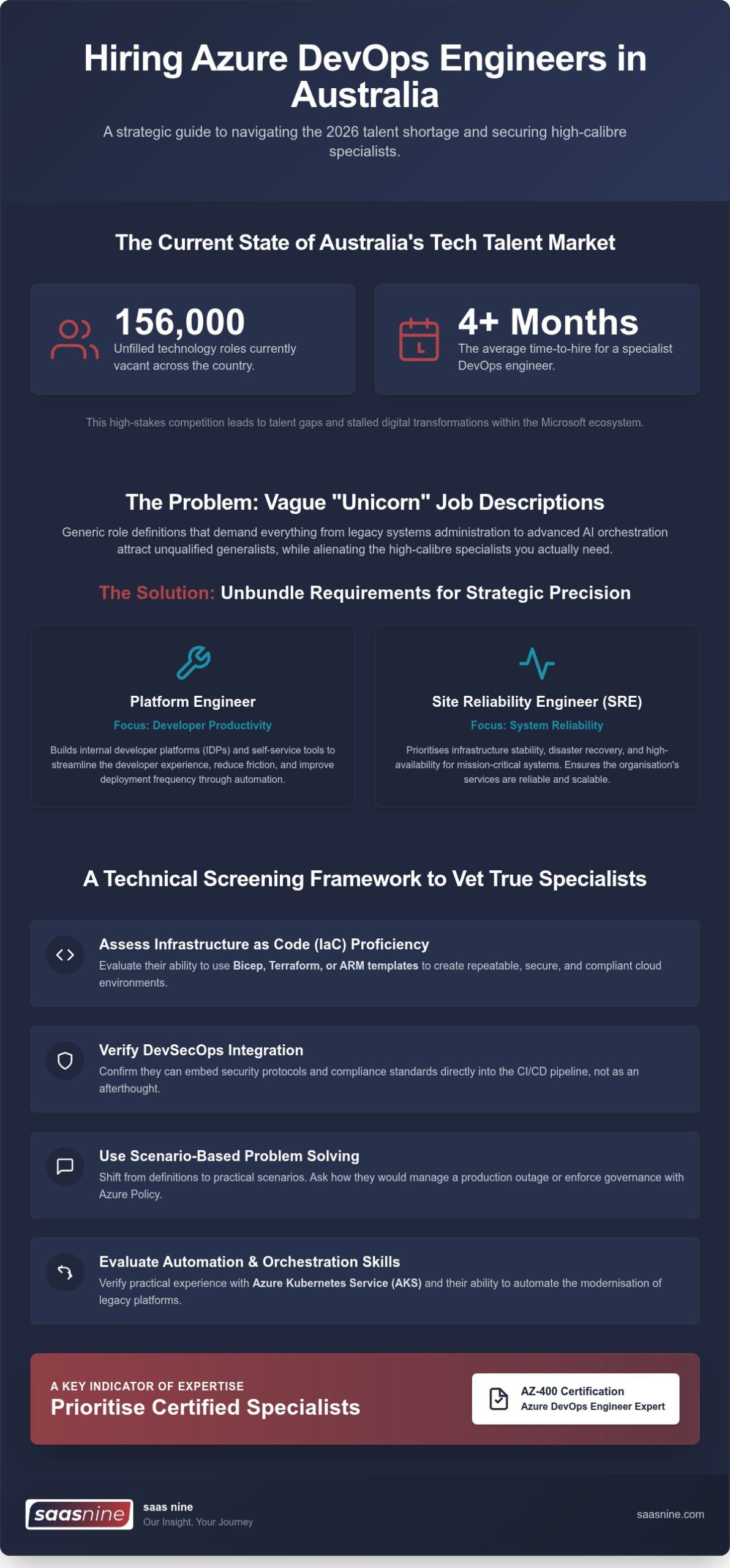
With 156,000 technology roles currently unfilled across the country, the effort to hire Azure DevOps engineer Australia specialists has become a high-stakes competition where the average time-to-hire now stretches beyond four months. You’ve likely experienced the frustration of vague job descriptions attracting traditional SysAdmins instead of true DevOps engineers who can actually bridge the gap between development and operations. It’s an exhausting cycle that often leads to talent gaps and stalled digital transformations within the Microsoft ecosystem.
At saas nine, we understand that securing high-calibre talent requires a more surgical approach than traditional recruitment. This guide provides a clear framework to unbundle complex requirements and define roles that actually align with your business strategy. You’ll learn how to reduce hiring risk through better vetting and how to access our pre-qualified talent pool to accelerate your delivery capability. Our insight, your journey starts with moving beyond generic hiring and adopting a strategic advisory model that prioritises technical precision and long-term organisational fit.
Key Takeaways
- Learn how to unbundle complex position descriptions into realistic roles, ensuring you attract the specific technical capabilities your project actually requires.
- Implement a technical screening framework that evaluates Infrastructure as Code and DevSecOps proficiency to maintain high standards of security and compliance.
- Navigate the 2026 talent shortage to hire Azure DevOps engineer Australia professionals by utilising advanced talent discovery platforms for faster team mobilisation.
- Discover the value of partnering with saas nine to bridge the gap between your technology strategy and the high-calibre workforce needed to execute it.
Defining the DevOps Role: Unbundling Requirements for the Australian Market
Generic job descriptions are the primary cause of hiring fatigue in the current Australian market. When you’re attempting to hire Azure DevOps engineer Australia talent using a “unicorn” template that demands everything from legacy server maintenance to advanced AI orchestration, you’re signalling a lack of technical clarity. This attracts unqualified generalists while alienating high-calibre specialists who value strategic precision. At saas nine, we advocate for unbundling these requirements to ensure your role aligns with a realistic Microsoft Ecosystem Capability Map. By grounding your search in core DevOps principles, you can define a position that actually exists in the local labour pool and serves your specific delivery objectives.
Platform Engineering vs. Site Reliability Engineering
Modern Australian enterprises are increasingly shifting toward internal developer platforms (IDPs) to streamline the developer experience. If your goal’s to reduce friction and improve deployment frequency through automation, you likely need a Platform Engineer to build these self-service tools. Conversely, if your priority is infrastructure stability, disaster recovery, and high-availability for mission-critical systems, a Site Reliability Engineer (SRE) is the appropriate choice. Defining these roles based on outcomes, such as developer productivity versus system reliability, ensures your workforce strategy matches your technical debt and growth targets.
The Microsoft Stack Specialisation
For 2026 projects, deep expertise in Azure DevOps and GitHub Enterprise has become the baseline for success. While many candidates claim broad cloud experience, you should prioritise specialists who hold the AZ-400 (Azure DevOps Engineer Expert) certification. This credential verifies a candidate’s ability to design and implement complex CI/CD pipelines and security protocols. Unbundling technical requirements from a generalist mindset is a strategic necessity for successful 2026 cloud delivery.
How to Vet Azure DevOps Engineers: A Technical Screening Framework
Vetting candidates in a shallow market requires moving past simple keyword matching. To hire Azure DevOps engineer Australia experts who offer more than just basic administration, you must assess their Infrastructure as Code (IaC) proficiency. Focus on their ability to use Bicep, Terraform, or ARM templates to create repeatable, secure environments. This technical depth is particularly vital for maintaining Australian compliance standards through robust DevSecOps integration. You need to confirm they can embed security protocols directly into the CI/CD pipeline rather than treating it as an afterthought.
The Technical Interview: Beyond the Buzzwords
Shift your interview strategy from definitions to scenario-based problem solving. Ask candidates how they would manage a production outage in a complex, hybrid Azure environment or how they’d implement Azure Policy to enforce governance without hindering developer velocity. This level of scrutiny ensures they possess the strategic mindset discussed in our guide on Vetting Cloud Architects for Australian Enterprises. Testing for soft skills like empathy and collaboration is equally critical; an engineer must champion a “You Build It, You Run It” culture to be truly effective.
Evaluating Automation and Orchestration Skills
Orchestration goes beyond simply managing containers. You should verify their practical experience with Azure Kubernetes Service (AKS) and their ability to automate the modernisation of legacy platforms. A high-calibre engineer identifies opportunities to reduce technical debt through continuous improvement rather than just keeping the lights on. Cultural fit is the silent killer of DevOps transformations, so ensure their values align with your team’s collaborative goals. If you’re struggling to distinguish between a SysAdmin and a true DevOps specialist, you can discuss your specific technical requirements with saas nine to ensure a precise match.
Navigating the 2026 Australian DevOps Talent Shortage
Australia’s tech labour market is currently defined by a shortfall of over 60,000 workers, with 156,000 roles remaining unfilled nationwide. This scarcity makes the effort to hire Azure DevOps engineer Australia specialists particularly challenging for organisations reliant on the Microsoft ecosystem. Traditional reactive hiring methods are no longer sufficient to secure high-calibre talent. At saas nine, we utilise market intelligence and our proprietary Agentic Workforce Platform to bypass traditional bottlenecks. This AI-powered discovery allows for faster mobilisation by identifying vetted talent that isn’t actively browsing traditional job boards.
Strategic Workforce Planning
Successful delivery requires moving from reactive recruitment to a proactive capability strategy. By using a detailed capability map, you can identify specific gaps in your DevOps team structure before they cause project delays. Our Strategic Advisory services help you design delivery teams for large-scale transformations, ensuring you have the right mix of permanent leadership and flexible contract support. This structured approach connects your business strategy directly with technical execution, allowing for a more resilient workforce model.
Leveraging Talent Augmentation
Project timelines often demand a rapid capability uplift that permanent hiring simply can’t match. In these scenarios, project-based teams provide the necessary momentum without the long-term overhead of permanent headcount. You can reduce hiring risk by accessing pre-vetted professionals through the saas nine Talent Portal. Whether you’re looking for specialists in Microsoft Fabric roles or CI/CD experts, our platform improves matching accuracy through automated workflows. If you need to secure hard-to-find Microsoft capability for your next project, you can request a workforce capability consultation to discuss your 2026 roadmap.
Partnering with saas nine: Beyond Traditional Recruitment
Traditional recruitment models often fail because they treat technical hiring as a transaction rather than a strategic alignment. To hire Azure DevOps engineer Australia specialists effectively, you need a partner that bridges the gap between technology strategy and workforce capability. At saas nine, we move beyond the passive “post and wait” approach of generic job boards. Our proprietary Agentic Workforce Platform enables faster mobilisation by identifying vetted talent through automated workflows and precise capability discovery. This ensures your project stays on track while maintaining the intellectual rigor required for modern cloud environments.
The saas nine Methodology
We help you identify the right delivery model, whether that involves contingent recruitment for immediate project needs or executive search for long-term leadership. By unbundling position descriptions into realistic, capability-led roles, we ensure successful hiring outcomes that avoid the “unicorn” trap. Our commitment to responsible AI adoption means we focus on practical business outcomes rather than technology hype. Our insight, your journey is more than a tagline; it’s a promise to provide the navigational support needed for complex digital transformations.
Next Steps for Your DevOps Journey
Securing high-calibre talent in the Australian Microsoft ecosystem requires a deliberate and structured path forward. You can book a strategic advisory session with our team to refine your organisational design and workforce planning. Explore the full range of saas nine services to see how we support Data and AI initiatives and ERP transformations. For the latest market intelligence and updates on the Australian tech landscape, connect with us on LinkedIn. We’re ready to help you build a high-performing team that delivers real-world value.
Securing Your Cloud Delivery for 2026 and Beyond
Successful DevOps transformation relies on moving beyond generic hiring and embracing a capability-led strategy. By unbundling complex position descriptions and implementing a rigorous technical screening framework, you can ensure your team possesses the precise skills needed for the Microsoft ecosystem. We’ve explored how navigating the current talent shortage requires more than just transactional recruitment; it demands a partnership that connects technology strategy with workforce execution. To hire Azure DevOps engineer Australia specialists who truly add value, you need to leverage modern discovery tools and deep market intelligence.
As a trusted advisor to Australian CIOs and CTOs, saas nine provides the expertise across the entire Microsoft ecosystem to help you build resilient delivery teams. Our proprietary AI-powered Agentic Workforce Platform streamlines capability discovery; it ensures you access vetted professionals faster and with reduced risk. If your broader cloud programme also requires you to hire Azure developers with the hands-on skills to bring your architectural vision to life, our structured approach to capability discovery applies equally across the full spectrum of Azure roles. Our insight, your journey is the foundation of our collaborative approach. Take the next step in your digital transformation and discuss your DevOps workforce strategy with saas nine today. We’re ready to help you navigate the path to a high-performing cloud future.
Frequently Asked Questions
What is the average lead time to hire a DevOps engineer in Australia in 2026?
The average lead time to hire a senior technology professional in Australia is currently 4.2 months. While the time-to-offer for some cloud roles has decreased to 12 days, the end-to-end recruitment cycle remains lengthy due to the technical vetting required. To hire Azure DevOps engineer Australia specialists faster, we recommend using a talent advisory that maintains a pre-qualified pool of vetted candidates to bypass traditional sourcing bottlenecks.
Should I hire a permanent DevOps engineer or a contractor for a short-term Azure migration?
For a short-term Azure migration, hiring a contractor is generally the most effective strategy. Contractors provide immediate technical uplift and specialised migration experience without the long-term overhead of a permanent salary, which typically ranges from $130,000 to $170,000. Permanent hires are better suited for long-term platform ownership and cultural transformation. We help organisations define which model suits their specific project timeline and budget requirements for 2026 delivery.
What specific certifications should I look for when hiring a Microsoft DevOps specialist?
The primary certification to look for is the AZ-400: Designing and Implementing Microsoft DevOps Solutions. This credential confirms a candidate’s ability to manage CI/CD pipelines and security within the Microsoft ecosystem. You should also value the AZ-104 Azure Administrator Associate and specific GitHub certifications. These formal qualifications provide a baseline of technical literacy, though they must be balanced against practical, real-world experience in complex Azure environments.
How does saas nine vet candidates for technical proficiency in the Microsoft ecosystem?
saas nine utilises a proprietary Agentic Workforce Platform to automate the initial discovery and matching of vetted talent. We move beyond keyword searches by unbundling position descriptions into realistic technical capabilities. Every candidate undergoes a rigorous screening process that evaluates their Infrastructure as Code proficiency and their alignment with your technology strategy. This methodology reduces hiring risk and ensures that we only present professionals who are job-ready for your specific environment.
What is the difference between a DevOps engineer and a Site Reliability Engineer (SRE) in a modern team?
A DevOps engineer primarily focuses on the speed of delivery and the automation of CI/CD pipelines to improve developer experience. In contrast, a Site Reliability Engineer (SRE) applies software engineering principles to infrastructure to maximise system uptime and reliability. While both roles use similar tools like Terraform and Kubernetes, the DevOps engineer is driven by deployment frequency, whereas the SRE is measured by service-level objectives and error budgets.