

A cloud migration can lose momentum before delivery begins if the role is defined by title rather than need. If you plan to hire cloud migration consultant australia-wide, start by identifying the capability gap the role must close. That might involve migration architecture, security, platform integration or delivery coordination.
A broad cloud title can make candidates difficult to compare. The right consultant depends on your environment, migration priorities and the responsibilities your internal team can own. Without clear outcomes and decision-making boundaries, even a technically capable hire may leave important delivery risks unresolved.
This guide explains how to define a realistic role or team structure, assess technical and stakeholder capability consistently, and choose between permanent and contract hiring. saas nine connects workforce planning with market intelligence to help organisations align business priorities with the talent needed to deliver. Our Insight, Your Journey.
Key Takeaways
- Before you hire a cloud migration consultant, define the delivery decisions and responsibilities the role must cover.
- Map programme gaps to capabilities such as Azure architecture, platform engineering, security and integration to make candidate comparisons more relevant.
- Use a structured assessment to explore comparable experience, delivery judgement and stakeholder communication without asking for confidential project details.
- Align permanent or contract hiring with programme needs, and consider complementary specialists or a project team when one role cannot cover the gaps.
What a cloud migration consultant should own in your Australian programme
A cloud migration consultant assesses workloads, shapes the migration approach and takes ownership of agreed technical or delivery responsibilities, from planning through transition and handover. The role may be advisory, providing options and recommendations, or hands-on, leading design and implementation alongside your team. Set this distinction before you hire a cloud migration consultant in Australia, so the title reflects the work rather than obscuring it.
The right profile depends on the workloads involved, the target environment, your team’s existing skills and the business outcomes the programme must support. A migration involving interconnected applications and sensitive data may need separate architecture, security and integration capabilities, rather than one generalist expected to cover every discipline. Cloud services provide the underlying environment. Cloud computing offers a foundational overview of the model.
Which migration responsibilities need clear ownership?
Assign an owner for discovery and workload assessment, target-state design, migration sequencing, risk management and transition planning. Then clarify who makes technical decisions, coordinates business and technology stakeholders, transfers knowledge and accepts the post-migration handover. For example, a consultant might recommend a sequence while an internal technology lead approves it. Record these boundaries, deliverables and escalation paths in the role brief.
When does a consultant differ from a migration delivery team?
A specialist adviser can fill a defined gap, such as reviewing an architecture or helping your team assess migration options, while internal staff retain delivery ownership. Broader programmes may need complementary architecture, engineering, security and change capabilities, coordinated across a team. If several gaps overlap, workforce planning can help distinguish the roles required from an overloaded position description. saas nine connects migration priorities with permanent and contract talent, including individual specialists and project teams. Explore technology talent solutions as part of that planning.
Match cloud migration consultant skills to your technology and delivery gaps
Build the role profile around the work to be done, not a generic list of cloud skills. The right balance depends on your target environment, migration scope and the capabilities already in your delivery team. For organisations looking to hire cloud migration consultant australia-wide, prioritise evidence that reflects the programme’s actual technical and delivery gaps.
Which capabilities belong in the role profile?
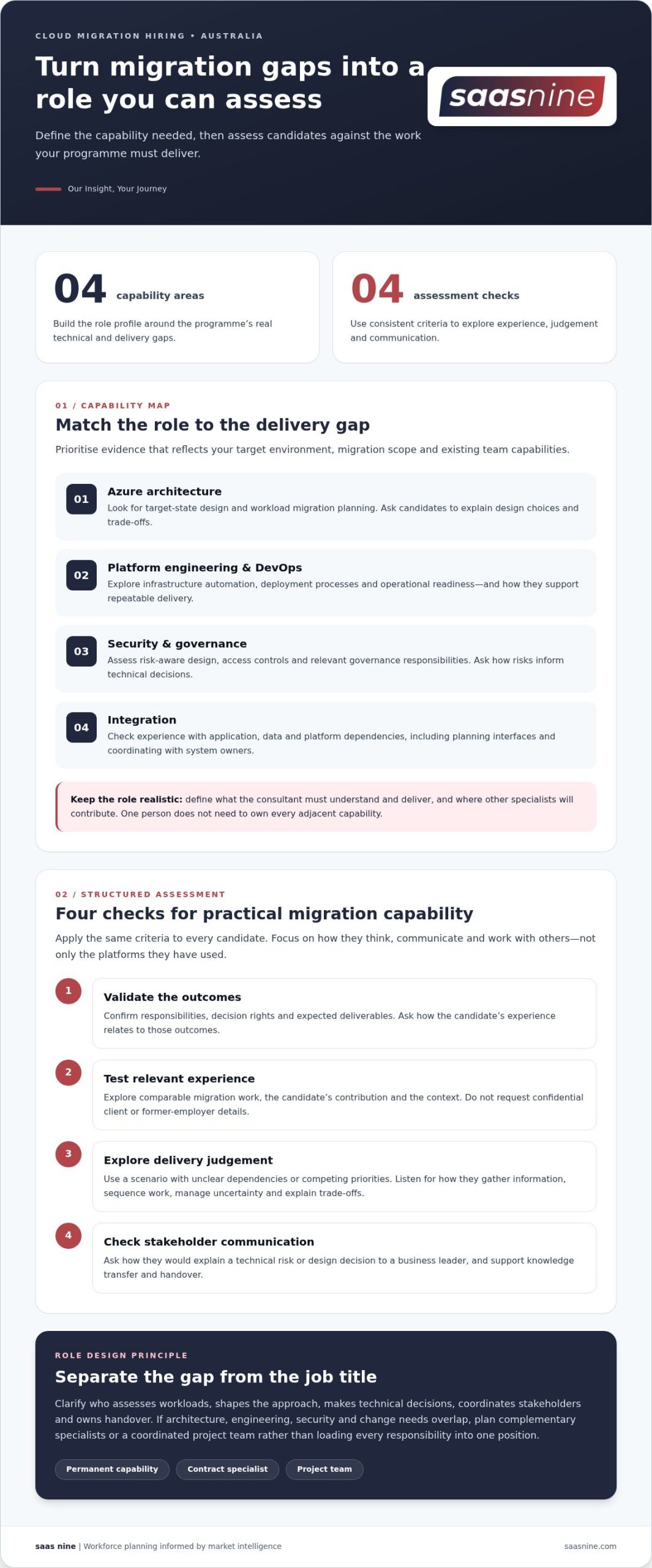
Use this comparison to connect programme needs with practical evidence to assess:
- Azure architecture: Target-state design and workload migration planning. Look for examples of explaining design choices and trade-offs.
- Platform engineering and DevOps: Infrastructure automation, deployment processes and operational readiness. Ask how the candidate has worked with engineering teams to support repeatable delivery.
- Security and governance: Risk-aware design, access controls and governance responsibilities relevant to the programme. Explore how the candidate identifies risks and incorporates them into technical decisions.
- Integration: Dependencies between applications, data and platforms. Ask how the candidate has planned or managed interfaces and coordinated with relevant system owners.
Technical depth matters, but it is not enough on its own. Assess whether the candidate can communicate risk clearly, work within a delivery team and tailor recommendations to business priorities. For roles focused on architecture, see saas nine’s technology talent support.
How should role requirements reflect the wider Microsoft environment?
Map dependencies on data platforms, business applications and existing Microsoft technologies before adding requirements. A migration involving Dynamics 365, for example, may require coordination with application and integration owners. That does not mean one consultant must own every adjacent capability. Define what the role needs to understand, what it must deliver and where other specialists will contribute. saas nine can help translate those gaps into a realistic profile and hiring pathway.
How to assess a cloud migration consultant before hiring
A structured assessment helps distinguish confident interview answers from evidence that matches your programme. Use the same criteria for every candidate and assess how they think, communicate and work with others, not just which platforms they have used.
- Validate the outcomes. Confirm the role’s responsibilities, decision rights and expected deliverables. Ask the candidate to explain how their experience relates to those outcomes.
- Test relevant experience. Explore comparable migration work, the candidate’s contribution and the context. Ask for examples without requesting confidential information about a client or former employer.
- Explore delivery judgement. Present a scenario involving unclear dependencies or competing priorities. Listen for how the candidate would gather information, sequence work, manage uncertainty and explain trade-offs.
- Check stakeholder communication. Ask how the candidate would communicate a technical risk or design decision to a business leader, and how they would support knowledge transfer and handover.
What interview prompts reveal practical migration judgement?
Try: “You discover an application has an undocumented dependency. What would you do before setting its migration sequence?” Follow with: “How would you explain the risk and options to a non-technical stakeholder?” Strong responses make assumptions visible, identify who needs to contribute and outline a considered decision process instead of jumping to a single solution.
Use a consistent scorecard covering role-specific evidence, decision-making, collaboration and knowledge transfer. Assess each area against the same role requirements, and record examples to support your evaluation. This makes strengths and gaps easier to compare across candidates.
How can market intelligence improve the hiring brief?
Compare your requirements with available capability and realistic delivery expectations. Market intelligence can help distinguish essential skills from preferences, or show where a brief combines responsibilities better covered by complementary specialists. saas nine’s Talent Portal supports candidate matching and visibility into specialist capability.
Use those insights to align the assessment with your programme’s actual needs. Discuss your migration hiring needs with saas nine.
Choose a hiring model that supports migration delivery with saas nine
The right hiring model depends on how long the capability is needed, where delivery ownership sits and what outcomes the role must support. A permanent hire may suit an organisation building enduring internal capability, while a contract specialist can address a defined programme requirement. Neither is automatically the better choice. Match the engagement to the work and the skills your team needs to retain.
When is permanent or contract hiring the better fit?
Consider a permanent role when migration expertise will remain important across ongoing platform decisions, operations or future change. A contract specialist may suit a bounded need, such as providing architecture expertise during a specific stage while internal staff retain long-term ownership. Be clear about deliverables, decision rights and handover expectations so the engagement supports continuity rather than creating a capability gap at the end.
One hire will not always cover the programme’s needs. Where architecture, security, engineering or integration work requires different strengths, several specialists or a project team may be a better fit than an overextended position description.
How can workforce planning support migration beyond one hire?
saas nine connects hiring decisions with workforce planning through Contingent Recruitment for permanent and contract roles, Talent Augmentation for individual specialists or project teams, and Strategic Advisory for capability strategy and organisational design. Market intelligence helps align business priorities with realistic role requirements. Longer-term planning can also help identify which capabilities to build internally and which to source for a defined need.
If you’re ready to hire a cloud migration consultant in Australia, saas nine can help you consider the role and engagement model in the context of your wider programme. Explore Microsoft ERP recruitment as part of your workforce planning.
Set your migration programme up for the right hire
A strong hiring decision starts with clear ownership. Define what the consultant must decide and deliver, then match the role profile to your programme’s technical and stakeholder needs. Assess candidates consistently against relevant experience, judgement, collaboration and knowledge transfer. Finally, choose permanent, contract or team-based hiring to suit the capability your organisation needs and how long it is needed.
If you’re looking to hire a cloud migration consultant in Australia, saas nine can connect your programme requirements with pre-qualified and vetted Microsoft professionals. Whether you need a permanent or contract hire, an individual specialist or a project team, the focus is on aligning capability with delivery. Strategic Advisory can also connect workforce planning with technology capability, helping you plan beyond the immediate vacancy.
Start with the outcomes your cloud programme needs to achieve, then shape the role or team around them. Explore saas nine’s Microsoft recruitment capabilities, then discuss your cloud migration hiring needs with saas nine.
Frequently Asked Questions
What does a cloud migration consultant do?
A cloud migration consultant helps an organisation plan or deliver the move of workloads to a cloud environment. Depending on the role, they may assess applications and dependencies, advise on target architecture, sequence migration work, manage technical risks or support hands-on delivery. Agree the scope upfront: an adviser recommending an approach has different responsibilities from a consultant expected to implement it with the delivery team.
How do I hire a cloud migration consultant in Australia?
Start by defining the programme outcomes, workload scope and responsibilities the hire will own. Then set the required technical capabilities, such as Azure architecture, security or integration, and assess candidates against comparable experience, decision-making and communication. To hire a cloud migration consultant in Australia, align the role with available capability and your delivery model. saas nine supports permanent and contract hiring for Microsoft professionals.
Should I hire a cloud migration consultant or a migration team?
Hire an individual consultant when a defined expertise gap can be filled within an established delivery team. Consider several complementary specialists or a project team if the programme needs distinct architecture, engineering, security or integration capabilities and no single role can reasonably cover them. The decision should reflect internal ownership, delivery scope and the capabilities your organisation needs to retain after the migration.
What skills should a cloud migration consultant have?
Prioritise skills that match your environment and migration scope. These may include Azure architecture, platform engineering, DevOps, security and governance, or integration with business applications and data platforms. Technical depth should be matched by sound risk judgement, clear communication with business stakeholders and the ability to collaborate across delivery teams. Ask candidates to explain relevant decisions and trade-offs without disclosing confidential project information.
Is a cloud migration consultant responsible for delivering the whole migration?
Not necessarily. Responsibility depends on the agreed role, team structure and decision rights. A consultant might assess workloads and recommend a migration sequence, while internal leaders approve decisions and engineers carry out implementation. In another engagement, the consultant may lead hands-on delivery for a defined scope. Specify ownership for stakeholder coordination, risk management, knowledge transfer and operational handover so expectations are clear across the programme.