

A generic job title won’t modernise your data platform. In data engineer recruitment australia, the real challenge is defining whether you need someone to shape the platform, build dependable pipelines or strengthen governance, then matching that capability to the work ahead. Position descriptions that combine all three can narrow the field before hiring begins.
That tension is familiar: data modernisation needs clear ownership, while delivery plans often span changing priorities and timelines. The right approach starts with business outcomes, not a list of tools. It also recognises that permanent hires can build enduring capability, while contract professionals can add focused expertise for defined delivery phases.
This article explains how to define realistic data engineering roles, distinguish platform, pipeline and governance skills, and compare permanent and contract hiring against your programme horizon. It also explores how platform choices, workforce planning and market intelligence can align, with saas nine’s recruitment and talent advisory perspective guiding practical decisions.
Key Takeaways
- Translate modernisation goals into clear delivery outcomes before writing a position description.
- Separate platform, pipeline, governance and reporting responsibilities to shape roles around the capability your team needs.
- Use data engineer recruitment australia planning to compare permanent, contract and talent augmentation options against your programme’s horizon.
- Connect role design, market intelligence and workforce planning so each hire supports delivery now and capability development over time.
Why data engineer recruitment in Australia starts with the modernisation outcome
A data engineer vacancy describes a position; a modernisation programme needs specific capability. Data engineers build and maintain reliable data movement and the platform foundations that make information usable. That can mean migrating data, integrating systems, improving data quality and enabling trusted analytics. The discipline also spans designing and operating data systems, as outlined in this Data engineering overview.
Start with the delivery challenge, not a generic list of tools. A programme consolidating data from business applications, for example, may need pipeline development and integration first, with governance and platform ownership becoming more important as the capability matures. Effective data engineer recruitment australia connects the role’s scope to those stages, rather than expecting one hire to own every part of modernisation.
Role scope should follow the delivery outcome, not the generic title.
Which business outcomes should shape the role?
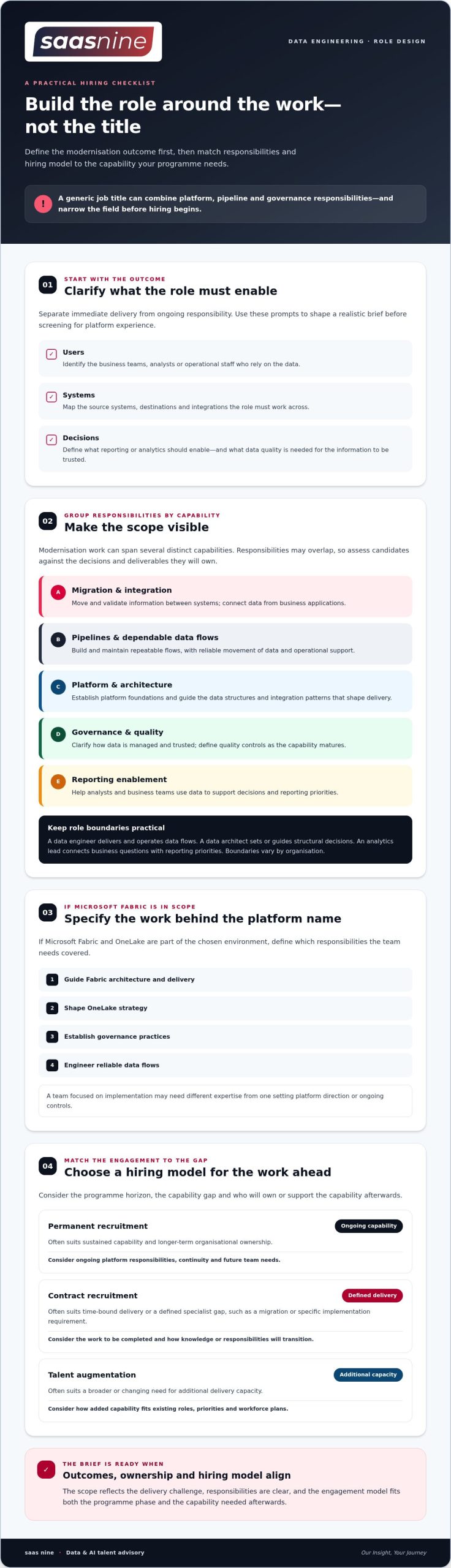
Separate immediate delivery from ongoing responsibility. A migration may require a specialist to move and validate data, while a lasting platform capability needs ownership of dependable pipelines, quality controls and operational support. Clarify who will use the data, which systems supply it, and what decisions the resulting information must support. These answers help distinguish a temporary delivery gap from a continuing team need.
- Users: Identify the business teams, analysts or operational staff who rely on the data.
- Systems: Map the sources, destinations and integrations the role must work across.
- Decisions: Define what reporting or analytics should enable, and what data quality is needed for it to be trusted.
Use those outcomes to shape a realistic brief before screening for platform experience. saas nine’s data and AI recruitment capability connects workforce needs with data engineering, architecture and governance expertise, helping organisations align hiring with the work their modernisation programme must deliver.
What data engineering capability does a modernisation team need?
Capability depends on where the programme needs to make progress. Data migration calls for moving and validating information between systems; pipeline engineering focuses on repeatable, dependable data flows. Platform delivery establishes the foundations those flows rely on, while governance clarifies how data is managed and trusted. Reporting enablement then helps analysts and business teams use it to support decisions.
Titles can help organise a team, but they don’t define universal boundaries. A data engineer may build pipelines and contribute to platform design. A data architect may set data structures and integration patterns, while an analytics lead may translate business questions into reporting priorities and guide analytical work. In practice, responsibilities can overlap, so assess candidates against the decisions and deliverables they’ll own.
Data engineering delivers and operates data flows; data architecture sets or guides the structural decisions that shape them, with responsibilities varying by organisation. For public sector programmes, the Data and Digital Government Strategy offers useful context on connecting data capability with public service outcomes.
How Microsoft Fabric changes the capability conversation
If Microsoft Fabric and OneLake are part of your chosen environment, define the capabilities the team needs in that context. Consider who will guide Fabric architecture and delivery, shape OneLake strategy, establish governance practices and engineer reliable data flows. The balance matters: a team focused on implementation may need different expertise from one setting platform direction or ongoing controls.
Build the brief around these responsibilities, then specify the relevant Microsoft experience. saas nine’s Microsoft Fabric recruitment capability connects platform requirements with data engineering, architecture and governance talent. For data engineer recruitment australia, that capability-led approach helps hiring teams avoid treating a platform name as a complete role definition.
How to choose a data engineer recruitment model for your programme
Match the engagement model to the capability gap and the work ahead. A defined specialist requirement may call for one professional; a broader shortfall in team capacity may need talent augmentation or a workforce plan that combines different skills. For data engineer recruitment australia, consider not only how long delivery is expected to take, but who will own and support the capability afterwards.
| Hiring model | Often suits | Consider |
|---|---|---|
| Permanent recruitment | Sustained capability and longer-term organisational ownership | Ongoing platform responsibilities, continuity and future team needs |
| Contract recruitment | Time-bound delivery or a defined specialist gap | The work to be completed and how knowledge or responsibilities will transition |
| Talent augmentation | A broader or changing need for additional delivery capacity | How the added capability fits with existing roles, priorities and workforce plans |
When is permanent hiring or contract recruitment the better fit?
Permanent hiring can be appropriate when the organisation needs enduring ownership of data platforms, pipelines or governance. Contract professionals can add focused expertise for a defined phase, such as a migration or a specific implementation requirement. Neither model is automatically preferable: the decision depends on whether the gap is temporary, ongoing or part of a wider capability challenge.
Market intelligence can help test whether a proposed role reflects the skills available and the work the organisation actually needs done. Use it to refine essential capabilities, separate must-haves from preferences and avoid combining platform, engineering and governance expectations into one unrealistic brief. For Microsoft Fabric programmes, saas nine’s Microsoft Fabric recruitment capability can inform role design alongside delivery requirements.
Define the outcome, duration, ownership and team context before settling on a model. To align data hiring with your programme’s delivery needs, discuss your data capability requirements with saas nine.
How saas nine connects data engineer recruitment with delivery capability
Recruitment works best when it follows a clear path from business need to delivery. saas nine connects workforce planning with technology capability, helping organisations move through four practical steps:
- Clarify outcomes: Define what the modernisation programme must enable and where the capability gap sits.
- Shape realistic roles: Separate responsibilities that require distinct engineering, architecture or governance expertise.
- Select an engagement model: Match permanent or contract hiring to the duration of the need and the ownership required.
- Align capability to delivery: Consider how each role works with the existing team, platforms and programme priorities.
A hiring brief becomes more useful when it defines the role in the context of delivery, not as an isolated list of skills. This gives hiring teams a clearer basis for assessing relevant experience and helps candidates understand the work, contribution and team environment.
From role definition to a tailored engagement model
A position description can gather too many responsibilities under one title. saas nine helps unbundle those requirements into realistic roles and consider how they fit together as a delivery team. A permanent hire may support sustained capability and organisational ownership; contract recruitment may address a defined project phase or specialist gap. The right model depends on the programme’s needs and longer-term workforce plan.
The Talent Portal supports capability discovery, candidate matching and workforce visibility as part of this process. It complements recruitment expertise by helping connect role requirements with candidate capability, while strategic advice keeps hiring aligned with business priorities. For data engineer recruitment australia, this joined-up approach helps organisations plan beyond a vacancy and build capability around delivery.
To discuss your data capability needs, connect with saas nine about the roles and engagement model that fit your programme.
Build your data capability around the work ahead
Strong data modernisation hiring begins with the capability your organisation needs, not a title that tries to cover every responsibility. Define the delivery outcomes, distinguish immediate specialist gaps from ongoing platform ownership, then choose an engagement model that fits the programme and workforce plan.
A considered approach to data engineer recruitment australia can help connect business priorities with realistic role requirements. saas nine supports Australian organisations with permanent and contract recruitment, alongside Microsoft data expertise spanning Fabric, OneLake, data engineering and governance. This brings hiring decisions into the wider context of technology capability and delivery needs.
Whether you’re planning a defined project or building enduring data capability, a clear brief is a practical first step. Discuss your data engineering capability needs with saas nine and take the next step towards a team aligned with your modernisation goals.
Frequently Asked Questions
What does a data engineer do in a modernisation programme?
A data engineer builds and maintains the systems that move data reliably between sources and make it usable. In a modernisation programme, this may include integrating business systems, migrating and validating data, developing pipelines, and supporting data quality and governance. The role’s emphasis depends on the delivery stage and team structure, so define the expected outcomes and ownership rather than relying on the job title alone.
Should we hire a permanent data engineer or a contractor?
Choose based on whether the need is ongoing or tied to a defined delivery requirement. A permanent data engineer may suit sustained platform ownership and long-term capability building. A contractor can provide specialist expertise for a time-bound project phase or a specific gap. Consider who will maintain the work afterwards and whether the requirement is an individual vacancy or part of a broader workforce need.
How do we write an effective data engineer position description?
Start with the outcomes, then describe the responsibilities and capabilities needed to achieve them. Specify the systems and data flows involved, the expected contribution to migration, engineering or governance, and how the role will work with users and other specialists. Separate essential requirements from preferences. A focused brief helps candidates understand the work and gives hiring teams a practical basis for assessing relevant experience.
Do we need a data engineer with Microsoft Fabric experience?
Require Fabric experience when the organisation’s chosen environment and delivery responsibilities call for it. Clarify whether the role will focus on engineering data flows, Fabric platform delivery, OneLake strategy or governance, and assess experience against those needs. If the programme uses another environment, prioritise the relevant platform skills instead. The strongest brief connects technology experience to the work the person will own.
Can recruitment support wider data workforce planning?
Yes. Data engineer recruitment australia can be part of workforce planning when hiring decisions are connected to programme outcomes, existing team capability and future ownership needs. saas nine supports permanent and contract recruitment alongside strategic advisory, helping organisations consider whether they need an individual specialist, a broader team or a longer-term capability plan. Its Talent Portal also supports capability discovery, candidate matching and workforce visibility.