
What if a hiring delay reflects a mismatch between the role and the work to be done, rather than a shortage of candidates? Hard-to-find Microsoft expertise can slow transformation, while broad position descriptions make it difficult to identify the capabilities a team actually needs. For Australian leaders, Microsoft talent advisory Australia connects hiring decisions with technology strategy and workforce planning.
It’s understandable to start with a vacancy when a project needs people. But hiring is more effective when leaders first clarify the outcomes, skills and team structure required. This guide explains how market insight and thoughtful role design can help define realistic Microsoft roles and capability needs.
You’ll also learn how to choose an engagement model that fits your priorities, from permanent or contract specialists to project teams and strategic advisory. saas nine brings these elements together as a trusted talent advisory partner, helping organisations connect workforce decisions with transformation goals and delivery needs.
Key Takeaways
- Use Microsoft talent advisory Australia to connect workforce planning and hiring choices with transformation priorities, rather than treating each vacancy in isolation.
- Clarify desired business outcomes first, then map the capabilities, roles and team structure needed to deliver them.
- Match the engagement model to the work ahead, whether you need enduring ownership, specialist delivery support or strategic workforce planning.
- See how saas nine brings market insight and AI-driven capability discovery together to support more informed talent decisions.
What Microsoft talent advisory in Australia means for transformation leaders
Microsoft talent advisory Australia connects business priorities, Microsoft capability and workforce decisions so transformation plans reflect the people and roles needed to deliver them. Microsoft talent advisory is the practice of aligning workforce capability and hiring decisions with an organisation’s technology strategy and intended outcomes.
That means looking beyond a vacancy. A position description may not reflect how work is divided across a programme, or which capabilities are needed now versus later. If specialist skills are difficult to secure, leaders can revisit delivery sequencing, clarify ownership or plan for adoption support. saas nine helps organisations shape these decisions through Microsoft talent advisory and recruitment.
How does talent advisory differ from traditional recruitment?
Recruitment focused only on candidate introductions starts with an existing role. Advisory starts by testing the role against the transformation outcome: what must be delivered, which skills are essential, and how the work fits with the existing team. Market intelligence can help set more realistic expectations and reveal when one broad role combines responsibilities that may be better separated.
From there, leaders can weigh permanent hiring for ongoing ownership, contract hiring for defined specialist needs, or a broader delivery-team design. Before deciding, clarify who will own key decisions, how long each capability is required, and where existing team members can contribute. This gives technology and people leaders a practical basis for balancing delivery priorities with workforce needs.
Which Microsoft capabilities can an advisory partner help map?
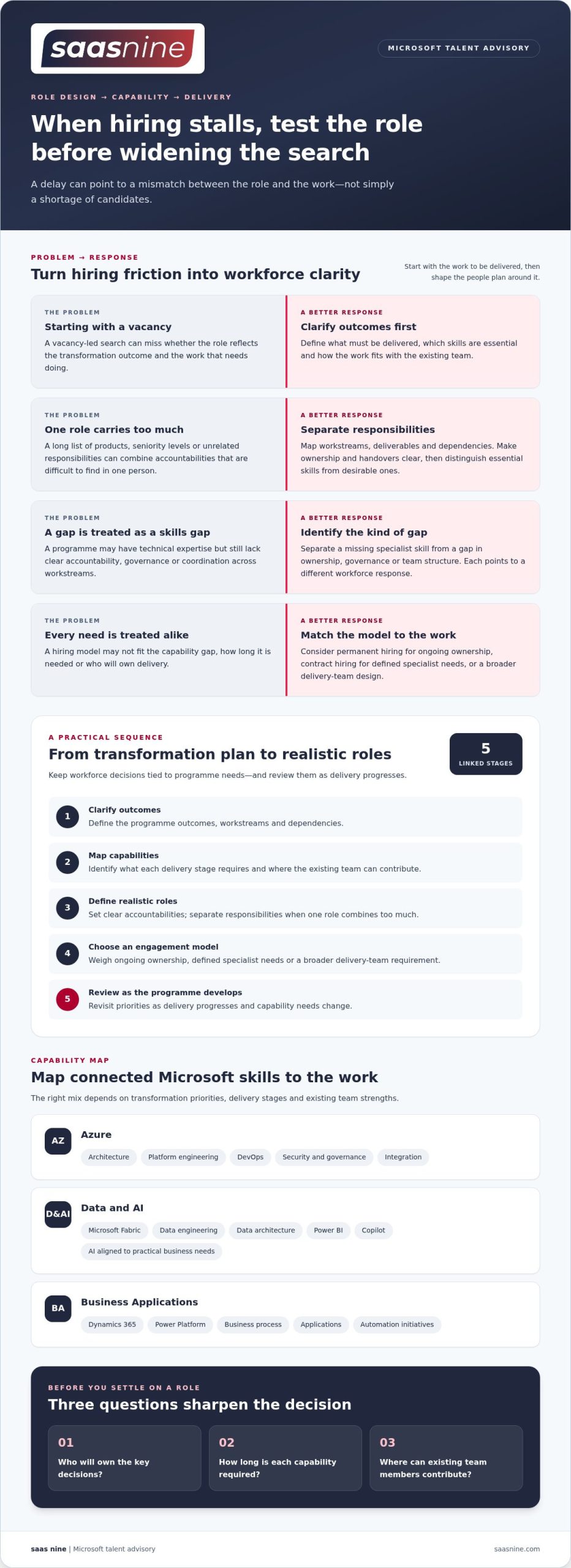
Capability mapping can cover interconnected areas, rather than treating each Microsoft product as a standalone requirement:
- Azure: architecture, platform engineering, DevOps, security and governance, and integration.
- Data and AI: Microsoft Fabric, data engineering and architecture, Power BI, Copilot and AI capability aligned to practical business needs.
- Business Applications: Dynamics 365 and Power Platform skills for business process, application and automation initiatives.
The right mix depends on transformation priorities, delivery stages and existing team strengths. An ERP programme, for example, may need Dynamics 365 functional and technical expertise alongside architecture and programme leadership. A data initiative may call for Fabric architecture, data engineering and governance. Mapping the work first helps define roles that fit the organisation’s actual needs.
How Microsoft talent advisory connects strategy, roles and delivery
Turn a transformation plan into workforce decisions through a clear sequence: clarify outcomes, map capabilities, define roles, choose an engagement model, then review needs as the programme develops. Business outcomes become deliverable when role design and workforce capability are aligned to the work at hand.
Market intelligence helps test whether role expectations reflect the talent market and the actual scope of work. It can also highlight when a long list of requirements combines accountabilities that are difficult to find in one person. In Microsoft talent advisory Australia, this insight helps leaders shape realistic roles and consider permanent hiring, contract specialists or a wider delivery team.
How do you turn a transformation plan into realistic roles?
Start with programme outcomes, workstreams and dependencies. Then identify the Microsoft capabilities each stage requires. For an ERP transformation, list the decisions and deliverables across architecture, engineering, functional design, data and programme leadership. Identify who owns each area and where responsibilities depend on one another. Separating these accountabilities can clarify decision-making and handovers instead of placing every requirement into one broad position description.
Next, distinguish essential skills from desirable ones. A role that combines too many products, seniority levels or unrelated responsibilities can make it harder to assess candidates consistently. saas nine connects role requirements with the capability needed to deliver them, rather than relying on job titles alone.
How should leaders assess capability gaps and delivery priorities?
Separate a missing specialist skill from a gap in ownership, governance or team structure. A programme may have technical expertise but lack clear accountability for design decisions, or it may need stronger coordination across workstreams. Each gap points to a different response, from sourcing an individual specialist to adjusting responsibilities or planning a broader team.
Connect immediate needs to longer-term workforce planning. For each gap, consider its effect on the next delivery milestone, whether the capability is needed throughout the programme, and whether the work can be supported by the current team. Review priorities as delivery progresses, then shape the advisory pathway around the capabilities and accountabilities that remain unresolved. This keeps hiring decisions tied to programme needs without assuming a fixed hiring outcome in advance.
Which Microsoft talent engagement model suits your organisation?
The right model depends on the capability gap, how long it’s needed and who will own delivery. Microsoft talent advisory Australia can help leaders weigh these factors against programme priorities, rather than treating every requirement as a like-for-like vacancy.
| Engagement model | Best suited to | Workforce need |
|---|---|---|
| Permanent hiring | Enduring capability | Ongoing ownership, continuity and accountability within the organisation. |
| Contract hiring | Defined delivery needs | Specialist capacity to address a particular workstream or capability gap. |
| Talent augmentation | Additional delivery capacity | An individual specialist or project team to complement existing teams. |
| Strategic advisory | Workforce planning | Capability strategy, organisational design and advice on how roles support transformation. |
When is permanent or contract hiring the better fit?
Consider permanent hiring where the organisation needs lasting expertise and clear ownership beyond a single programme phase. Contract professionals may suit a defined delivery requirement, such as specialist capacity for a Microsoft implementation. The distinction isn’t simply about employment type: consider whether the capability must remain embedded over time or is tied to a specific need, and whether the organisation has ongoing work and accountability for the role.
When might a specialist or project team be more useful?
Talent augmentation can add an individual specialist or a project team where existing staff need complementary capability to progress delivery. If the challenge is less about filling a skills gap and more about how work is structured, strategic advisory can help leaders consider workforce planning, capability strategy and organisational design. saas nine tailors engagement models to the organisation’s needs, from strategic leadership and project delivery to specialist expertise.
These models can also be combined or adjusted as a programme moves from planning into delivery. A transformation may call for strategic advice first, then specialist mobilisation, with enduring roles identified as long-term ownership becomes clearer.
To consider the approach that fits your programme, discuss your Microsoft workforce priorities.
How saas nine brings Microsoft talent advisory into delivery
saas nine connects business priorities with Microsoft capability and workforce decisions, helping leaders move from transformation goals to practical talent requirements. Market intelligence informs role definition and hiring approaches, while the engagement model can be tailored to the work, whether that calls for permanent capability, contract expertise, an individual specialist or a project team.
The Agentic Workforce Platform supports AI-driven workforce discovery, capability matching and workforce visibility. These insights can help leaders understand where expertise sits and where capability gaps may affect delivery. Used alongside clear role definitions and programme priorities, the platform helps inform talent decisions. The focus stays on applying technology to workforce needs, not treating AI as an end in itself.
What can leaders expect from an advisory conversation?
Bring the outcomes you need to achieve, the capabilities you believe are missing and any delivery constraints shaping the programme. It can also help to outline the work already underway, the decisions that need clear ownership and the capabilities available in your current team. Together, these provide a practical starting point for clarifying roles, accountabilities and the best-fit engagement model. Depending on the need, the pathway may focus on strategic advice, individual expertise or a project team.
That approach reflects saas nine’s partnership principle: “Our Insight, Your Journey”.
Where can organisations explore Microsoft talent capabilities?
Use the Microsoft talent portal to explore talent and capability support across the Microsoft ecosystem. For Data and AI priorities, leaders can consider the specialist capabilities needed to turn business objectives into practical delivery requirements, such as expertise aligned to Microsoft Fabric or AI initiatives.
A useful next step is to outline the business outcome, the work that must be delivered and the capability already available in your team. That makes it easier to identify whether the priority is workforce planning, role definition or talent mobilisation. To explore a tailored approach, talk with saas nine about Microsoft talent advisory.
Put your Microsoft workforce plan into motion
Transformation delivery depends on more than filling vacancies. Start with the outcomes you need, define the capabilities and accountabilities behind them, then choose a workforce model that fits the work. That’s the practical value of Microsoft talent advisory Australia: it connects business strategy with role design and delivery planning.
saas nine brings expertise across Azure, Microsoft Fabric, Copilot, Dynamics 365 and Power Platform, with support spanning strategic advisory, permanent and contract hiring, and talent augmentation. Its Agentic Workforce Platform uses AI-driven capability discovery to support workforce visibility and matching, helping inform talent decisions alongside market intelligence.
Whether you’re shaping a transformation team or addressing a specific capability gap, begin with a clear view of priorities. Discuss your Microsoft talent advisory needs with saas nine and explore an approach aligned with your organisation’s goals. With the right roles and capability in view, your next step can be a more considered one.
Frequently Asked Questions
What does Microsoft talent advisory include?
Microsoft talent advisory Australia connects business priorities with Microsoft capabilities and workforce decisions. It can include workforce planning, capability mapping, role design, market intelligence and advice on how to structure delivery teams. Depending on the organisation’s needs, the resulting approach may involve strategic advice, permanent or contract hiring, or talent augmentation with individual specialists or project teams.
How is Microsoft talent advisory different from recruitment?
Traditional recruitment often starts with a defined vacancy and focuses on finding candidates for that role. Talent advisory can start earlier by examining the business outcome, work required and capabilities a team needs. It can help leaders refine or separate broad role descriptions, consider team structure and select a hiring approach, then support candidate sourcing where hiring is part of the solution.
When should an organisation use contract Microsoft professionals?
Contract Microsoft professionals may suit a defined delivery need, a specialist capability gap or additional capacity for a programme workstream. For example, an organisation may need expertise in Dynamics 365, Microsoft Fabric or Power Platform to support a particular initiative. Leaders can weigh contract support against permanent hiring by considering whether the capability is required for ongoing ownership or a specific delivery need.
Can a talent advisory partner help define Microsoft project roles?
Yes. A talent advisory partner can work from programme outcomes and workstreams to clarify the capabilities and accountabilities required. This can reveal when a broad position description combines distinct responsibilities, such as architecture, functional delivery, data or programme leadership. Separating those needs helps create more realistic roles and a clearer view of how each person contributes to delivery.
How can saas nine support Microsoft workforce planning in Australia?
saas nine supports Australian organisations by connecting workforce planning, Microsoft capability strategy and hiring delivery. Its expertise spans Azure, Microsoft Fabric, Copilot, Dynamics 365 and Power Platform, with support tailored across strategic advisory, permanent and contract hiring, and talent augmentation. The Agentic Workforce Platform uses AI-driven capability discovery and insights to support matching and workforce visibility as leaders plan capability needs.