
What if the right Microsoft specialist for your next project never appears in a conventional CV search? AI Recruitment Australia is moving beyond automated filtering, but finding scarce Azure, Dynamics 365 and emerging AI capability takes more than matching keywords.
Technology and talent leaders face a practical challenge: traditional screening can miss qualified people with non-traditional career paths, while roles such as AI Engineer can be difficult to assess. Used thoughtfully, AI can broaden candidate discovery. Sound hiring still depends on a well-defined role, specialist insight and human judgement.
This guide explains how agentic AI and market intelligence can help Australian organisations uncover niche Microsoft talent, match capability to business priorities and mobilise project teams. It also sets out a practical approach to responsible AI in recruitment, from defining the role and assessing evidence of capability to keeping people accountable for hiring decisions. The aim is not simply to hire faster, but to build the right team for the work ahead.
Key Takeaways
- See how AI Recruitment Australia can move beyond CV filtering to uncover Microsoft capability that keyword searches may miss.
- Use a Microsoft Ecosystem Capability Map to clarify the skills your transformation programme needs before defining roles.
- Choose between permanent and contract hiring based on the capability gap, delivery requirements and expected project horizon.
- Combine AI-enabled discovery with specialist market intelligence and human assessment to support better-informed hiring decisions.
The State of AI Recruitment in Australia for 2026
For Australian organisations modernising ERP, data and customer platforms, recruitment is part of the transformation challenge. Specialists across Azure, Dynamics 365, Microsoft Fabric and Copilot can be difficult to find. Meanwhile, conventional hiring workflows may not translate changing project needs into clear role requirements. This is driving interest in AI Recruitment Australia, particularly where technology can help identify capability beyond familiar job titles and CV keywords.
Hiring technology is shifting from routine automation, such as interview scheduling, towards agentic discovery: using AI to help surface and match skills to business needs. The idea connects with Algorithmic management, where algorithms inform how work and people are organised. In recruitment, the practical opportunity is to support discovery, not hand hiring decisions over to an algorithm.
Bridging the Gap Between Strategy and Workforce
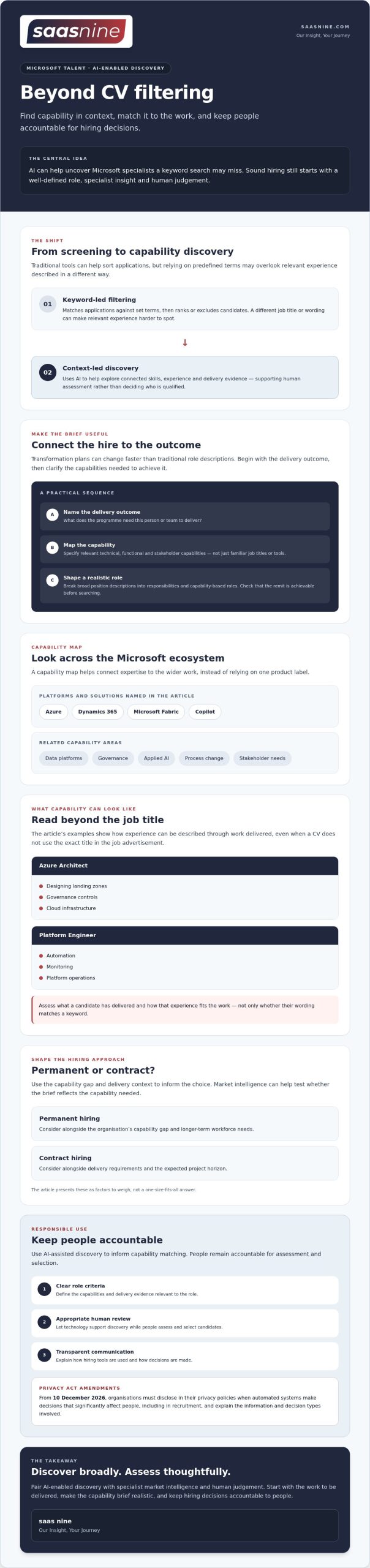
Digital transformation plans can evolve faster than traditional role descriptions and approval workflows. A position description focused on a narrow list of tools may miss transferable experience or the mix of functional and technical skills a programme needs. Start by linking each hire to a delivery outcome, then specify the capabilities needed to achieve it. For example, an ERP modernisation may require people who can connect platform knowledge with process change and stakeholder needs.
An Intelligent Enterprise in 2026 is an organisation that connects data, technology, people and decision-making to adapt and deliver business outcomes. saas nine’s Microsoft Ecosystem Capability Map can help leaders define needs across areas such as Microsoft data and AI recruitment.
Regulatory Context and Ethical AI
Australia has no single statute dedicated to AI in the workplace; existing privacy, workplace and anti-discrimination frameworks remain relevant. From 10 December 2026, Privacy Act amendments require organisations to disclose in their privacy policies when automated systems make decisions that significantly affect people, including in recruitment, and to explain the information and decision types involved. This makes it timely to review how hiring tools are used and explained.
For saas nine and its clients, responsible adoption means using AI-assisted discovery to inform capability matching while keeping people accountable for assessment and selection. Clear role criteria, appropriate human review and transparent communication help ensure technology supports considered hiring decisions.
Moving Beyond Filtering: The Agentic Workforce Model
Traditional recruitment AI often acts as a gatekeeper. It filters applications against predefined terms, then ranks or excludes candidates. That can make a search more efficient, but it may also overlook people whose relevant experience is described differently. saas nine’s Agentic Workforce Model takes a discovery-led approach, using AI to help explore capability in context. The goal is to support informed human assessment, not let an automated score decide who is qualified.
Capability Discovery vs. Resume Scanning
Consider an Azure Architect whose CV describes designing landing zones, governance controls and cloud infrastructure, but doesn’t use the exact title in a job advertisement. Technical stack mapping can help surface those connected skills. It can also reveal a Platform Engineer’s experience across automation, monitoring and platform operations, even when their previous role had a different title. This shifts assessment from ticking off keywords to examining what a candidate has delivered and how that experience fits the work.
saas nine’s Agentic Workforce Platform supports capability discovery, while its talent portal gives employers access to searchable talent and candidate expertise. To make sourcing more effective, break broad position descriptions into realistic responsibilities and capability-based roles. If one role is expected to cover data architecture, engineering and AI delivery, clarify whether that is a realistic remit before the search begins.
Reducing Hiring Risk for Niche Roles
For hard-to-find Microsoft roles, a capability map connects required expertise to the wider ecosystem instead of relying on a single product label. This is especially useful in Data & AI recruitment, where requirements may span data platforms, governance and applied AI. Market intelligence adds context for senior technology leaders: it can help test whether a brief reflects the capability needed, where skills overlap and whether a permanent or contract hire fits the delivery requirement.
Responsible discovery also needs clear oversight. The ANAO report on AI governance offers a public-sector example of examining AI implementation and risk management. Use that lens to ask how tools inform sourcing, what criteria guide matching and where people review the results. Aligning the role brief with delivery priorities is a useful first step with a specialist recruitment partner such as saas nine.
Strategic Implementation: Sourcing Microsoft Talent
Effective AI Recruitment Australia starts with a defined capability gap, not a broad request for “Microsoft experience”. Use a Microsoft Ecosystem Capability Map to connect business priorities with the skills needed for delivery, then choose a hiring model that fits the work. Permanent recruitment may suit an ongoing capability need; contract hiring can address a defined project requirement. These are distinct workforce choices, so consider the duration and continuity of the work before deciding.
- Map the gap: identify the outcomes, platform knowledge and delivery responsibilities the team needs.
- Choose the model: weigh the duration and continuity of the work when considering permanent or contract hiring.
- Improve visibility: use AI-powered recruitment tools to support candidate matching and workflow visibility, with people reviewing suitability.
- Plan for the future: align each hire with workforce planning and organisational design, rather than treating recruitment as a standalone transaction.
Specialised Sourcing for Modern Platforms
Start with the work the platform must enable. A Microsoft Fabric recruitment strategy should clarify the data capabilities required and how they support organisational objectives. Dynamics 365 and Power Platform roles also need relevant domain understanding. Match implementation experience to the business processes involved, whether finance, supply chain or customer engagement. Familiarity with a tool alone doesn’t establish that fit.
Executive Search in an AI-Driven Market
Senior appointments shape the direction, governance and delivery of transformation. For CIO and CTO searches, market mapping can help identify relevant leadership experience and engage potential candidates directly, including people who aren’t actively applying. saas nine combines this market intelligence with executive search and strategic advisory, helping organisations assess how leadership capability fits their technology roadmap and future structure.
For a more joined-up workforce plan, explore saas nine’s strategic advisory and recruitment services. Consider how role design, hiring model and delivery priorities can work together.
Partnering for the Future: saas nine and Your Journey
Legacy modernisation is a workforce challenge as much as a technology programme. Organisations need to align platform decisions with the people and leadership capability required to deliver change. As a specialist recruitment partner and talent advisory, saas nine connects workforce planning, Microsoft expertise and business priorities, helping leaders make considered decisions as requirements evolve. In AI Recruitment Australia, the aim is not simply to introduce new tools, but to build a workforce approach that supports delivery and responsible adoption.
Our Insight, Your Journey reflects a partnership focused on practical advice and long-term capability, not just filling an immediate vacancy.
The saas nine Advantage
saas nine combines specialist Microsoft ecosystem knowledge with an Agentic Workforce Platform for capability discovery. This supports access to pre-qualified and vetted Microsoft professionals, while helping organisations consider permanent and contract hiring against delivery needs. For a project modernising Dynamics 365 or strengthening data capability, first identify the outcomes, skills and responsibilities the team needs. Then assess which roles should build long-term capability and which are tied to a specific programme.
For a practical workforce-planning resource, explore the saas nine talent portal, which provides a searchable view of talent and candidate expertise.
Next Steps for Australian Leaders
Start with a clear view of the transformation ahead. Map the capabilities already in your organisation, identify gaps against your roadmap and check whether current position descriptions reflect realistic responsibilities. Then consider how workforce planning and organisational design can support delivery beyond the next hire. saas nine’s strategic advisory can help executive stakeholders connect these decisions with technology and business priorities.
To begin, bring your roadmap, current team structure and priority capability gaps into a discussion with saas nine. A focused review can help clarify where specialist Microsoft sourcing, executive search or broader workforce planning may be relevant, and establish a practical path forward.
Build the Microsoft capability your next phase needs
AI Recruitment Australia works best when it helps organisations discover relevant capability rather than simply filter applications. Clear role design and specialist market intelligence can help leaders match Microsoft talent to business priorities, while human judgement remains central to hiring decisions.
For transformation leaders, a practical starting point is to map the capability gaps behind the roadmap, then decide which roles need to be permanent and which relate to a specific delivery need. saas nine brings together Microsoft Ecosystem Capability Mapping, an Agentic Workforce Platform for capability discovery, and strategic workforce advice to support that planning.
Our Insight, Your Journey reflects a partnership focused on helping organisations make thoughtful hiring and workforce decisions as their needs evolve. If you’re planning a Microsoft transformation or reviewing the skills your team will need, talk with saas nine about your workforce planning priorities. A clear view of the capability required is a strong first step towards building a team ready for what comes next.
Frequently Asked Questions
How does AI recruitment improve the quality of Microsoft specialist hires?
AI can broaden discovery beyond exact CV titles and keyword matches. A capability-based search can connect evidence such as Azure architecture, platform engineering or Fabric delivery to the outcomes a role requires. Recruiters can then assess relevant transferable experience, while structured interviews and human judgement help verify depth, context and fit. This supports better-informed choices, not an automatic guarantee of performance.
Is AI recruitment legal and ethical under Australian privacy laws?
AI recruitment isn’t subject to one dedicated Australian workplace AI law, but existing privacy, workplace and anti-discrimination laws still apply. From 10 December 2026, Privacy Act amendments require organisations to disclose in their privacy policies when automated systems make decisions that significantly affect people, including recruitment decisions. Organisations should explain the types of personal information used and decisions made, and ensure people oversee hiring outcomes.
What is the difference between an AI gatekeeper and saas nine’s Agentic Workforce Model?
An AI gatekeeper filters or ranks candidates against set criteria, which can screen out relevant experience expressed in unexpected ways. saas nine’s Agentic Workforce Model uses AI-driven capability discovery and workforce insights to help identify skills in context and match them to business needs. The platform supports sourcing and mobilisation; it doesn’t replace human assessment or make the final hiring decision.
How can AI help Australian companies address the Microsoft talent shortage?
AI can broaden the search for Microsoft professionals by mapping related capabilities across platforms, roles and delivery experience. For example, a search can look beyond a specific job title to identify relevant experience across data engineering, governance and analytics. Combined with market intelligence, this can help employers refine role requirements, consider transferable skills and choose between permanent or contract hiring to suit delivery needs.
Will AI recruitment replace the need for human executive search consultants?
No. AI can support market mapping and help surface potential candidates, but executive search still relies on human judgement to understand leadership context, assess motivation and build trusted conversations. For CIO and CTO appointments, fit involves more than matching a profile to a list of skills. Specialist search consultants can connect organisational priorities with leadership capability and guide a considered selection process.