

The hardest part of an executive hire may not be finding a leader. It may be defining what the business needs them to achieve. Executive Search & Headhunting is most useful when a senior or niche Microsoft professional is unlikely to be actively applying. But a search can lose direction if the role combines distinct capabilities or lacks clear outcomes.
For Australian organisations, a poor appointment can disrupt transformation priorities and delivery. A well-defined brief connects leadership capability to business results. This article explains when executive search makes sense and how to assess a search partner’s ability to identify and evaluate suitable candidates. You’ll learn how to shape a realistic leadership brief, assess strategic, commercial and technical fit, and choose an engagement approach suited to the role. You’ll also see how market intelligence and role definition can help distinguish between one executive appointment and a broader capability need, so your next step is grounded in the outcomes the business needs.
Key Takeaways
- Use Executive Search & Headhunting when leadership capability is hard to find through applicants alone and direct engagement is needed.
- Define the outcomes and capabilities the role must deliver before mapping the market. Use market intelligence to test assumptions about candidate availability.
- Compare search partners by how they clarify the brief, approach candidates, assess leadership fit and communicate market insights.
- Consider whether the need is for one executive or a broader capability structure, then align the hiring approach with transformation priorities.
What executive search and headhunting mean for Australian technology hiring
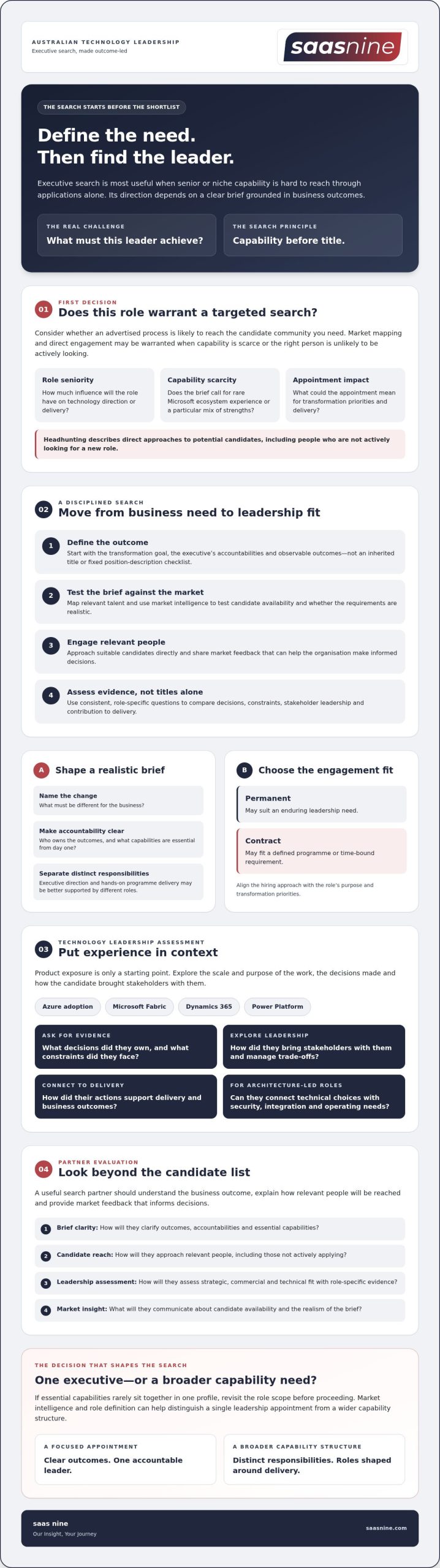
Executive search is a targeted approach to identifying and engaging senior professionals, particularly when the right capability is scarce or unlikely to surface through applications alone. Executive search is often used as a broad term for this focused process. Headhunting describes a key part of it: approaching potential candidates directly, including people who aren’t actively looking for a new role.
Unlike a general advertised process, a strategic search starts by defining the business need. The search partner then maps relevant talent and assesses candidates against the outcomes required. Not every senior vacancy needs this approach. Role seniority, capability scarcity and the consequences of getting the appointment wrong all help determine whether market mapping and direct engagement are warranted.
When does a technology leadership role warrant executive search?
Consider the scope and influence of the role. A CIO or CTO may shape technology direction. A Head of Data & AI may need to connect data capability with practical business value. Programme leadership may be central to a major ERP transformation. Ask whether an advertised process is likely to reach the candidate community you need. If the brief calls for rare Microsoft ecosystem experience or a particular blend of commercial, technical and leadership capability, market mapping can help test where that talent sits and how to approach it.
Why define the capability before searching for a title?
Titles can obscure the actual requirement. Start by separating essential business outcomes from inherited or inflated position-description criteria. Then identify the capabilities needed to deliver those outcomes. If one brief combines executive direction with hands-on programme delivery, those may be distinct responsibilities better supported by different roles. saas nine’s workforce planning and capability strategy services can help organisations examine the structure before hiring. A useful starting point is to write down what must change, who will be accountable for it, and which capabilities are essential from day one.
How executive search maps the market and assesses leadership fit
A disciplined search moves from an agreed brief to market mapping, direct candidate engagement and structured assessment. Each stage should inform the next, rather than treating a position description as a fixed checklist.
Market mapping is the process of identifying relevant talent across the market and examining how candidates’ capabilities align with the role. It can test assumptions about candidate availability and whether the brief’s requirements are realistic. If the search reveals that essential capabilities rarely sit together in one profile, the organisation can reconsider the scope before proceeding.
From business outcomes to a search brief
Start with the transformation goal, then define the executive’s accountabilities and observable outcomes. For example, a brief for a data leader should clarify whether success means setting data strategy, establishing governance or enabling teams to use insights in decisions. Separate essential leadership capability from specialist skills that can sit elsewhere in the team. A permanent appointment may suit an enduring leadership need. Contract hiring may fit a defined programme or time-bound requirement.
Assessing Microsoft ecosystem leadership capability
Technology experience needs context. If a candidate has guided Azure adoption, Microsoft Fabric capability, Dynamics 365 implementation or Power Platform governance, assess the scale and purpose of that work, not just their exposure to a product. Explore the decisions they made, how they brought stakeholders with them, what trade-offs they managed and how they guided delivery. For an architecture-led role, check whether the candidate can connect technical decisions with security, integration, operating needs and business outcomes.
Use consistent, evidence-based questions to compare candidates. What decisions did they own? What constraints did they face? How did their actions support delivery? saas nine combines role-specific assessment with market intelligence, helping organisations refine the brief as the search progresses. This makes Executive Search & Headhunting a considered path from business need to leadership fit, rather than a shortlist built on titles alone.
How to evaluate an executive search partner before you engage
A useful partner should do more than present candidates. They should understand the business outcome behind the appointment, explain how they’ll reach relevant people and share market feedback that helps you make informed decisions. Before engaging a partner, compare their approach across four areas:
- Expertise: Can they demonstrate an understanding of the relevant technology and leadership context?
- Role understanding: Can they turn business priorities into clear accountabilities and distinguish essential capability from desirable extras?
- Search process: Can they explain how they’ll map the market, engage candidates and assess fit?
- Communication: Will they agree how progress, feedback and changes to the brief will be discussed?
Also ask how they connect strategy, technology capability and team design. A leadership gap may not be solved by one appointment if the role combines executive direction with specialist delivery responsibilities.
Questions to ask about the search process
Ask how candidates are identified beyond those applying for advertised roles, what market intelligence informs the search, and how findings will be shared. Agree who will communicate with candidates, what information they’ll receive about the opportunity, and how your organisation will provide feedback. Clarify how often you’ll review progress and how the partner will raise concerns if search evidence challenges the original brief.
Signs the brief or search approach needs refinement
Revisit a brief that bundles unrelated accountabilities or expects one person to bring an unusually broad mix of expertise. If market feedback suggests the required capabilities are rarely found together, discuss whether to adjust the criteria, reshape the role or build capability elsewhere in the team. A partner should make those trade-offs visible and explain the options, rather than simply repeat the initial requirements.
Use these questions to assess whether an Executive Search & Headhunting partner offers a considered process and practical advice. To explore your requirements, discuss your executive search requirements with saas nine.
How saas nine connects executive search with transformation capability
A leadership appointment is more likely to support transformation when the search starts with the organisation’s priorities, not just a title. saas nine connects business strategy, technology capability and workforce needs before sourcing. This helps clarify whether the gap calls for an executive leader, specialist expertise or a broader team structure.
Its Executive Search & Headhunting work sits alongside Strategic Advisory, including workforce planning, capability strategy and organisational design. This brings the brief into the context of delivery requirements: what needs to change, which capabilities must lead that change, and where responsibilities should sit across the team. Relevant leadership and Microsoft ecosystem capabilities span Cloud, Data, AI and Business Applications.
Choose an engagement model around the capability gap
A permanent appointment may suit an ongoing leadership need, while a contract specialist may be appropriate for a defined programme or time-bound capability gap. If a brief combines strategic leadership with several distinct delivery responsibilities, workforce planning and organisational design can help assess whether a wider team is more realistic than one all-encompassing role. Explore saas nine’s Strategic Advisory and recruitment services for further detail. The Agentic Workforce Platform combines specialist recruitment expertise with AI-driven workforce discovery to support capability matching, workforce visibility and workforce-planning intelligence.
Prepare for a focused executive search conversation
Before discussing a search, outline the business outcome, role scope and capabilities that are essential from day one. Include the relevant Microsoft platforms and transformation context, such as whether the priority is ERP change, data capability or responsible AI adoption. This gives the discussion a practical starting point and helps distinguish core requirements from skills that could sit elsewhere in the team.
Our Insight, Your Journey. To discuss your requirements with saas nine, contact saas nine.
Turn your technology leadership need into a clear search
A senior appointment starts with a clear view of the capability the business needs, not simply a title or an inherited position description. Match the search approach to the role’s seniority, scarcity and impact, then assess candidates against the outcomes they’ll need to deliver in your organisation’s technology environment.
Executive Search & Headhunting can help reach senior technology leaders and niche Microsoft specialists through market mapping and direct engagement. Use intelligence gathered during the search to test assumptions about the brief and refine the capability sought. Where the gap extends beyond one appointment, Strategic Advisory can support workforce planning, capability strategy and organisational design.
saas nine brings these considerations together through recruitment and talent advisory services. Before a discussion, outline the business outcome, role scope and essential capabilities. Discuss your executive search requirements with saas nine and take a considered next step. Our Insight, Your Journey.
Frequently Asked Questions
What is executive search?
Executive search is a targeted way to identify and engage candidates for senior, specialist or hard-to-fill roles. Rather than relying only on applications, the process can include defining the role, mapping relevant talent and approaching potential candidates directly. For technology leadership, a clear brief connects business priorities with the capabilities required, such as leading an ERP transformation or shaping data and AI direction.
When should a business use a headhunter?
Consider headhunting when a role is senior, strategically important or calls for specialist capability that may be difficult to reach through applications alone. First define the outcomes, accountabilities and essential skills. If the organisation can’t describe what success looks like, refine the brief before starting a search. Direct outreach can help reach potential candidates, but it can’t make an unclear role compelling or assessable.
How does executive search work for technology leaders?
Executive Search & Headhunting typically starts by aligning on business priorities and defining the role. The search partner then maps relevant talent, engages potential candidates and assesses their experience against agreed requirements. For a Microsoft-focused appointment, clarify which platforms and leadership context matter. Agree how candidate progress, market feedback and any changes to the brief will be communicated, so decisions stay grounded in the role’s actual needs.
How do you choose an executive search partner?
Choose a partner that understands the business context, explains its market-mapping approach and asks precise questions about outcomes and capability. Discuss how they’ll identify and engage candidates, share market intelligence and communicate progress. For a technology appointment, check that they can connect leadership requirements with the relevant Microsoft ecosystem and delivery environment. A strong partner should also be able to discuss whether the brief needs refinement as market insights emerge.