
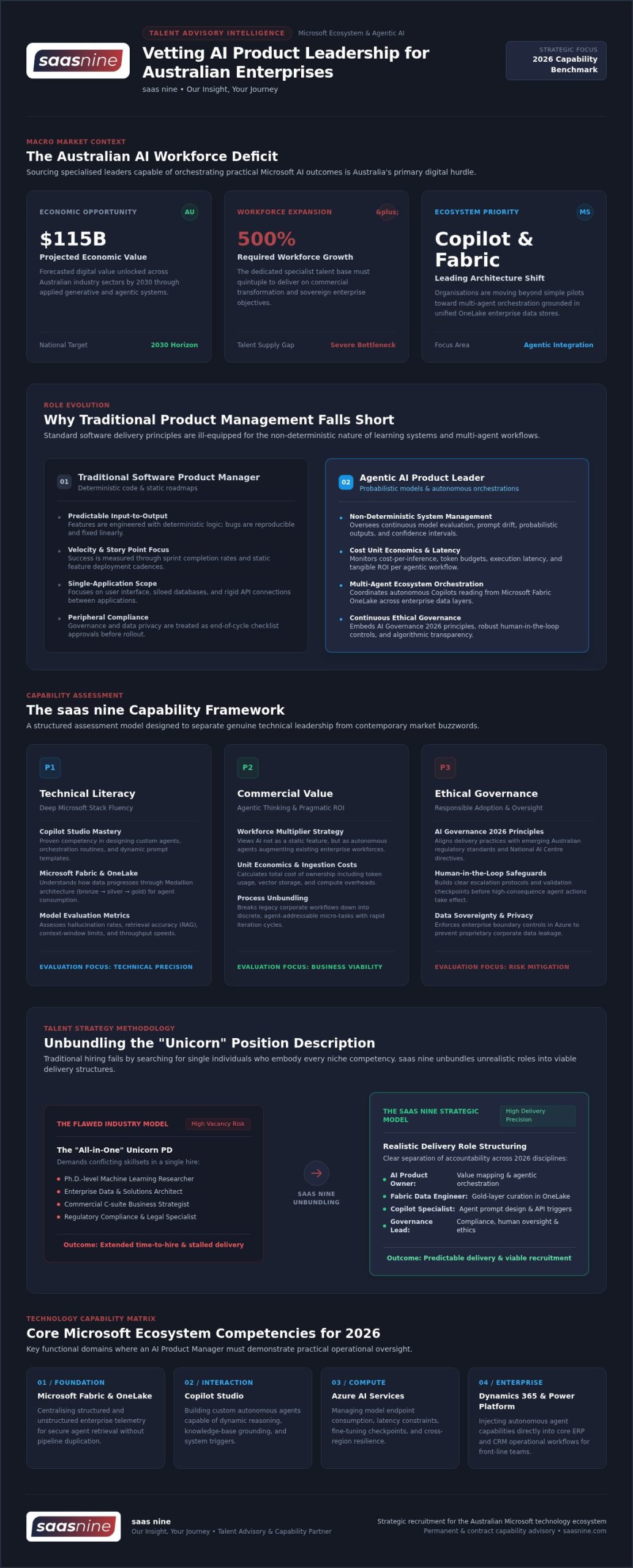
Did you know that while AI is projected to deliver $115 billion in economic value to Australia by 2030, the dedicated workforce must expand by 500% to meet that demand? This massive shortfall makes AI product manager recruitment one of the most significant hurdles for local enterprises. You’ve likely noticed that traditional hiring models are failing to keep pace with the 2026 market. It’s difficult to distinguish genuine technical capability from the surrounding hype, especially when seeking specialists who can orchestrate outcomes within the Microsoft ecosystem.
At saas nine, we understand that securing the right talent requires a move away from legacy methods. We’ll show you how to identify, vet, and secure specialised AI Product Managers who bridge the gap between Microsoft technology and real business value. You’ll discover a clear framework for vetting AI Product Owners and learn how a strategic talent partner ensures the successful delivery of your AI initiatives. Our insight, your journey starts with defining the right roles for your specific transformation path.
Key Takeaways
- Understand the critical shift from traditional software management to Agentic AI orchestration within the 2026 Microsoft ecosystem.
- Utilise the Microsoft Ecosystem Capability Map to refine your AI product manager recruitment and vet candidates for genuine technical literacy and ethical governance.
- Learn the strategic value of unbundling complex “unicorn” job descriptions into realistic, specialised roles that drive practical business outcomes.
- Leverage the saas nine Agentic Workforce Platform to automate capability matching and improve the precision of your talent discovery journey.
The Evolution of AI Product Manager Recruitment in Australia
Australian enterprises have moved past simple generative pilots. By 2026, the demand for specialists who can bridge the gap between Microsoft technology and business value has reached a fever pitch. Traditional AI product manager recruitment often fails because it looks for generalists rather than experts who understand non-deterministic software. In the current market, an AI Product Owner must navigate the complexities of Microsoft Fabric and Copilot Studio to drive measurable outcomes. This scarcity of specialised capability is the primary bottleneck for digital transformation in Australia.
Why Traditional Product Management Isn’t Enough
While the foundations of product management remain relevant, the standard software development lifecycle isn’t designed for the iterative, data-heavy nature of AI. Australian organisations are transitioning toward the Intelligent Enterprise model, where products aren’t just code but evolving learning systems. This requires a shift from managing static features to managing model performance, latency, and cost unit economics. Responsible AI adoption is no longer an optional extra; it’s a core competency for modern leaders who must ensure transparency and human oversight in every deployment.
The Rise of Agentic AI Roles
We’re seeing a significant rise in roles focused on Agentic AI orchestration. These specialists manage multi-agent workflows within the Microsoft ecosystem, ensuring that custom Copilots interact seamlessly with operational data in OneLake. Because these systems operate with a degree of autonomy, AI product manager recruitment must prioritise candidates who understand the AI Governance 2026 guide principles. At saas nine, we help you identify these niche specialists who can turn Microsoft AI Copilot capabilities into sustainable competitive advantages. Our insight, your journey begins with finding leaders who can manage complexity with calm assurance.
Vetting for Excellence: Capability Framework for AI Leaders
Successful AI product manager recruitment requires a shift from evaluating general project management skills to verifying deep competency within the Microsoft stack. At saas nine, we utilise our Microsoft Ecosystem Capability Map to assess candidates across three critical pillars: Technical Literacy, Business Value, and Ethical Governance. Capability is everything. Our specialised map provides a steady hand, guiding you through the intricacies of modern talent acquisition. This framework ensures that your leadership talent understands how to leverage Microsoft Fabric and Azure AI Services to drive production-ready outcomes. In a Medallion Architecture context, the AI Product Owner ensures that data transitions from silver to gold layers are specifically curated for high-value agentic consumption.
Technical Vetting: Beyond the Buzzwords
Testing for expertise in Copilot Studio and Agent Design is essential to avoid the “hype” often found in current CVs. We look for the ability to unbundle complex enterprise requirements into achievable AI sprints, a method similar to our vetting cloud architects process. It’s a precise science. We probe for specific experience in model evaluation and prompt engineering to ensure candidates can lead technical teams effectively. This technical depth is vital for aligning with the National AI Centre’s workforce initiatives, which focus on building domestic capability for safe, reliable adoption across Australian industries.
Assessing Strategic Alignment
Strategic leaders must possess “Agentic Thinking,” viewing AI not just as a tool but as a workforce multiplier. They should understand how workforce planning and organisational design change when multi-agent orchestrations are introduced into business workflows. This involves mapping how AI agents interact with human teams to improve productivity and value. If you need assistance defining these complex requirements before you hire, you can reach out for a strategic advisory session. Precision drives successful delivery. Our insight, your journey is built on ensuring that technology capability directly supports your broader commercial strategy.
Structuring Your AI Delivery Team for Success
Building a high-performing AI team isn’t just about filling seats; it’s about defining the specific capabilities required for your unique journey. At saas nine, we help you define the right roles before the search even begins. This strategic approach prevents the common pitfall of hiring based on a reactive job description. We focus on unbundling position descriptions into realistic, specialised roles that drive actual delivery. Our approach to AI product manager recruitment involves balancing permanent hires with targeted talent augmentation to maintain momentum during complex project-based transformations without overextending your long-term headcount.
Unbundling the “Unicorn” Job Description
Searching for a single candidate who can master every technical and commercial domain often leads to total recruitment failure. Effective AI product manager recruitment focuses on finding leaders who excel at orchestrating specialists rather than trying to be one. This Harvard Business Review analysis on product leadership highlights how distinct skill sets are required for successful data-driven delivery. We recommend breaking down requirements into dedicated AI Engineers, Architects, and AI Product Owners. This ensures that technical depth and strategic oversight coexist without one compromising the other.
Integrating AI Product Managers into Legacy Structures
Modernising legacy platforms while adopting AI responsibly requires a delicate touch and clear communication. The AI Product Manager acts as the strategic fulcrum, bridging the gap between the CIO’s high-level vision and the technical delivery team’s daily execution. They translate business value into technical requirements that align with your existing Microsoft stack. For deeper insights on organisational design, refer to our guide on Technology Workforce Planning Australia. This approach ensures your team structure evolves alongside your technology stack. If you’re ready to design your future workforce, you can book a team structure consultation with our advisory team.
Partnering with saas nine: Our Insight, Your Journey
Choosing a partner for AI product manager recruitment requires more than a transactional search. At saas nine, we act as a strategic talent advisory, bridging the gap between your commercial objectives and the technical intricacies of the Microsoft stack. We’ve moved beyond traditional models by investing in our proprietary Agentic Workforce Platform. This system serves as the future of talent discovery, using AI-driven capability matching to reduce hiring risk. It ensures that the leaders we place don’t just fill a role but actively drive your transformation toward becoming an Intelligent Enterprise.
Leveraging the Talent Portal for Faster Mobilisation
Our commitment to precision is physically manifested in the saas nine talent portal. This platform automates complex workflows for Australian leaders, allowing for the rapid identification of pre-qualified and vetted Microsoft professionals. We don’t just match keywords; we match deep technical capability and strategic mindset. By using real-time market intelligence, we improve mobilisation speed, ensuring your AI initiatives aren’t stalled by the 2026 talent shortage. It’s a structured approach that provides visibility and engagement for both clients and candidates throughout the hiring journey.
Bespoke Engagement Models
Every organisation is at a different maturity stage. Whether you’re in the initial phase of exploration or scaling complex multi-agent orchestrations, we tailor our engagement to suit your specific needs. Our delivery includes both executive search and strategic advisory, providing a holistic view of your workforce planning. For those requiring specific expertise in the latest orchestration tools, our Microsoft AI Copilot Recruitment Australia services connect you with specialists who understand the deep technical layers of Copilot Studio. We help you navigate AI product manager recruitment with calm assurance, ensuring your team is structured for long-term success. Our insight, your journey is about more than just a placement; it’s about a shared commitment to your delivery capability.
Securing Your Leadership in the Intelligent Enterprise
Success in the 2026 market depends on your ability to move beyond generic hiring and embrace specialised capability. We’ve explored how unbundling the “unicorn” job description and utilising a rigorous Microsoft-centric vetting framework can transform your delivery outcomes. By focusing on technical literacy and ethical governance, you ensure your AI initiatives transition from mere experiments to production-ready assets. Effective AI product manager recruitment is no longer just a talent search; it’s a strategic investment in your organisation’s future.
As your trusted talent advisory partner, saas nine provides the strategic advisory and deep Microsoft ecosystem expertise required to navigate this shift. Our proprietary Agentic Workforce Platform automates discovery, ensuring you connect with pre-vetted leaders who understand the nuances of Microsoft Fabric and Copilot Studio. Let us help you bridge the gap between strategy and workforce capability. Our insight, your journey starts with a team structured for precision.
Discover how saas nine can help you secure specialised AI talent on our Talent Portal. Your path to a successful AI transformation is a shared journey; we’re here to guide you every step of the way.
Frequently Asked Questions
What is the average salary for an AI Product Manager in Australia in 2026?
Senior AI PMs earn between $170,000 and $200,000 plus base per annum. Mid level roles typically sit between $130,000 and $150,000, while Lead or Principal positions can reach $250,000 or more. These figures exclude the statutory 12.0% superannuation guarantee. Contractor day rates generally range from $1,100 to $1,500 for senior experts. These rates reflect the severe talent shortage currently impacting AI product manager recruitment across the country.
How does an AI Product Manager differ from a traditional Technical Product Manager?
Traditional PMs manage deterministic software with fixed outputs, while AI PMs oversee non-deterministic systems. They must understand model evaluation, latency and cost unit economics, and multi-agent orchestration. A key differentiator is the focus on data as the primary product driver. AI leaders manage the lifecycle of learning systems, requiring a deep understanding of model benchmarks and the ethical governance frameworks necessary for responsible enterprise adoption.
Why is Microsoft ecosystem expertise critical for AI PMs in Australian enterprises?
Most Australian organisations standardise on Microsoft platforms like Dynamics 365, Power Platform, and Microsoft Fabric. An AI PM must bridge business processes with modern agentic architectures like Copilot Studio and Azure AI Services. Without deep stack knowledge, they can’t effectively align operational data from OneLake with live business workflows. This technical literacy ensures that AI initiatives deliver actual business value within the existing enterprise architecture.
Can saas nine help with both contract and permanent AI recruitment?
Yes, saas nine supports both permanent and contract hiring through our flexible delivery models. We provide contingent recruitment for rapid access to specialists and executive search for senior leadership roles. Our talent augmentation service also allows you to secure individual specialists or full project teams for specific transformation initiatives. We use our proprietary Agentic Workforce Platform to ensure precise capability matching for every engagement.
What are the key technical red flags when interviewing an AI Product Owner?
A major red flag is an inability to explain the difference between generative AI pilots and production-ready agentic workflows. Candidates who focus only on prompt engineering without understanding model evaluation or the Medallion Architecture often lack the depth required for enterprise roles. Another warning sign is a lack of familiarity with the 6 Essential Practices for AI adoption or upcoming ADM privacy disclosure requirements under the reformed Privacy Act.