
The strongest Copilot Studio hire isn’t necessarily the person with the broadest technical skill set. It’s the person whose expertise matches the agent’s business purpose, operating context and long-term ownership. That’s the distinction at the heart of copilot studio recruitment australia.
If role descriptions are blending agent design, technical delivery and governance into one vague brief, it’s difficult to assess who you really need. Starting with a job title before defining the use case can also lead to a capability mismatch, while delivery pressure can push responsible adoption and ongoing ownership down the priority list.
This guide will help you turn an agent initiative into realistic roles and capability requirements, then compare permanent, contract and team-based engagement models against your delivery needs. You’ll also learn how to connect business goals with technology expertise and workforce planning. As a trusted recruitment partner and talent advisory business, saas nine brings market intelligence and strategic insight to that decision, helping you choose a path that supports delivery now and capability over time. Our Insight, Your Journey.
Key Takeaways
- For copilot studio recruitment australia, anchor the role brief in the agent’s intended business outcome and operating context.
- Separate agent design, development, architecture, governance and product ownership to identify the capabilities your initiative actually needs.
- Use a clear sequence to scope responsibilities, select an engagement model and establish delivery ownership before hiring.
- See how saas nine connects Microsoft capability with business strategy through recruitment, Talent Augmentation, Executive Search & Headhunting and Strategic Advisory.
Why Copilot Studio recruitment in Australia starts with a defined business outcome
Agent initiatives need clear ownership, defined use cases and realistic delivery expectations before a hiring brief takes shape. Copilot Studio recruitment means sourcing the capability to build, govern or improve business agents. The platform name alone, however, doesn’t describe the work: a role focused on exploring an idea has different priorities from one responsible for integrating an agent into an established business process.
A useful capability brief starts with the operating context, not a generic request for a Copilot Studio specialist. What is Microsoft Copilot Studio? provides background on the Microsoft Copilot family, but the hiring decision depends on what the agent must do, who will use it and how the organisation will manage its performance. For Australian organisations, copilot studio recruitment australia is more effective when those details shape the role from the outset.
Start with the work the agent must perform
Describe the process the agent will support, its intended users and the practical outcome sought. For example, an agent that helps staff find internal information has a different operating context from one that supports a multi-step customer or finance workflow. An exploratory initiative may need discovery and design capability; a defined delivery requirement may call for people who can progress architecture, implementation and operational handover. Neither starting point is inherently better. The brief should reflect the initiative’s maturity.
Decide what success needs to look like
Before recruitment begins, identify who will own the agent after delivery, how changes and issues will be managed, and what responsible adoption means for its users. Choose measures that relate to the intended outcome, such as whether a process becomes easier to complete or staff can access the information they need. Keep accountability visible across business, technology and governance stakeholders.
“A defined business outcome turns a tool-led request into a capability brief people can assess.” That brief can clarify the balance of design, delivery and oversight required. For a broader leadership perspective, explore AI governance for business leaders. saas nine connects Microsoft capability with organisational needs through Microsoft AI and Copilot recruitment, using market insight to inform realistic role definitions.
Which Copilot Studio roles and capabilities should your team recruit for?
A useful capability map separates the work across an agent’s lifecycle. Depending on the initiative, that may mean sourcing one specialist with a focused remit or bringing together complementary expertise. Avoid treating “Copilot Studio specialist” as a complete position description: the title signals a platform, but not the responsibilities or delivery outcomes.
A role title names a position; delivery capabilities describe the work and outcomes the person must own. In copilot studio recruitment australia, making that distinction helps organisations assess candidates against the actual brief rather than a broad list of tool-related terms.
Separate agent design, development and architecture
Agent design and architecture translate business needs into requirements, solution boundaries and intended workflows. The work includes clarifying what the agent should handle and where its remit ends. Copilot Studio development focuses on building and refining agents for agreed use cases. Depending on the solution, the specialist may need to collaborate with Power Platform professionals, data specialists and business stakeholders to align the agent with existing systems, information and processes.
Include governance and ownership in the capability map
Agent governance focuses on accountability and oversight, including how the organisation will manage responsible use and ongoing changes. AI product ownership connects delivery with business priorities: it can involve shaping the work to be done, coordinating stakeholders and keeping attention on the intended value after initial delivery. These responsibilities may sit with dedicated people or be shared, but the brief should make ownership clear.
Map each capability to a real responsibility before deciding whether to combine duties into one role or distribute them across a team. A single specialist may need to work closely with Power Platform, data or process owners; more complex delivery may call for distinct design, development and governance input. saas nine’s Microsoft AI and Copilot recruitment capability connects role requirements with Microsoft delivery context. If you’re shaping a team, discuss your capability requirements with saas nine.
How to assess a Copilot Studio consultancy or recruitment partner
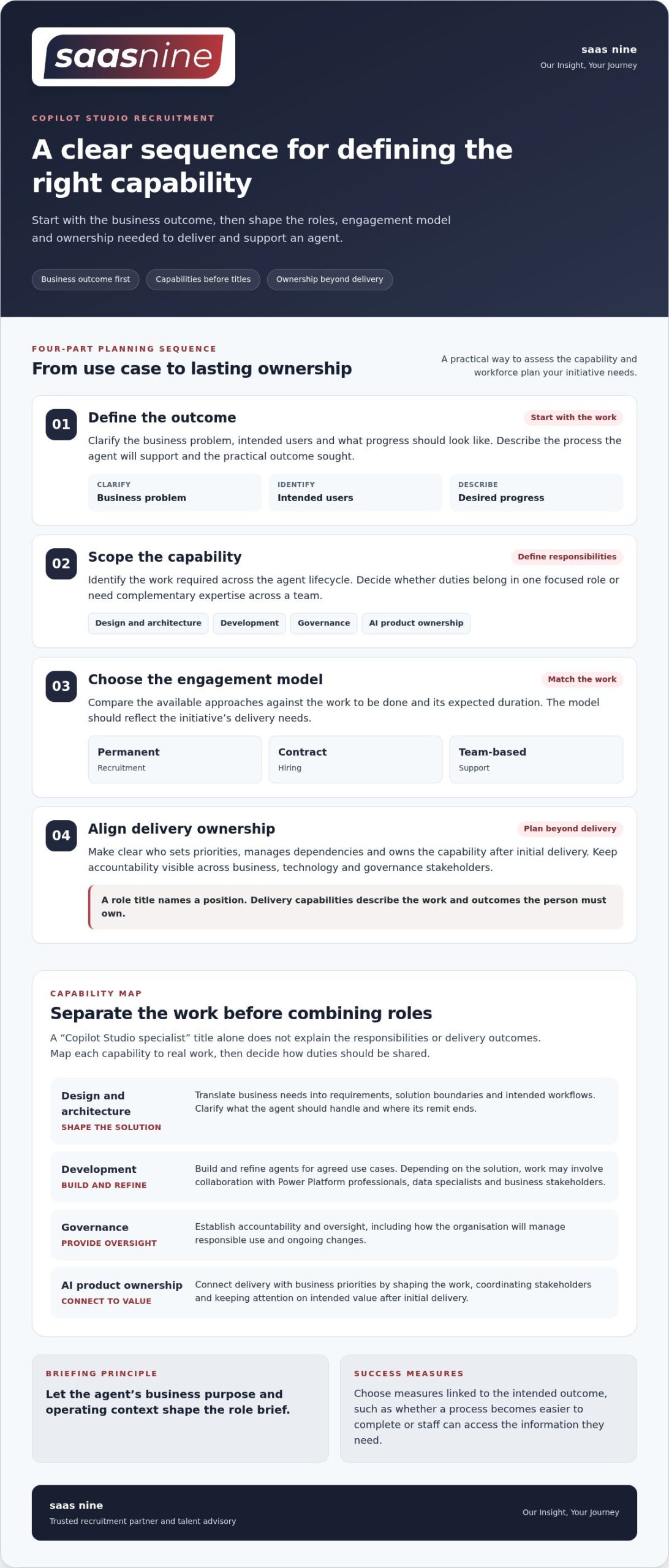
Use a practical sequence to test whether a partner can connect your agent initiative to the capability and workforce plan needed to deliver it:
- Define the outcome: clarify the business problem, intended users and what progress should look like.
- Scope the capability: identify the responsibilities required, from design and development to governance or product ownership.
- Choose the engagement model: match permanent recruitment, contract hiring or team-based support to the work and its expected duration.
- Align delivery ownership: make clear who sets priorities, manages dependencies and owns the capability after initial delivery.
This sequence helps separate a genuine delivery requirement from a broad request for a Copilot Studio expert. It also gives you a basis to assess whether a proposed role is realistic and connected to business priorities.
Test for market insight and role clarity
Ask how market intelligence informs role scope and capability matching. A useful partner can help unbundle an overloaded position description, distinguishing essential responsibilities from adjacent skills that may belong elsewhere in the team. For example, a brief combining agent architecture, development, governance and business ownership may describe several complementary capabilities rather than one practical role. saas nine uses market insight to shape realistic requirements for Microsoft talent sourcing.
Choose an engagement model that fits delivery
Permanent recruitment can suit an ongoing need to build organisational capability, particularly when the role will continue beyond a single initiative and fits the workforce plan. Contract specialists may align with defined delivery or capability-uplift needs. Where the work spans several disciplines, Talent Augmentation can provide individual specialists or project teams to complement existing staff. The right model depends on the initiative’s duration, delivery structure and where long-term ownership should sit.
For copilot studio recruitment australia, assess the partner on the quality of its scoping as well as its ability to source talent. saas nine connects workforce planning with Microsoft delivery capability and can tailor an engagement to your requirements. Discuss a Copilot Studio hiring model with saas nine.
Build Copilot Studio capability with saas nine
Copilot Studio initiatives sit at the intersection of business priorities, Microsoft technology and workforce capability. saas nine brings these elements together as a recruitment partner and talent advisory business, helping organisations plan for the skills needed to progress an initiative and sustain ownership beyond initial delivery. Its support can include contingent recruitment, Executive Search & Headhunting, Talent Augmentation and Strategic Advisory.
For organisations shaping a longer-term Microsoft capability plan, Microsoft Copilot talent services connect role requirements with the delivery context. saas nine can help source individual professionals or project teams, while Strategic Advisory can inform capability strategy and workforce planning around transformation priorities. This helps leaders consider not only which skills are needed now, but where ongoing accountability should sit.
Bring recruitment and advisory into one workforce plan
Start by mapping transformation priorities to the work and capabilities required. Strategic Advisory can help clarify whether the organisation needs to build enduring internal capability, add specialist capacity for a defined initiative, or combine both approaches. Contingent Recruitment and Executive Search & Headhunting support different hiring needs, while Talent Augmentation can bring individual specialists or teams into a delivery environment. The appropriate mix depends on organisational goals and delivery structure.
The AI-enabled Talent Portal supports candidate matching, workflow visibility and workforce discovery, adding practical insight to talent planning. It complements the human judgement needed to align experience and capability with the initiative, rather than replacing the work of defining what the organisation needs.
Make the next conversation practical
To frame your requirement, bring three points into focus: the business outcome you’re pursuing, the initiative’s delivery stage, and the capability gaps you need to address. These details help connect a hiring decision to the wider workforce plan and make the next steps more purposeful.
Our Insight, Your Journey. If you’re considering copilot studio recruitment australia, discuss your Copilot Studio requirement with saas nine to explore an engagement model aligned with your goals.
Turn your agent initiative into a lasting capability
The next decision is not simply whom to hire, but what your organisation wants to be able to do once an agent is in use. Treat each Copilot Studio initiative as an opportunity to clarify capability, accountability and future priorities. Consider how the work could evolve, which expertise should stay close to the business, and where flexibility will matter as plans develop.
A considered approach to copilot studio recruitment australia can turn an immediate delivery requirement into a workforce decision that supports the organisation beyond launch. It gives leaders a stronger basis for adapting roles as business needs and agent use cases change, without assuming every new requirement belongs in the same position. This perspective can also help keep business and technology priorities aligned as the initiative progresses.
When you’re ready to shape the next step, discuss your Copilot Studio capability needs with saas nine. Bring the outcome you’re working towards and the capability questions you’re weighing up. A clear starting point can make the hiring path more purposeful and help your organisation move forward with confidence.
Frequently Asked Questions
Is Microsoft Copilot Studio the same as Microsoft Copilot?
No. They’re related Microsoft offerings, but the names describe different capabilities. Copilot Studio is used to create and manage customised agents, while Microsoft Copilot can refer to assistant experiences across Microsoft products. For a hiring brief, specify the work rather than relying on either label. Clarify whether the person will shape agent interactions, deliver a solution, support governance or help users adopt it.
Can a Copilot Studio agent use an organisation’s existing business information?
It may be possible, depending on the information sources and the organisation’s requirements. For example, an internal agent intended to help staff find policies needs a different scope from one that uses operational records to support a business process. Consider who should access the information, what permissions apply and what security expectations matter. Describe these factors in the brief so the required integration and oversight capabilities are clear.
What happens after a Copilot Studio agent is deployed?
Deployment begins an ongoing operating phase, rather than closing out every responsibility. Teams may need to review how the agent performs, consider user feedback, manage changes and maintain oversight. For example, if staff report that an agent’s responses no longer support a process, someone needs to assess the issue and coordinate a suitable change. Assigning these responsibilities helps prevent operational work from falling between teams.
Do Australian organisations need a permanent Copilot Studio specialist?
No, not by default. Before creating a permanent role, estimate whether there will be a continuing pipeline of agent changes, new use cases or cross-team requests after the initial work. If demand is uncertain, a staged workforce plan can preserve flexibility while leaders build a clearer picture of adoption and ongoing workload. For copilot studio recruitment australia, this demand outlook helps assess whether a permanent specialist is justified.
How can leaders reduce risk when recruiting for Copilot Studio work?
Use a practical assessment tied to the proposed work. Give candidates a brief scenario, such as an agent supporting an internal approval process, and ask how they would clarify users, boundaries, dependencies and oversight needs. Compare their reasoning with the role’s actual responsibilities, not just broad AI claims. This helps reveal whether their experience fits the operating context and can support a grounded hiring decision.