

An interim CIO should do more than keep the seat warm. When a leadership gap threatens decisions, delivery and accountability, the appointment needs to stabilise technology leadership and prepare the organisation for what comes next. This guide to interim CIO recruitment Australia explains when an interim leader is the right fit and how to distinguish that mandate from project-specific expertise. It also considers how recruitment can connect leadership capability with business priorities.
It’s understandable to prioritise speed when a CIO departs or a critical programme starts to drift. But a broad brief can attract candidates whose experience doesn’t match the immediate need, while an unclear handover can leave the next leader without a useful starting point. Define the business priorities, decision-making authority, delivery expectations and transition outcomes from the outset.
Here, you’ll learn how to assess the need, shape a focused leadership brief and build a practical handover into the appointment. saas nine brings recruitment and talent advisory together to help connect leadership capability with business priorities, supporting a transition that maintains momentum and prepares the organisation for its next phase.
Key Takeaways
- Use interim CIO recruitment Australia when an executive vacancy, major transition or delivery instability calls for temporary technology leadership.
- Build the brief around the business issue, decision authority, priority outcomes and a defined handover.
- Assess candidates against the mandate and organisational context, including their approach to teams, suppliers, risk and executive communication.
- Connect the interim appointment with the organisation’s longer-term leadership plan, using market insight to guide contract or permanent hiring.
When does interim CIO recruitment make sense for an Australian organisation?
Interim CIO recruitment fills a temporary executive technology leadership need. It can make sense when an executive vacancy leaves decisions without an owner, a major transition needs senior oversight, or delivery instability is affecting confidence and momentum. The question is not simply how quickly someone can start. It’s whether the organisation needs temporary accountability across technology or a specialist to complete a defined piece of work.
Clarify the scope before opening the search. A CIO’s remit can span strategy, operations, risk and executive decision-making, as outlined in the Chief Information Officer (CIO) role. If the immediate need is a specific platform workstream rather than organisation-wide leadership, sourcing capability in Dynamics 365 and Power Platform recruitment may be a closer fit. The appointment will only help if its authority, priorities and decision rights are understood by the board, executive team and technology function.
Interim CIO, fractional CIO or project leader: what is the distinction?
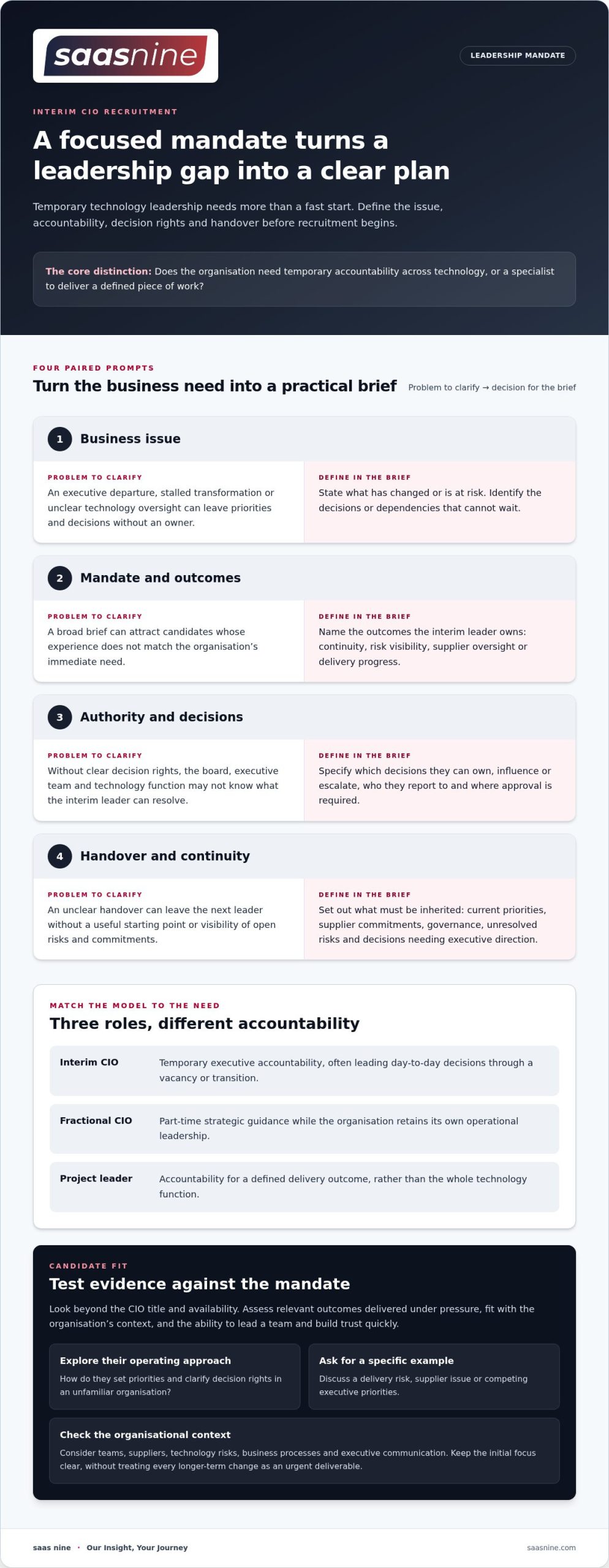
An interim CIO takes temporary executive accountability, often leading day-to-day decisions through a vacancy or transition. A fractional CIO usually provides part-time strategic guidance to an organisation that retains its own operational leadership. A project leader, by contrast, is accountable for a defined delivery outcome, not the whole technology function. Match the model to the authority and availability the business needs.
What should the appointment stabilise first?
Start by identifying the decisions or dependencies that cannot wait. Map critical systems, technology risks, supplier commitments, team responsibilities and business processes that depend on reliable technology. Separate continuity needs, such as keeping services and decisions moving, from transformation outcomes that need further planning. This gives candidates a clear initial focus without treating every longer-term change as an urgent deliverable.
Before recruitment begins, executives should agree who the interim leader reports to, which decisions they can make and where approval is required. That clarity helps distinguish genuine leadership gaps from capacity shortages and gives the search a practical basis for assessing fit.
How to define an interim CIO mandate before recruitment begins
A focused brief separates the executive outcomes the organisation needs from an idealised list of every capability a CIO might possess. For interim CIO recruitment Australia, define the need in four steps before sourcing begins:
- Business issue: State what has changed or is at risk, such as an executive departure, stalled transformation or unclear technology oversight.
- Mandate: Describe the outcomes the interim leader is accountable for, including continuity, risk visibility, supplier oversight or delivery progress.
- Authority: Specify which decisions they can own, influence or escalate, and who they report to.
- Handover: Set out what the next leader or operating model must inherit, from documented risks and governance to open decisions.
Use these steps to set priorities across technology risk, suppliers, teams, transformation delivery and executive reporting. Then translate those priorities into relevant experience, rather than adding every desirable qualification to the position description. A leader overseeing a complex ERP transition, for example, may need experience with executive governance and supplier coordination, not deep expertise in every system the organisation uses.
Which decisions and outcomes belong in the brief?
Name the decisions that need an owner, such as resolving competing delivery priorities or escalating a material technology risk. Identify the stakeholders the interim CIO must work with, including the executive sponsor, technology leads and business owners affected by change. Define practical outcomes, such as clearer reporting, continuity of critical services and visible ownership of delivery issues. Avoid arbitrary targets that are not tied to the mandate.
How should the organisation define a successful handover?
Plan the handover before the appointment starts. Specify what the incoming leader or future operating model will need: current priorities, supplier commitments, governance arrangements, unresolved risks and decisions still requiring executive direction. This makes knowledge transfer part of the mandate, rather than a final administrative task. For broader capability planning, saas nine’s workforce planning and strategic advisory can connect leadership requirements with the organisation’s longer-term needs.
How to assess interim CIO candidates for fit, not just availability
A candidate’s experience should match the mandate, organisational context and decision authority, not just the CIO title on their résumé. In interim CIO recruitment Australia, assess evidence of outcomes delivered under pressure alongside the candidate’s ability to lead a team and build trust quickly. In a Microsoft-dependent environment, Microsoft technology recruitment services can help align role-specific capability with the organisation’s platforms and business priorities.
What evidence reveals an interim leader’s operating style?
Ask candidates to explain how they set priorities and clarify decision rights when entering an unfamiliar organisation. Explore a specific example involving a delivery risk, supplier issue or competing executive priorities. What did they communicate? What trade-offs did they present, and which decisions did they own or escalate? Look for direct leadership evidence, such as setting direction for a technology team, rather than advisory experience alone.
Use a scenario based on the organisation’s actual context. For example, ask how they would respond if a transformation milestone were at risk while operational teams needed support. A useful answer should show how they would establish the facts, engage stakeholders and explain options without overstating certainty. Ask how they would document unresolved risks and transfer context to the next leader.
How can market intelligence strengthen the shortlist?
Market insight helps test whether the brief’s expectations align with relevant candidate experience. It can also reveal when requirements combine distinct capabilities, such as executive leadership and hands-on programme recovery, that may need to be prioritised rather than treated as one non-negotiable profile. saas nine’s Talent Portal supports AI-driven capability discovery and candidate matching, helping inform a shortlist against the agreed mandate.
Compare candidates consistently against the same evidence: leadership scope, relevant delivery context, stakeholder communication and approach to transition. This keeps availability in perspective and makes trade-offs visible to decision-makers. The recruitment discussion should centre on the agreed mandate and the evidence each candidate brings to it. Learn how saas nine approaches leadership requirements.
How saas nine can support interim CIO recruitment and the next leadership step
An interim appointment is one part of a broader workforce decision, not simply a vacancy to fill. saas nine connects role definition and market intelligence with contract or permanent hiring, helping organisations align leadership capability with the mandate and what follows it. The engagement model can be tailored to the need for executive cover, delivery capability or workforce planning.
How can recruitment connect immediate cover with longer-term capability?
Before sourcing begins, consider which responsibilities need to remain with the technology function, which knowledge should transfer to a successor, and whether the future structure needs different capability. An interim leader may provide continuity while the organisation determines whether its next step is a permanent CIO, a broader leadership arrangement or additional programme expertise. Executive search and leadership recruitment can form part of that longer-term plan, alongside contract hiring and strategic advisory shaped to the organisation’s needs.
This joined-up view keeps the temporary mandate focused while making its outputs useful beyond the appointment. Market intelligence can inform how the brief reflects the talent market and the capability the organisation needs, rather than defaulting to an inflated position description.
What should leaders prepare for an initial recruitment discussion?
Bring a clear account of the business context, the leadership gap, immediate priorities and intended handover outcome. It also helps to identify who will agree the mandate, clarify decision authority and assess candidates. These inputs give the recruitment discussion a practical starting point and connect the immediate appointment with longer-term workforce choices.
With saas nine, interim CIO recruitment Australia is approached as a considered leadership decision, supported by recruitment partnership and talent advice. Discuss your interim CIO recruitment brief and the capability your organisation will need next. Our Insight, Your Journey.
Set the next leadership decision in motion
The value of an interim appointment can extend beyond the period of cover when it gives decision-makers a clearer view of the leadership capability the organisation needs next. Use the transition to consider how technology priorities connect with business direction, and ground the next decision in what the organisation has learned during the interim period.
For interim CIO recruitment Australia, saas nine supports CIO and CTO leadership recruitment and can align contract or permanent hiring, executive search and strategic advisory with the organisation’s priorities. The aim is a considered pathway, not a rushed appointment made under pressure.
Bring your current priorities and the decisions ahead into a focused discussion. Work through your interim CIO hiring priorities with saas nine and take the next step with a clearer view of the capability your organisation needs.
Frequently Asked Questions
What does an interim CIO do?
An interim CIO provides temporary executive oversight of an organisation’s technology function. Depending on the mandate, they may represent technology in executive discussions, guide team leaders, manage supplier relationships and ensure business impacts are considered in technology decisions. During a leadership vacancy, for example, they can help business units understand which technology decisions need attention now and which should wait for the permanent leader.
When should an organisation recruit an interim CIO instead of a permanent CIO?
Choose an interim CIO when immediate leadership is needed but the organisation has not yet settled its enduring technology leadership requirements. Interim CIO recruitment Australia can provide temporary executive coverage while a business restructures, works through a transition or considers the scope of a permanent role. A permanent appointment is generally more suitable when the organisation is ready to define ongoing accountability, strategic ownership and the leadership capability it needs over the long term.
How do you write a brief for interim CIO recruitment?
Write the brief so a candidate can understand the organisation’s situation before discussing solutions. Include a plain-language description of the business context, who the role will work with, the systems or programmes that shape the assignment, and any known constraints. Describe what success should look like at the end of the engagement, then distinguish essential experience from preferences. This gives assessors a consistent basis for comparing candidates.
Can an interim CIO lead a digital transformation programme?
Yes, if the mandate gives them appropriate executive authority and the programme leadership structure is clear. An interim CIO can provide governance, align senior stakeholders, resolve cross-business priorities and ensure programme decisions connect to operational needs. For a major ERP transformation, for instance, they might oversee executive steering and escalations while programme managers and delivery specialists lead their defined workstreams.
How can an organisation reduce disruption when an interim CIO leaves?
Make continuity part of the assignment from the outset. Keep key decisions, risks, supplier commitments and programme dependencies in shared records rather than relying on the interim leader’s personal knowledge. Maintain clear owners for operational responsibilities, and arrange structured introductions between the departing leader, internal technology leads and their successor. A concise handover meeting focused on unresolved decisions can help the next leader pick up work with context.