

In 2026, the success of your digital transformation doesn’t depend on the sophistication of your Microsoft Dynamics 365 environment, but on the precision of your human architecture. Most leaders agree that the gap between a visionary strategy and a failed rollout is almost always a lack of niche capability. With the national shortage of Microsoft specialists reaching critical levels, a traditional recruitment approach is no longer enough to protect your investment. This guide explores why a robust ERP implementation staffing strategy Australia is the most vital component of your project’s lifecycle.
At saas nine, we understand that “Our Insight, Your Journey” means more than just filling seats; it’s about unbundling complex roles to ensure your delivery team is structured for long-term business value. You’ll learn how to de-risk your rollout by aligning Microsoft technology strategy with elite workforce capability. We’ll preview a clear roadmap for success, showing you how to access pre-qualified talent and navigate the 2026 market with the confidence of a specialist partner by your side.
Key Takeaways
- Transition from high-risk big-bang rollouts to a modular, capability-led model that aligns legacy modernisation with 2026 AI readiness.
- Master the essential steps for data governance using Microsoft Fabric to ensure your business processes are mapped for strategic value before execution.
- Identify the critical technical and leadership roles required to bridge the gap between strategy and delivery with a tailored ERP implementation staffing strategy Australia.
- Explore how saas nine de-risks your digital transformation by unbundling position descriptions into realistic roles and providing access to pre-qualified Microsoft professionals.
Beyond Software: Why ERP Implementation Best Practices Start with Capability
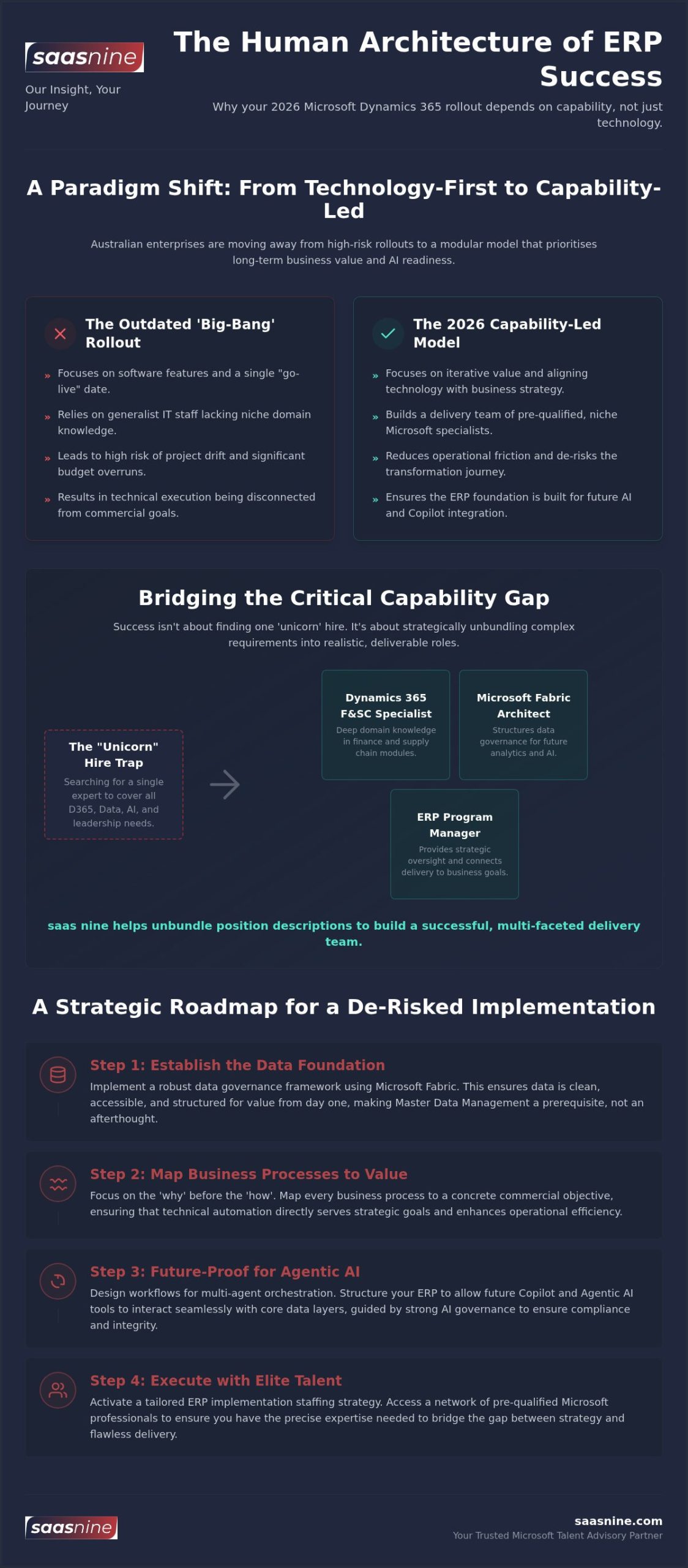
Modern Enterprise Resource Planning (ERP) success in 2026 is no longer defined by the technical “go-live” date. Instead, it’s measured by how effectively your legacy modernisation aligns with future AI readiness. Australian enterprises are moving away from risky, “big-bang” implementations. They’re choosing modular, capability-led rollouts that allow for iterative value and reduced operational friction. Adopting a tailored ERP implementation staffing strategy Australia ensures that technical execution remains subservient to your overarching commercial goals. While many focus on software features, saas nine advocates for a capability-first philosophy. This approach bridges the gap between boardroom strategy and technical delivery, ensuring your workforce can actually drive the technology rather than just reacting to it.
The High Cost of the Capability Gap
Relying on generalist IT staff for specialised Microsoft ecosystem projects often leads to project drift and budget overruns. A successful ERP implementation staffing strategy Australia requires unbundling generic position descriptions into realistic, niche roles. By identifying specific needs for Dynamics 365 or Finance & Supply Chain experts, you avoid the “unicorn” hire trap. Our Insight, Your Journey ensures you have the precise expertise to execute complex technical tasks. This method reduces the high failure rates associated with under-qualified delivery teams that lack deep domain knowledge.
Aligning ERP with the Intelligent Enterprise
Your ERP serves as the critical data foundation for the five stages of AI maturity. Without a robust data layer, investments in Agentic AI or Copilot will underperform. A strategic roadmap must consider long-term workforce planning, ensuring your team can manage the shift toward an “Intelligent Enterprise.” This isn’t just about today’s rollout; it’s about building a delivery team that can sustain business value as the Microsoft ecosystem evolves. We help organisations define these roles early, ensuring your data strategy and human capability move in lockstep to support future growth.
Strategic Frameworks: Essential ERP Implementation Best Practices for 2026
Success in 2026 requires a shift from technical configuration to strategic orchestration. Implementing ERP implementation best practices begins with business process mapping to uncover the “why” before the “how.” This ensures that every automated workflow serves a concrete commercial purpose. A robust ERP implementation staffing strategy Australia prioritises the recruitment of specialists who understand this synergy between business logic and technical execution.
Data Governance as the Implementation Foundation
Establishing a governance framework with Microsoft Fabric and OneLake is the first step toward unlocking data value from day one. Fabric Architects play a critical role in this phase. They ensure that information isn’t just stored but is clean, accessible, and structured for insights. In an AI-driven environment, Master Data Management is no longer optional; it’s the prerequisite for any system that aims to provide real-time dashboards or predictive analytics. If you’re looking to secure these niche skills, exploring Microsoft Fabric recruitment options early in the planning phase is essential for project stability.
Preparing for Agentic AI Adoption
Designing your ERP for multi-agent orchestration is a 2026 necessity. You must structure workflows to allow future Copilot and Agentic AI tools to interact seamlessly with your core data layers. This involves moving beyond simple automation to creating an environment where AI agents can execute complex tasks across departments. AI Governance acts as the essential guardrail for responsible ERP modernisation, ensuring compliance and data integrity across the ecosystem. Preparing your workforce for this shift requires a structured approach to capability uplift. Change management isn’t just a final step; it’s a continuous journey of preparing your people for a new way of working. Our Insight, Your Journey helps you navigate these complexities. To discuss how to structure your delivery team for these challenges, feel free to reach out to our advisory team.
The Human Factor: Vetting and Sourcing Elite Microsoft Talent in Australia
Software provides the framework, but your people provide the momentum. A successful ERP implementation staffing strategy Australia focuses on securing three critical pillars: Functional Leads who understand business logic, Solution Architects who design the technical blueprint, and AI Product Owners who ensure the system remains future-proof. saas nine moves beyond the surface level of a CV. We verify technical capability through deep ecosystem literacy, ensuring that every professional we present is pre-qualified for the specific rigours of your transformation.
Vetting Dynamics 365 Specialists
Finding a Dynamics 365 Technical Lead requires looking past basic certifications. You need integration expertise and industry-specific knowledge that aligns with Australian market conditions. We use market intelligence to identify niche specialists who are often invisible to traditional search methods. This is a core part of our Dynamics 365 ERP Recruitment Australia service. By unbundling position descriptions into realistic roles, we match specific technical needs to verified talent, ensuring your delivery team is capable of executing the strategy from day one.
Permanent vs. Contract: Choosing the Right Delivery Model
Deciding between permanent placements and talent augmentation depends on your project phase. Contingent recruitment offers the agility needed for rapid scaling during a rollout’s peak intensity. Conversely, finding a CIO or Program Director to lead the transformation often requires a dedicated executive search. Our Insight, Your Journey supports both models. We help you decide when to invest in long-term leadership and when to leverage contractors for specific technical milestones. If you’re ready to secure the talent your transformation requires, contact our talent advisory team to discuss your capability map.
De-Risking Your Journey: How saas nine Orchestrates ERP Success
Digital transformation is inherently complex, yet the risks are manageable with the right partner. Traditional hiring models often fail because they focus on matching keywords rather than verifying delivery capability. At saas nine, we provide a modern alternative through our Agentic Workforce Platform. This proprietary technology automates workflows and enhances candidate matching, ensuring you access professionals who are truly ready for the demands of a 2026 rollout. By integrating this into your ERP implementation staffing strategy Australia, you move from reactive hiring to proactive capability building.
Our Insight, Your Journey: A Partnership Model
Our collaborative approach focuses on reducing hiring risk by unbundling position descriptions into realistic, executable roles. We don’t just fill gaps; we help you design successful delivery teams through our Strategic Advisory services. A cornerstone of this process is the Microsoft Ecosystem Capability Map. This tool allows executive stakeholders to visualise their current workforce against the technical requirements of Dynamics 365 or Microsoft Fabric. It ensures your Technology Workforce Planning Australia aligns with the long-term business value of your digital investments.
Next Steps for Australian Technology Leaders
For CIOs and transformation leaders, the first step isn’t choosing a technical stack. It’s conducting a comprehensive capability audit. Understand the skills you have versus the specialists you need before committing to a multi-year roadmap. We invite you to explore the saas nine Talent Portal to see how we mobilise pre-qualified Microsoft professionals with speed and precision. By connecting strategy, technology, and workforce capability, we ensure your path to modernisation is both stable and successful. “Our Insight, Your Journey” is our commitment to being the steady hand that guides your enterprise through the complexities of the 2026 landscape.
Securing Your Enterprise Future through Strategic Capability
Success in the 2026 ERP landscape requires moving beyond simple software deployment toward a model that prioritises human capability. We’ve explored how a modular, capability-led rollout reduces risk and why establishing a data foundation with Microsoft Fabric is essential for AI readiness. By unbundling roles and focusing on verified technical expertise, you ensure your delivery team is equipped for the complexities of the modern Microsoft ecosystem. A robust ERP implementation staffing strategy Australia isn’t just about hiring; it’s about aligning your long-term technology roadmap with the right workforce architecture.
saas nine provides the deep expertise and specialised Agentic Workforce Platform needed for faster mobilisation and reduced project drift. Our strategic advisory services ensure your workforce capability stays in lockstep with your business strategy. Ready to mobilise your transformation team? Contact saas nine to bridge the gap between strategy and capability. Your digital journey is complex, but with the right guide, it becomes a clear path to sustained commercial value.
Frequently Asked Questions
What are the most common reasons for ERP implementation failure in Australia?
ERP implementation failures in Australia often stem from inadequate change management and a fundamental disconnect between boardroom strategy and technical execution. Many projects stall because organisations underestimate the complexity of data migration or rely on generalist IT staff. Implementing a precise ERP implementation staffing strategy Australia ensures you secure niche specialists who can bridge this gap. This approach reduces the high failure rates associated with under-qualified delivery teams that lack deep ecosystem literacy.
How long does a typical Dynamics 365 Finance & Operations implementation take?
A typical Dynamics 365 Finance & Operations rollout for an Australian enterprise generally spans between 12 and 18 months. This timeline varies based on the scale of legacy modernisation and the complexity of business process mapping. Adopting a modular, capability-led approach can deliver iterative value sooner than traditional “big-bang” implementations. We recommend conducting a capability audit early to ensure your delivery team is structured to meet these project milestones effectively.
Should we hire permanent staff or contractors for our ERP rollout?
Most successful transformations utilise a hybrid model. Contractors offer the niche expertise and agility required for the high-intensity build and deployment phases, while permanent staff provide long-term operational stability. saas nine assists organisations in unbundling position descriptions to identify which roles suit talent augmentation and which require executive search for permanent leadership. This strategic balance ensures you have the right capability at each stage of your digital journey.
What is the role of Microsoft Fabric in a modern ERP implementation?
Microsoft Fabric serves as the unified data foundation, allowing your organisation to consolidate information into OneLake for advanced analytics. It is a critical component for AI readiness, ensuring that your ERP data is clean, governed, and accessible. By integrating Fabric Architects into your delivery team, you unlock real-time business intelligence and prepare your system for multi-agent orchestration. This shifts the ERP from a legacy record-keeper to a proactive strategic asset.
How do we vet Dynamics 365 consultants for technical and cultural fit?
Effective vetting should move beyond standard CV reviews to focus on verified technical capability and industry-specific experience. Look for consultants with a deep understanding of the Microsoft technical stack and a history of successful deliveries in the Australian market. saas nine utilises a proprietary Agentic Workforce Platform for capability discovery, providing access to pre-qualified professionals. This ensures your consultants possess the technical rigour and cultural alignment necessary to de-risk your transformation journey.