

A Power BI Centre of Excellence is not a technical help desk; it’s a strategic workforce capability that bridges the gap between data engineering and commercial decision-making. Most Australian leaders recognise the frustration of “shadow BI”, where fragmented reports and conflicting metrics across departments erode trust in your organisational data. You’ve likely experienced the difficulty of sourcing pre-qualified Microsoft professionals in a tight market, making it hard to maintain a single source of truth. At saas nine, we believe the path to clarity requires more than just software; it demands a structured approach to talent and governance.
This guide will show you how to architect Power BI Centres of Excellence that transform raw data into a competitive advantage. We’ll explore a roadmap to align your technology capability with business strategy, improve data literacy, and unbundle generic position descriptions into realistic, high-impact roles. By the end, you’ll have a clear framework to navigate the complexities of the Microsoft ecosystem and ensure your journey leads to measurable commercial outcomes. Our Insight, Your Journey.
Key Takeaways
- Shift your perspective from viewing analytics as a technical help desk function to a strategic capability that drives consistent, governed decision-making.
- Understand the critical roles required for success, including the need to unbundle position descriptions to secure highly specialised Microsoft Fabric and data governance expertise.
- Follow a structured roadmap to architect Power BI Centres of Excellence that align your technology investments with long-term commercial goals and workforce planning.
- Uncover strategies to overcome the local talent shortage by connecting with pre-qualified professionals who can lead your digital transformation journey.
Defining the Power BI Centre of Excellence in the Australian Enterprise
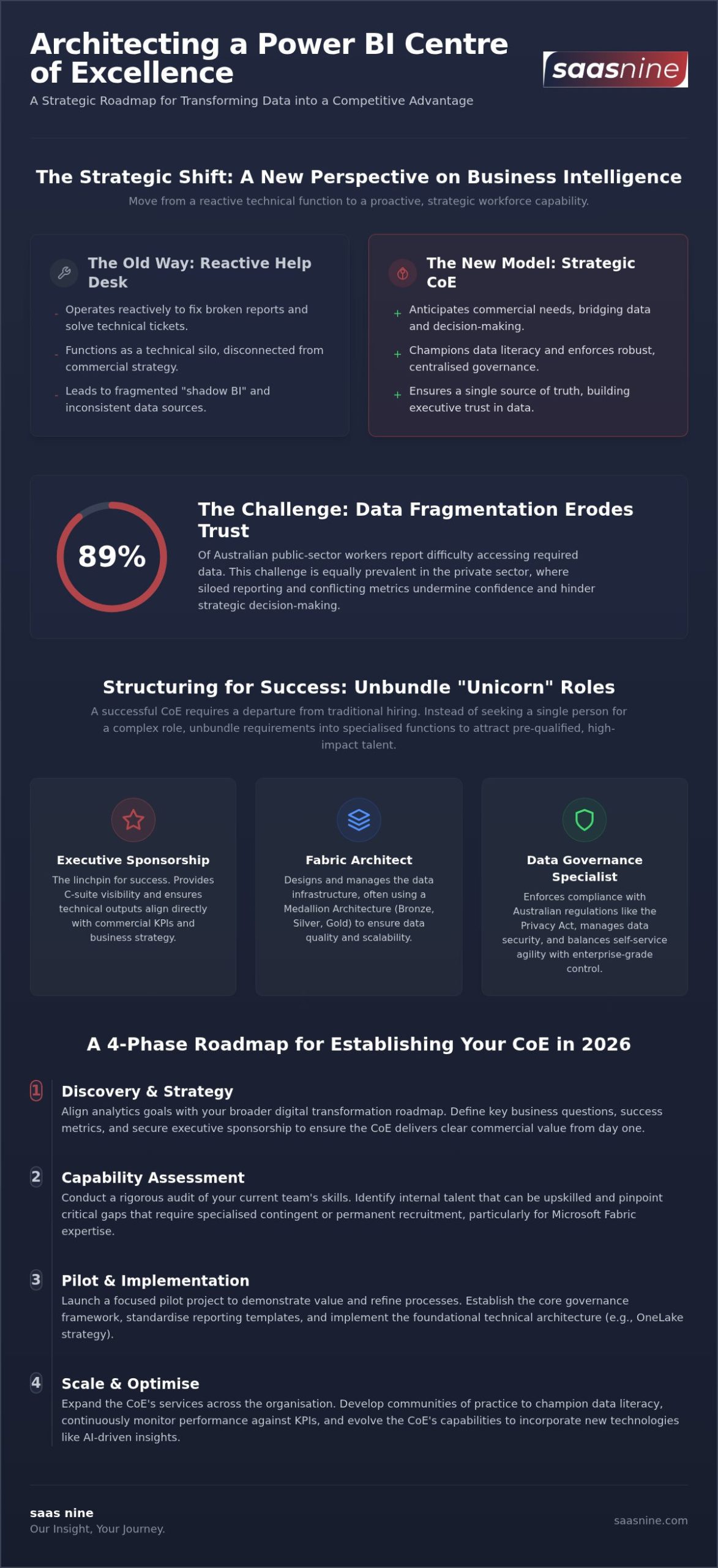
Modern Power BI Centres of Excellence are far more than technical repositories or platform maintenance teams. They function as centralised hubs designed to standardise analytics, champion data literacy, and enforce robust governance across the organisation. While a traditional IT help desk operates reactively to fix broken reports, a proactive CoE anticipates commercial needs and ensures that data remains a strategic asset. In 2026, Australian organisations are moving toward this model to combat the rising tide of data fragmentation. Research shows that 89% of Australian public-sector workers report difficulty accessing required data, a challenge equally prevalent in the private sector where fragmented “shadow BI” erodes executive trust.
Success requires a fundamental shift in perspective. Instead of viewing business intelligence as a series of isolated projects, leaders must treat it as a continuous workforce capability. At saas nine, our philosophy is simple: “Our Insight, Your Journey” starts with clear organisational design. We don’t just help you find staff; we help you build a sustainable framework that aligns your technology investment with your long-term business strategy.
The Strategic Value of “Discipline at the Core”
Establishing “discipline at the core” ensures that executive decision-making is underpinned by a single source of truth. Without formalised Power BI Centres of Excellence, departments often create siloed reporting environments that lead to conflicting metrics and security risks. By centralising governance, you ensure compliance with evolving Australian data regulations. To understand how technical expertise supports this structure, refer to our guide on Microsoft Fabric Roles: A Guide for Australian Leaders. These specialised roles are vital for a resilient environment that scales as your business grows.
Structuring Your CoE: Essential Roles and Governance Frameworks
Scaling Power BI Centres of Excellence requires a departure from traditional “unicorn” hiring. Many Australian organisations struggle because they attempt to wrap data engineering, visualisation, and governance into a single position description. This approach often fails in a competitive market. Instead, saas nine recommends unbundling these requirements into specialised roles: Analytics Leads, Fabric Architects, and Data Governance Specialists. By defining these niche functions, you attract pre-qualified talent capable of executing a Medallion Architecture (Bronze, Silver, and Gold zones) that ensures data quality at every stage.
Executive sponsorship remains the linchpin of successful Power BI Centres of Excellence. A CoE must have C-suite visibility to ensure technical outputs align with commercial KPIs. Without this bridge, the initiative risks becoming a technical silo rather than a strategic workforce capability.
Mapping Capability to the Microsoft Ecosystem
Before recruiting, conduct a thorough audit. Utilising a Microsoft Ecosystem Capability Map helps identify where your current team excels and where gaps persist. As businesses shift from legacy reporting to AI-driven insights within Microsoft Fabric, the need for advanced architectural oversight grows. For those appointing senior leadership, our insights on Vetting Cloud Architects for Australian Enterprises provide a framework for screening high-level expertise.
Governance and OneLake Strategy
Governance shouldn’t be a bottleneck. Adopting a “Lakehouse” mindset within the CoE allows for a OneLake strategy that centralises data while empowering individual departments. This approach balances self-service agility with the enterprise-grade security required by Australian regulations like the Privacy Act. If you need assistance defining these roles for your transformation, reach out to our advisory team for a confidential discussion.
A Roadmap for Establishing Your CoE in 2026
Building Power BI Centres of Excellence is a methodical journey that requires more than technical installation. In 2026, Australian leaders must navigate a four-phase roadmap to ensure measurable ROI. Phase 1, Discovery and Strategy, aligns analytics goals with your broader digital transformation roadmap to avoid wasted effort. Phase 2 involves a rigorous Capability Assessment, identifying whether internal talent can manage the transition to Microsoft Fabric or if specialised contingent recruitment is required. Phase 3 focuses on Pilot and Governance, implementing a Medallion Architecture for a specific business unit to prove value through structured Bronze, Silver, and Gold data layers. Finally, Phase 4 scales these capabilities nationally, ensuring every department operates from a single source of truth.
The Importance of Workforce Planning
Traditional recruitment often fails because generic position descriptions don’t capture the nuance of modern data roles. At saas nine, we help organisations unbundle these descriptions into realistic, high-impact roles. Strategic workforce planning should leverage market intelligence to benchmark CoE roles against current Australian standards. For specific Phase 2 guidance, refer to our guide on How to Hire a Medallion Architecture Data Engineer in Australia. This structured approach ensures you don’t just fill seats, but build a resilient delivery team.
Scaling a CoE nationally is a complex undertaking that demands a steady hand. If you’re looking to align your technology capability with business strategy and secure the right talent, reach out to our talent advisory team to start your journey. Our Insight, Your Journey.
Sourcing the Capability to Lead Your Power BI Transformation
The most common objection we hear from Australian executives is that finding local specialists to staff Power BI Centres of Excellence is nearly impossible. With the persistent tech talent shortage, it’s easy to feel stuck in a cycle of failed recruitment. However, the issue often lies in how roles are defined rather than a total lack of candidates in the market. saas nine acts as a strategic partner to bridge this gap. We don’t just supply resumes; we provide the talent advisory needed to align your workforce capability with your commercial objectives. By using our vetted talent portal, you gain access to pre-qualified Microsoft professionals who can mobilise project teams quickly. This platform automates workflows and enhances visibility, ensuring your CoE doesn’t stall due to hiring delays.
Bridging the Gap Between Strategy and Execution
Execution fails when position descriptions don’t match the technical reality of the Microsoft ecosystem. We help you unbundle generic requirements into realistic, high-impact roles that specialists actually want to fill. This precision reduces hiring risk and ensures your leadership team consists of experts who understand both data governance and business value. Our role as an Expert Guide is to facilitate your progress in establishing Power BI Centres of Excellence, providing the market intelligence required to make informed decisions about permanent and contract hiring. For organisations ready to hire data engineers in Australia, understanding how to navigate the current talent landscape and unbundle Fabric-centric roles is essential to reducing hiring risk and accelerating project mobilisation. We focus on long-term outcomes, ensuring your technology capability grows alongside your business strategy. If you’re ready to move from fragmented data to a unified strategic capability, contact saas nine for a capability consultation. Our Insight, Your Journey.
Architecting Your Data-Driven Future
Establishing Power BI Centres of Excellence is a transformative step that moves your organisation beyond fragmented reporting toward a unified, strategic capability. Success requires a deliberate shift from reactive IT support to a proactive governance framework that prioritises data literacy and executive alignment. By unbundling complex position descriptions into realistic, high-impact roles, you can overcome the local talent shortage and build a resilient delivery team. saas nine stands ready as your Expert Guide, offering deep expertise across Microsoft Fabric, OneLake, and Power BI. We provide access to pre-qualified and vetted Microsoft professionals, ensuring you have the niche capability required for a successful journey.
Don’t let your digital transformation roadmap stall due to workforce gaps. Discuss your CoE workforce strategy with saas nine to ensure your technology investments deliver measurable commercial outcomes. Our Insight, Your Journey. We look forward to supporting your progress as you navigate this complex landscape with confidence and clarity.
Frequently Asked Questions
What is the primary purpose of a Power BI Centre of Excellence?
The primary purpose is to centralise governance and standardise analytics to ensure a single source of truth across the organisation. By establishing Power BI Centres of Excellence, businesses move away from fragmented reporting silos and “shadow BI”. This structure promotes data literacy and aligns technology capability with business strategy. It ensures every department makes decisions based on consistent, reliable metrics while maintaining compliance with Australian data regulations.
How many people do I need to start a Power BI CoE in an Australian SME?
You can initiate a CoE with a lean team of two or three core roles. Start with an Analytics Lead to drive strategy and a Data Architect to manage the technical foundation. Small teams often begin by sharing these responsibilities among high-performing staff before scaling. For Australian SMEs, the focus should be on unbundling position descriptions to ensure you have the right mix of technical and commercial insight from the outset.
What is the difference between a Power BI CoE and a standard data team?
A standard data team often operates as a reactive help desk, whereas a CoE is a proactive strategic capability. While data teams focus on report generation, Power BI Centres of Excellence emphasise governance, scalability, and democratising data access. The CoE acts as an expert guide, empowering business units to perform self-service analytics within a secure framework. This ensures data engineering directly supports commercial decision-making rather than just technical maintenance.
Can saas nine help us source contract specialists for a CoE pilot?
Yes, saas nine specialises in connecting organisations with pre-qualified and vetted Microsoft professionals for both permanent and contract roles. We understand the need for speed during a pilot phase. Our talent portal allows you to mobilise project teams quickly to prove the value of your CoE. By unbundling complex roles, we help you find the specific expertise needed to lead your digital transformation journey without unnecessary hiring risk.
How does Microsoft Fabric change the way we structure a CoE in 2026?
Microsoft Fabric introduces a unified “Lakehouse” mindset that requires your CoE to manage data residency and sovereignty more closely. In 2026, the focus has shifted toward Fabric Capacity Units and F-SKU models, such as the F2 SKU starting at approximately A$383 per month. This means your CoE must now include Fabric Architects who can navigate integrated workloads across Power BI, Data Factory, and Real-Time Intelligence within a single platform.