

What if the hardest part of hiring a technology executive isn’t finding candidates, but agreeing what the role must deliver? A brief that combines transformation, operational stability, technical depth and broad team leadership can make it difficult to identify the right person. That’s why choosing a partner for tech executive search Australia starts with a clear, achievable leadership mandate.
Senior technology leaders can also be difficult to reach through conventional hiring channels, and a poor appointment can unsettle transformation priorities and team delivery. The answer isn’t simply to widen the search. It’s to connect the organisation’s business outcomes with the capabilities and leadership scope the role genuinely requires.
This guide explains how to define that mandate, assess executive search partners and evaluate candidates for leadership, transformation experience and relevant technical capability. It also explores how market mapping, direct engagement and the right hiring model can support different organisational needs. With a practical framework, you can make a considered appointment that advances your transformation priorities, rather than adding complexity to them.
Key Takeaways
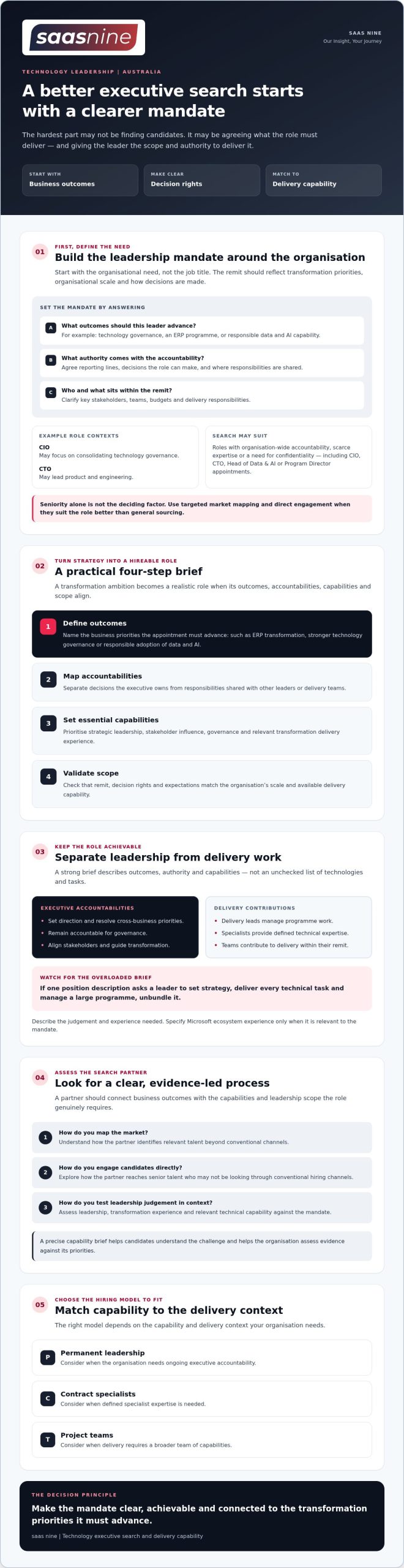
- Anchor the leadership mandate to business outcomes, organisational scale and decision rights before drafting the role brief.
- When assessing a tech executive search Australia partner, ask how it maps the market, engages candidates directly and tests leadership judgement in context.
- Separate essential executive accountabilities from specialist or delivery work to make an ambitious brief achievable.
- Choose between permanent leadership, contract specialists and project teams based on the capability and delivery context your organisation needs.
Why tech executive search in Australia starts with the leadership mandate
Start with the organisational need, not the job title. A technology leader’s remit should reflect the transformation priorities, scale and decision-making structure of the organisation. A CIO in a business consolidating technology governance may need a different mandate from a CTO leading product and engineering. Executive search is a targeted approach to identifying and engaging senior talent for strategically significant appointments, rather than general candidate sourcing. The Executive search model is most useful when the role calls for a deliberate search beyond applicants already looking through conventional channels.
When does a technology leadership role warrant executive search?
Consider it for roles such as CIO, CTO, Head of Data & AI or Program Director when the appointment carries organisation-wide accountability, requires scarce expertise or needs to be handled confidentially. Seniority alone isn’t the deciding factor: a niche specialist may also be difficult to identify through broad advertising. For example, a search for a leader combining data strategy with AI adoption needs a precise capability brief; saas nine’s Data & AI recruitment capability is relevant to that talent context. Not every vacancy needs executive search. Use it when targeted market mapping and direct engagement are better suited to the role than a general sourcing process.
What should the appointment deliver for the organisation?
Translate transformation priorities into outcomes the executive can influence, such as improving technology governance, guiding an ERP programme or building responsible data and AI capability. Avoid broad ambitions without clear authority. Before opening the search, agree on:
- Who the role reports to and which decisions it can make.
- Which executives and business stakeholders it must work with.
- What teams, budgets or delivery responsibilities sit within its remit.
This clarity helps distinguish essential leadership capabilities from accountabilities that belong elsewhere. In tech executive search Australia, a well-defined mandate gives candidates a realistic picture of the challenge and helps the organisation assess evidence against its priorities.
Turn an Australian technology transformation brief into a realistic executive role
A transformation brief often describes an ambition, not yet a hireable role. To shape it, connect the business priority to work the leader will own, then check that the authority and capability required are realistic. A strong role brief specifies the outcomes expected, the authority to make decisions and the capabilities needed to deliver.
Use this sequence to turn strategy into a practical mandate:
- Define outcomes: Identify the business priorities the appointment must advance, such as ERP transformation, stronger technology governance or responsible adoption of data and AI.
- Map accountabilities: Separate decisions the executive owns from responsibilities shared with other leaders or delivery teams.
- Set essential capabilities: Prioritise strategic leadership, stakeholder influence, governance and relevant transformation delivery experience.
- Validate scope: Check that the role’s remit, decision rights and expectations match the organisation’s scale and available delivery capability.
Which leadership capabilities should the brief make explicit?
Describe the judgement and experience needed, not just a long list of technologies. For example, a leader overseeing an ERP programme may need to align business stakeholders, govern delivery and manage change. Specify Microsoft ecosystem experience only if it’s relevant to the mandate. For data leadership requirements, see data and AI recruitment in Australia.
How should the role fit the wider delivery team?
Keep executive accountabilities distinct from specialist delivery skills. The executive might set direction, resolve cross-business priorities and remain accountable for governance, while delivery leads manage programme work and specialists provide defined technical expertise. If one position description expects a leader to set strategy, deliver every technical task and manage a large programme, unbundle it. Permanent leadership, contract expertise or a combined team may better fit the work. Clear interfaces reduce duplicated ownership and help candidates understand the role.
For organisations refining a technology leadership mandate, saas nine’s strategic advisory and executive search can help connect role design with capability needs. Discuss your leadership requirements.
How to assess a tech executive search partner in Australia
A strong search partner should explain how it will translate the agreed leadership mandate into a focused search, not simply promise access to candidates. In tech executive search Australia, look for a clear method for market mapping, role calibration and direct engagement with relevant leaders, including people who may not be actively applying.
What evidence should a search partner provide?
Ask to see how the partner will organise the search and keep it accountable. Agree on assessment criteria and a reporting cadence before work begins. Useful questions include:
- How will market intelligence test the role scope and indicate where relevant capability may sit?
- How will the search identify and engage suitable candidates directly?
- How will progress, candidate feedback and proposed changes to the brief be shared?
- What experience does the partner have with the relevant Microsoft ecosystem and transformation context?
Look for considered answers, not guarantees about candidate availability or outcomes. A partner should be able to explain how evidence from the market could inform role calibration if the initial brief proves too narrow or combines competing requirements.
How can you reduce appointment risk without over-screening?
Executive evaluation should test judgement, context and leadership capability, not just technical knowledge. A specialist technical vetting process, such as a cloud architect vetting framework, focuses on role-specific technical evidence; executive assessment must also explore how a candidate sets direction, leads delivery and aligns stakeholders.
Use consistent, role-related interview questions and agreed evidence criteria. Ask candidates to explain how they have handled decisions relevant to your mandate, then assess the reasoning and context rather than relying on titles or polished answers alone. Keep the process focused on essential requirements; adding repeated assessments without a clear purpose can obscure the qualities the role actually needs.
For a search grounded in clear role calibration and market insight, discuss your executive search requirements with saas nine.
How saas nine connects executive search with technology delivery capability
A leadership appointment is one part of the workforce plan. saas nine combines Executive Search & Headhunting, including market mapping and direct engagement, with Strategic Advisory covering workforce planning, capability strategy, organisational design and transformation advice. That connection helps organisations consider not only who should lead, but how the wider structure can support delivery.
When should search connect to workforce planning?
Link the leadership mandate to the operating model: clarify where decisions sit, which capabilities need to be built or sourced, and how delivery will be governed. Permanent leadership may suit an enduring accountability; contract specialists can address defined capability gaps, while a project team may fit work requiring several complementary roles. saas nine supports permanent and contract hiring, with options considered against the organisation’s needs. Explore executive search and talent advisory services for relevant service details.
The supplied description positions saas nine’s AI-powered Talent Portal around workflow automation, candidate matching and visibility. Confirm its current public-facing capabilities before relying on specific features. The Agentic Workforce Platform is described as supporting capability discovery and workforce visibility, useful considerations when mapping existing capability against future needs.
What information should you bring to an initial discussion?
Prepare a concise picture of the transformation context, outcomes the appointment should advance, reporting relationships and known capability gaps. Note what must remain with the executive and what belongs with delivery leads. If the role is not fully defined, say so; the engagement model can be clarified as the mandate takes shape.
Be ready to discuss whether you need a permanent leader, contract expertise, a project team or support to scope the requirement. Share those priorities with saas nine to help focus the conversation. Our Insight, Your Journey.
Set your technology leadership search up for success
A sound appointment begins before candidate outreach. Define the business outcomes, decision authority and leadership capabilities the role needs, then choose a search partner who can explain how market insight and evidence-based assessment will support the process. This gives your organisation a clearer basis for comparing candidates and keeping the appointment connected to transformation priorities.
Effective tech executive search Australia also considers how the leader fits the wider workforce. The right answer may combine permanent leadership with contract capability, supported by strategic workforce advice, rather than expecting one executive to cover every need.
saas nine’s Executive Search & Headhunting includes market mapping and direct engagement. Its support for permanent and contract hiring, alongside strategic workforce advice, can help organisations align leadership appointments with delivery capability. Bring your mandate, known capability gaps and preferred engagement model into the conversation, even if some details are still taking shape.
Discuss your technology leadership search with saas nine and take a considered next step towards the leadership your transformation needs.
Frequently Asked Questions
What does a technology executive search firm do?
A technology executive search firm identifies and engages senior candidates for strategically important technology roles. The process can include clarifying the mandate, mapping relevant talent, approaching candidates directly and assessing leadership experience against the organisation’s needs. Unlike general candidate sourcing, executive search focuses on a defined appointment and its context. Roles may include CIO, CTO, Head of Data & AI or Program Director.
When should an Australian organisation use executive search for a technology role?
Use executive search when a role carries significant organisational accountability, requires scarce expertise, or needs a confidential replacement process. It can also help reach suitable leaders who aren’t actively applying through conventional channels. The decision isn’t based on seniority alone: a niche specialist may need targeted search, while a senior role with a clear scope and accessible candidate pool may suit a broader hiring approach.
How do you choose a technology executive search partner?
Ask the partner to explain its market-mapping approach, how it calibrates the role and how it engages candidates directly. Agree on assessment criteria and how progress, candidate feedback and changes to the brief will be communicated. Check whether the partner understands the relevant transformation context, including Microsoft ecosystem experience where needed. For tech executive search Australia, look for clear reasoning and evidence, not promises about outcomes.
Can an executive search partner help define the role before searching?
Yes. A search partner can help connect the business priority to role outcomes, decision authority, reporting lines and essential capabilities before candidate outreach begins. This can expose a brief that expects one executive to lead strategy, deliver specialist technical work and manage a programme. Clarifying accountabilities helps separate the leadership mandate from delivery roles. saas nine also provides strategic advice on workforce planning and organisational design.
Should we hire a permanent technology executive or use contract leadership?
Choose based on the duration and nature of the accountability. A permanent executive may suit an ongoing leadership need, while contract leadership or specialist expertise may fit a defined period of change or a specific capability gap. Some organisations may need both: an enduring leader alongside contract specialists or a project team. Consider continuity, decision rights, delivery responsibilities and whether the capability will remain essential after the transformation work.