

What if the right BI hire isn’t the person with the longest list of tools, but the person who can help your organisation make better decisions? It’s easy for a position description to blend business intelligence analysis, data engineering and business analysis into one role. For employers planning business intelligence recruitment Australia, that lack of clarity can make it harder to connect technical requirements with the outcomes the business needs. You’re right to look beyond dashboard skills: effective BI capability depends on the decisions to support and the people and platforms needed to deliver insight.
This guide shows you how to translate business priorities into clear role requirements, distinguish reporting and analytics skills from data platform capabilities, and choose a hiring approach that suits your delivery needs. You’ll learn what to clarify before writing a position description, how to assess practical experience against business outcomes, and when permanent or contract hiring may fit. With a sharper view of the capability required, you can build a more focused hiring plan and avoid asking one role to cover work that calls for different expertise.
Key Takeaways
- Start business intelligence recruitment Australia by identifying the decisions leaders need to make and the insight required to support them.
- Compare the contributions of BI analysts, Analytics Leads, Power BI Consultants, Data Engineers and Data Architects, while tailoring role boundaries to your organisation.
- Build a focused hiring brief by defining outcomes, mapping responsibilities, setting essential skills and assessing evidence of delivery.
- Choose between permanent recruitment, contract hiring or broader capability planning based on the work ahead and whether you need an individual specialist or complementary roles.
What business intelligence recruitment in Australia needs to solve
Leaders need information they can trust and use, but a dashboard alone won’t resolve unclear definitions, disconnected data or reporting that doesn’t address the decisions at hand. The right hiring brief depends on your organisation’s data maturity, reporting needs and delivery priorities. A team establishing reliable reporting may need different capability from one improving data architecture or expanding analytics across the business.
Business intelligence recruitment is the process of identifying and hiring people with the capability to turn organisational data into useful reporting and insight. The broader Business intelligence discipline brings together practices and technologies for analysing data and supporting decision-making. For employers, the practical task is to identify which capabilities are needed in their own environment. For example, saas nine’s data and AI recruitment work includes Microsoft data and analytics roles.
Start with the business questions, not the job title
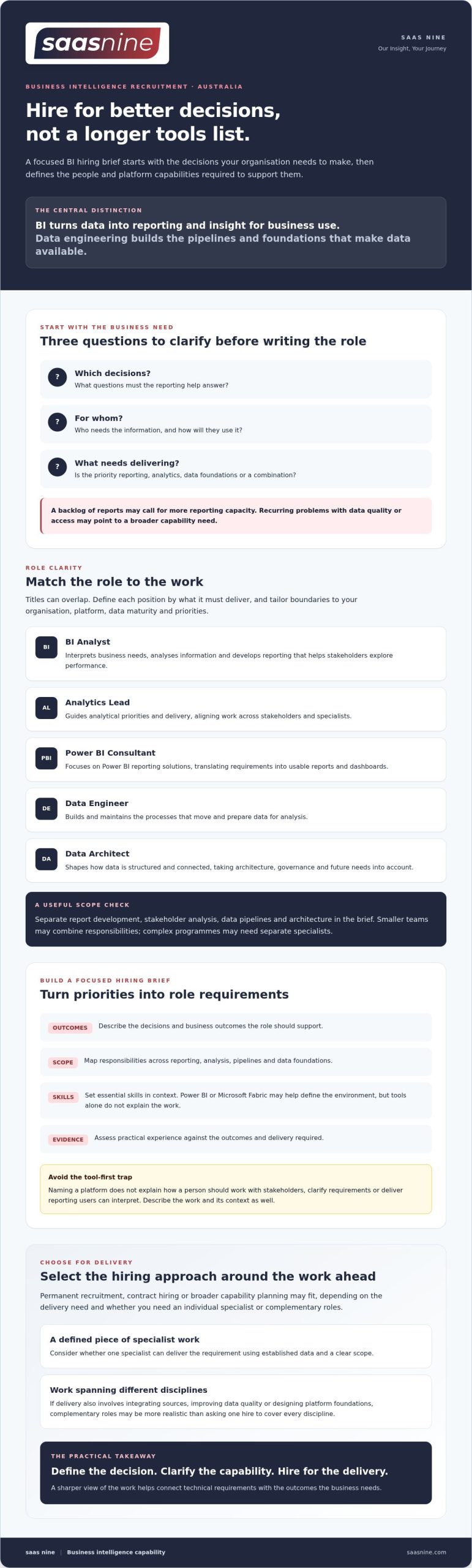
Before advertising a role, identify the decisions it should support, who will use the information, and what reporting is required. Ask whether the immediate issue is a backlog of reports or a wider gap in data capability, ownership or ways of working. Those problems call for different responses: more reporting capacity may clear queued requests, while recurring issues with data quality or access may point to a broader capability need.
A tool-first position description can narrow the search too early. Naming Power BI or Microsoft Fabric may help define the environment, but it won’t explain how the person should work with stakeholders, clarify requirements or deliver reporting that users can interpret. Describe the work and its context as well as the platform.
- Decisions: What questions must the reporting help answer?
- Audience: Who needs the information, and how will they use it?
- Delivery: Is the priority reporting, analytics, data foundations or a combination?
Clear answers give business intelligence recruitment Australia a more useful starting point: a capability brief shaped around organisational needs, rather than a list of tools attached to a job title.
Which business intelligence roles and Microsoft skills might your team need?
Role titles can overlap, so define each position by the work it must deliver. In business intelligence recruitment Australia, this helps separate the need for clearer reporting from the need to strengthen data pipelines or architecture. The right mix depends on your current platform, data maturity and delivery priorities.
- BI analysts interpret business needs, analyse information and develop reporting that helps stakeholders explore performance.
- Analytics Leads guide analytical priorities and delivery, aligning work across stakeholders and specialists.
- Power BI Consultants focus on reporting solutions in Power BI, including translating requirements into usable reports and dashboards.
- Data Engineers build and maintain the processes that move and prepare data for analysis.
- Data Architects shape how data is structured and connected, considering architecture, governance and future needs.
BI roles focus on interpreting data and presenting insight for business use; data engineering roles focus on building the pipelines and foundations that make data available for that work. The distinction is useful, but not absolute: in smaller teams, responsibilities may overlap, while complex programmes may need separate specialists.
Match role scope to the work that must be delivered
Separate report development, stakeholder analysis, data pipelines and architecture in your hiring brief. One specialist may be suitable when the need is well-defined, such as developing a set of Power BI reports using established data. If the work also involves integrating sources, improving data quality or designing platform foundations, complementary roles may be more realistic than expecting one hire to cover every discipline.
Microsoft Fabric, Power BI and OneLake may be relevant where they align with your environment and requirements; they shouldn’t appear as mandatory skills by default. Specify the tasks candidates must handle and the platform context they’ll work in. For Fabric-specific hiring considerations, explore Microsoft Fabric recruitment with saas nine.
How to define and assess a business intelligence hiring brief
A focused brief gives candidates and hiring teams the same picture of the work. For business intelligence recruitment Australia, move through four steps: define the outcomes, map responsibilities, set essential skills, then assess evidence against the brief. Keep requirements tied to the work rather than adding tools or credentials simply because they appear in other position descriptions.
- Define outcomes: Specify what the role must deliver, such as a reliable reporting pack or clearer analysis of a defined business process.
- Map responsibilities: Identify who gathers requirements, prepares data, develops reports and explains findings. Separate tasks that need distinct expertise.
- Set essential skills: Name the platforms and methods candidates must use in your environment, distinguishing essential capability from skills that can be developed.
- Assess evidence: Look for examples of relevant delivery and how candidates approached the problems behind it.
Connect each requirement to an observable deliverable. If the priority is operational reporting, assess how a candidate would clarify measures, check data definitions and present results for the intended audience. For broader data and analytics capability, saas nine’s data and AI recruitment in Australia page outlines related role areas.
Make candidate assessment relevant to the role
Use a role-relevant scenario or work discussion, not an assumed standard test. Ask candidates to talk through how they would handle an ambiguous reporting request: what would they clarify, who would they consult, and how would they explain an unexpected result? For platform experience, invite them to describe work in the tools your team actually uses and what they personally delivered.
Assess communication, stakeholder discovery and data reasoning alongside technical experience. Don’t make a certification mandatory unless the role genuinely requires it. A consistent set of questions, mapped to the brief, helps interviewers compare evidence rather than impressions. This is also where a specialist talent partner such as saas nine can help employers refine role scope and connect requirements with relevant capability.
Choose a business intelligence recruitment model that fits delivery
The right hiring model depends on the work’s duration, urgency and place in your wider data strategy. Permanent recruitment may suit an ongoing need, such as building internal reporting capability or maintaining data foundations. Contract hiring can be appropriate for defined delivery periods, specialist gaps or project phases. If priorities span several disciplines, broader capability planning can help determine whether to recruit one specialist, complementary roles or a project team.
Before sourcing begins, refine the role against delivery needs. Market intelligence can help test whether the brief combines responsibilities that are difficult to find in one person, or asks for skills beyond what the work requires. That can lead to a more realistic position description and a clearer view of the capability available to support it. This is a practical foundation for business intelligence recruitment Australia.
Connect recruitment with workforce planning
Look beyond the vacancy. Map current capability against delivery priorities, then consider which skills the organisation will need to build or access over time. For example, an immediate reporting requirement may sit alongside a longer-term need for data engineering or architecture capability. Understanding that relationship can guide whether to hire permanently, engage a contractor or plan for a combination of roles. A wider technology workforce planning framework can help connect these decisions with organisational priorities.
Candidate discovery is another part of the process. saas nine’s Talent Portal supports candidate discovery and matching. Use it as a resource within a considered hiring approach, alongside a well-defined brief and assessment criteria.
If you’re weighing up the right mix of BI capability and hiring options, discuss your requirements with saas nine to explore a suitable approach.
Turn BI hiring priorities into a clear capability plan
Effective business intelligence recruitment Australia starts with the decisions your organisation needs to support, then defines the capability and delivery responsibilities required. A clear brief distinguishes reporting and analytics from data engineering and architecture, sets realistic expectations for each role, and assesses candidates against relevant evidence rather than a tool list alone.
The hiring model matters too. Permanent recruitment may support ongoing capability, while contract hiring can address defined delivery needs. Where priorities extend across several roles or future skill gaps, workforce planning can help shape a more connected approach.
saas nine sources Microsoft data and analytics professionals, including Data Engineers, Analytics Leads and Power BI Consultants. Engagement approaches include permanent and contract recruitment, Talent Augmentation and Strategic Advisory, with role design and workforce advice to help connect hiring decisions with business priorities.
Ready to clarify the capability your organisation needs? Discuss your business intelligence capability needs with saas nine and take a considered next step towards a hiring plan that fits your delivery goals.
Frequently Asked Questions
What does business intelligence recruitment involve?
Business intelligence recruitment involves identifying and hiring people who can turn organisational data into useful reporting and insight. It starts with understanding the decisions information must support, then matching required capability to responsibilities. That may include analysis and reporting, stakeholder engagement, or data engineering and architecture. For business intelligence recruitment Australia, define the outcomes and platform context before selecting a job title or sourcing candidates.
Which skills should employers look for when hiring a business intelligence analyst?
Look for analytical reasoning, data interpretation and the ability to explain findings clearly to the people who need to act on them. Stakeholder discovery matters too: analysts must clarify questions and understand what measures mean to the business. Assess relevant reporting experience, attention to data quality and familiarity with platforms such as Power BI when they match your environment. Use examples of past work to explore how candidates approached a real business question.
What is the difference between a BI analyst and a data engineer?
A BI analyst interprets data and develops reporting or analysis to help business users understand performance and answer questions. A data engineer builds and maintains the processes that make data available for that analysis, such as pipelines and data preparation. Their work connects, but the emphasis differs. If reports are needed from accessible, prepared data, an analyst may be the priority; if data isn’t reliably available, engineering capability may also be needed.
Should an Australian organisation hire a permanent BI professional or a contractor?
Choose based on how long the capability is needed and the work to be delivered. Permanent recruitment may suit ongoing responsibilities, such as maintaining reporting or building internal analytics capability. Contract hiring may fit a defined project, specialist requirement or temporary delivery gap. Consider whether the work continues beyond a project, how it connects with existing roles, and what knowledge the organisation needs to retain after delivery.
How can a business define its business intelligence hiring requirements?
Start by identifying the decisions the role should support, who will use its outputs and what needs to be delivered. Then map responsibilities, distinguish essential skills from preferences, and specify relevant platforms only where they reflect the working environment. Assess candidates against the brief using examples or role-related discussions. Ask how they clarify requirements, reason through data and communicate findings, rather than relying on job titles alone.