

The right ERP team is defined by delivery outcomes, not the number of job titles on an organisation chart. For leaders considering ERP project staffing australia, that distinction matters: blurred responsibilities can leave critical work uncovered, while scarce specialists are stretched across competing demands.
Skilled people are central to a successful implementation, but assembling the team takes more than listing vacancies. Leaders need to decide which capabilities the programme requires, when they are needed and whether to hire permanently, bring in contractors or combine both. A generic job description rarely captures the work across design, data, testing, change and ongoing support.
This article explains how to shape roles around realistic responsibilities, choose a staffing mix for each project stage and connect workforce decisions to ERP strategy. saas nine brings market intelligence and talent advisory together to help organisations build delivery capability, not simply fill vacancies.
Key Takeaways
- Anchor ERP project staffing australia in programme outcomes, deliverables and decision responsibilities rather than defaulting to standard job titles.
- Map each workstream to the capabilities it requires, then clarify ownership to reduce gaps and duplicated effort.
- Match permanent, contract or blended hiring to the capabilities the organisation needs during each delivery phase and beyond.
- Connect transformation goals to role design and engagement choices, using market insight to shape a team with lasting organisational value.
Why ERP project staffing in Australia needs to start with delivery outcomes
ERP change brings together business decisions, technology delivery and operational readiness, often when specialist capability is difficult to secure. A programme can lose momentum when responsibilities are unclear or one person is expected to cover work that requires different expertise. A practical approach to ERP project staffing australia starts with the programme’s intended outcomes, then identifies the capabilities and role ownership needed to achieve them.
ERP project staffing matches workforce capability to defined programme outcomes, with clear role ownership aligned to each delivery stage and longer-term business needs. This differs from filling an ongoing vacancy. A permanent operational role addresses continuing responsibilities; a transformation team is assembled around a change with defined stages, decisions and outcomes. Some capabilities are needed throughout, while others are essential only at specific points.
What makes ERP project staffing different from filling a vacancy?
A programme depends on complementary responsibilities across design, delivery and adoption. For example, a process decision needs to be translated into a workable solution, tested against business needs and communicated to the people who will use it. If these responsibilities are bundled into a generic position description, ownership can become blurred and important handovers may be missed.
A job title signals a broad discipline, not the scope or result of a role. Define each position by its decisions, deliverables, dependencies and stage of involvement. This gives hiring teams a clearer basis for assessing capability and helps project leaders see where accountability sits.
Where Microsoft ERP capability fits
Microsoft ERP programmes differ by platform and organisational context. Dynamics 365 Finance & Operations and Business Central are distinct ERP environments, so the processes in scope and the intended operating model should shape the team’s capability requirements. A useful foundation is What is Enterprise Resource Planning (ERP)?, which outlines ERP’s role in connecting business operations. For Microsoft-specific workforce planning, Dynamics 365 ERP recruitment in Australia explores how specialist capability can be aligned with programme needs.
How to map ERP project roles to the work that must be done
Build the role map from programme deliverables, workstreams and decisions, rather than copying a standard ERP team structure. Start by listing what the programme must produce, who owns each decision and where accountability passes between teams. For an Australian public sector programme, the Australian Government ERP Standards can provide relevant context when considering ERP capability.
Role-mapping principle: each position should own a defined contribution to delivery. Keep accountabilities separate from skills. A role may require configuration experience, stakeholder facilitation or data expertise, but those skills describe how someone contributes. They should not obscure the outcome the person is accountable for. This distinction helps keep position descriptions realistic and makes capability easier to assess.
Build a balanced Microsoft ERP delivery team
Match roles to the actual scope. A Dynamics 365 functional specialist may translate business processes into system requirements, while a solution architect guides how the solution fits together. Add technical, integration, data or testing capability when the design and delivery plan call for it. For example, an integration workstream may need a role accountable for interface design, but a programme without that scope does not need the same role by default.
Change responsibilities also depend on the programme’s adoption needs. Assign clear ownership for activities such as preparing users and coordinating readiness, rather than assuming another role will absorb the work.
Turn programme scope into realistic position descriptions
For each position, specify the expected outcome, decision boundaries, dependencies and collaboration required. If one description combines process design, data migration, testing and user adoption, separate the accountabilities when they require different expertise or ownership. This makes responsibilities clearer for candidates and programme leaders alike.
Use platform context to refine the scope. A Dynamics 365 ERP capability plan can connect specialist requirements with programme needs. saas nine supports organisations to define roles and shape delivery teams; a focused role map is a practical starting point for that work.
Permanent, contract or blended ERP staffing: choose for the delivery phase
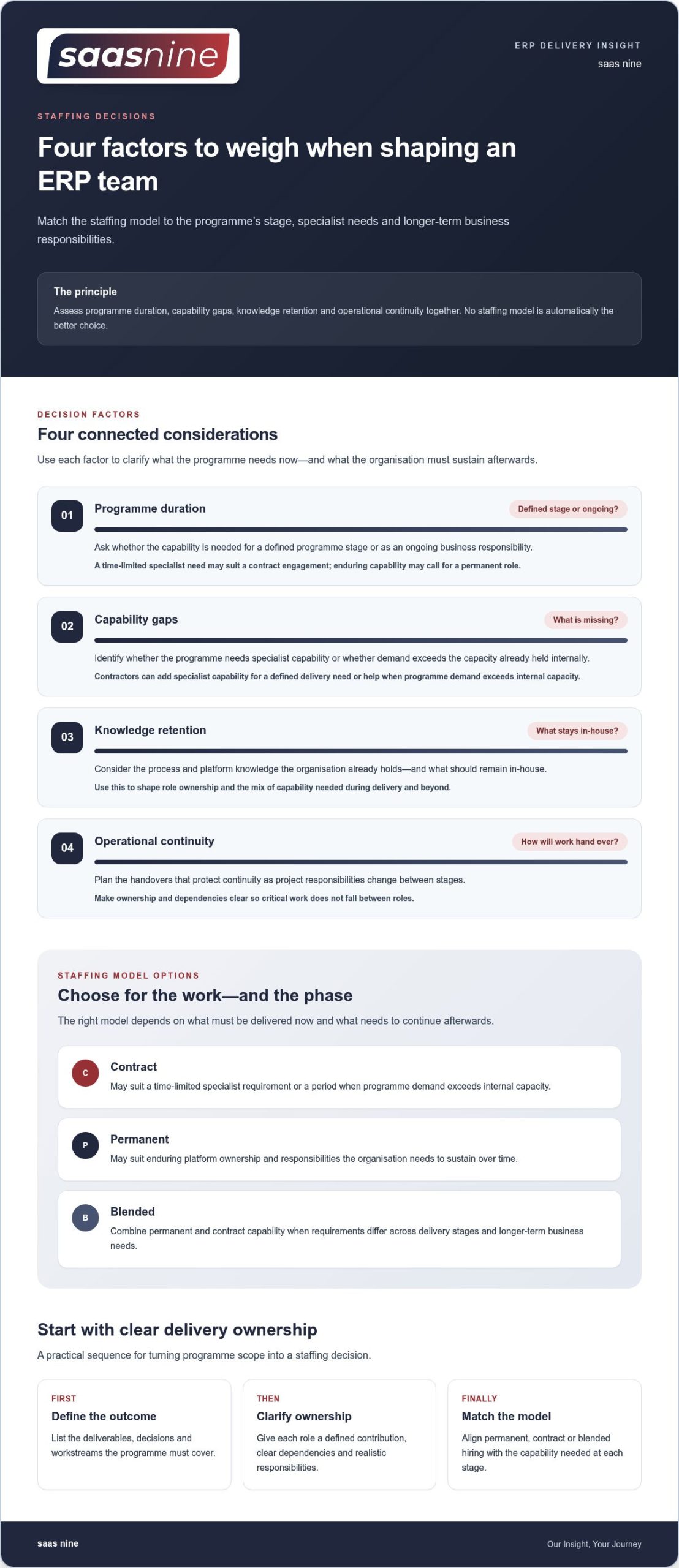
The right staffing model depends on what the organisation needs to deliver now and what it must sustain afterwards. For ERP project staffing australia, assess programme duration, capability gaps, knowledge retention and operational continuity together. A time-limited specialist need may suit a contract engagement; enduring platform ownership may call for permanent capability. Neither model is automatically the better choice.
Use these questions to guide the decision:
- Is the capability required for a defined programme stage or as an ongoing business responsibility?
- Does the organisation already hold process and platform knowledge that should remain in-house?
- What handovers will protect continuity as project responsibilities change?
When does contract ERP staffing make sense?
Contractors can add specialist capability for a defined delivery need or when programme demand exceeds internal capacity. For example, an organisation may need focused expertise for a specific workstream without creating a permanent role around a temporary requirement. Plan collaboration with internal teams from the outset. Agree shared decisions, document relevant context and set handover points so knowledge remains accessible after the engagement ends.
When should ERP capability be retained permanently?
Consider permanent hiring where the organisation needs sustained platform ownership, ongoing optimisation or deep knowledge of its business processes. Internal capability can maintain the connection between system decisions and changing operational needs beyond implementation. A blended team can bring these strengths together: permanent staff contribute organisational context, while contractors add specialist delivery capacity for defined needs.
Review the model as the programme moves through delivery and into operations. If a temporary responsibility becomes an ongoing need, revisit whether the capability belongs in the permanent team. If internal ownership is clear but a specialist gap remains, targeted contract support may complement it. Workforce planning should connect these choices with broader capability priorities, and saas nine’s technology workforce planning can help organisations consider that alignment.
To assess the right balance of enduring capability and project support, discuss your ERP workforce needs with saas nine.
How saas nine connects ERP staffing with transformation delivery
Strong ERP workforce planning starts with the transformation goal, not a list of vacancies. saas nine helps organisations move from strategic intent to delivery capability: clarify the outcomes, identify the capabilities required, shape realistic roles and select an engagement model suited to the work and its longer-term needs.
From role definition to mobilisation
Market intelligence helps test whether a proposed role reflects its responsibilities and the capability available in the Microsoft talent market. saas nine uses this insight alongside workforce planning to refine position descriptions, distinguish overlapping accountabilities and focus hiring on agreed programme needs. Contingent Recruitment supports permanent and contract appointments, while Talent Augmentation provides individual specialists or project teams for transformation programmes. Strategic Advisory connects workforce choices with capability strategy and transformation priorities.
For organisations exploring existing and emerging workforce capability, the Talent Portal supports capability discovery, workflow automation, candidate matching and visibility for clients and candidates. It can complement a broader planning approach that includes clear role outcomes and an understanding of the skills already present in the organisation.
This joined-up view helps leaders consider not only who is needed for implementation, but how knowledge and ownership will continue after key delivery stages. It connects strategy, technology choices and workforce decisions, rather than treating hiring as a separate activity.
Plan the next step for your ERP programme
Before mobilising, bring together three practical inputs: the programme outcomes, capability gaps that could affect delivery and the preferred balance of permanent and contract support. These give workforce discussions a clear starting point and keep role design grounded in the transformation context.
saas nine works as a recruitment partner and talent adviser, helping organisations define capability and build teams around delivery needs. To discuss how this approach could fit your programme, talk with saas nine about ERP project staffing.
Carry delivery capability beyond go-live
Plan workforce capability as something your organisation will need to maintain and adapt, not just assemble for implementation. As the ERP programme moves towards business as usual, revisit who owns platform decisions, where critical knowledge sits and which capabilities will support the next stage of transformation. This forward view connects project delivery with the organisation’s longer-term technology direction.
For ERP project staffing australia, turn that direction into a practical workforce plan. Consider how capability across Dynamics 365 Finance & Operations, Dynamics 365 CE and Business Central can support the outcomes you’re pursuing, then align permanent and contract recruitment, Talent Augmentation or Strategic Advisory with the needs ahead.
saas nine brings workforce planning and Microsoft technology recruitment together, helping organisations make considered decisions about roles and delivery capability. Start a focused conversation about your programme’s priorities and where your team needs to grow: explore ERP staffing support with saas nine. A clear next step can help your transformation move forward with confidence.
Frequently Asked Questions
Is ERP project staffing only needed for a new implementation?
No. Staffing considerations arise whenever an ERP initiative changes the work people must perform or the expertise available to support it. For a small system change, existing operational staff may be able to absorb the work; a broader programme may need dedicated capacity. Distinguish project work from routine support by checking whether existing teams can meet business-as-usual commitments while contributing to the change.
Can contract ERP specialists work alongside a permanent team?
Yes. A practical arrangement is to have internal subject matter experts contribute at planned points, rather than expecting them to be available throughout every project activity. For example, schedule their input around process workshops, validation sessions or operational readiness reviews, and agree how much time their managers can release. This protects day-to-day responsibilities while making internal knowledge accessible to the programme.
What should an ERP project role description include?
Beyond outlining responsibilities, make the role description useful for assessing candidates. Identify the business context they’ll work in, the stakeholder groups they’ll engage with and the evidence that would demonstrate relevant experience. For example, ask candidates to explain how they’ve handled a comparable process challenge, not just which ERP platform they’ve used. This helps distinguish hands-on capability from familiarity with product terminology.
How can an organisation avoid gaps between ERP project roles?
Look beyond the organisation chart and check whether key people are available when the programme needs them. Business specialists may be needed for project workshops while also managing operational peaks, creating a capacity clash even when a role has an assigned owner. Compare the delivery calendar with team commitments, then flag periods when competing demands could affect participation or timely decisions.
When should ERP project staffing planning begin?
Prepare a useful starting point by bringing together the approved programme scope, an inventory of internal skills and a view of team availability. Include existing platform knowledge and relevant business-process experience, not just formal job titles. These inputs help leaders identify which capabilities are available internally and where external support may be needed, making workforce discussions more grounded in the programme.