

Did you know that Australia’s technology workforce recently recorded its first decline in 12 years, just as demand for AI and data specialists reached a fever pitch? It’s a sobering reality for executives trying to scale complex Microsoft ecosystems. Finding deep expertise in Azure or Fabric often feels like searching for a needle in a haystack, resulting in inflated salary expectations for mediocre candidates. We understand the frustration of seeing a bold business strategy stalled by a lack of technical delivery capability. Our insight, your journey starts with a more structured way to look at talent.
This guide provides a strategic roadmap for technology workforce planning Australia in 2026, moving beyond simple headcount to a modernised approach of architecting genuine capability. You’ll discover how saas nine helps organisations unbundle position descriptions into realistic, high-impact roles. We’ll show you how to reduce hiring risk through expert vetting and access a pool of pre-qualified Microsoft professionals ready to drive your digital transformation. By the end of this article, you’ll have a clear path to align your technical teams with your commercial goals.
Key Takeaways
- Understand why the shift from cloud-first to AI-native operations requires a total rethink of how you align human capital with your digital transformation goals.
- Learn a structured five-step process for technology workforce planning Australia that maps your Microsoft ecosystem requirements directly to your business strategy.
- Discover how to avoid common “unicorn” hiring traps by unbundling position descriptions into realistic, delivery-focused roles that attract high-calibre talent.
- Explore how saas nine uses an Agentic Workforce Platform to replace slow hiring workflows with AI-driven discovery and precision candidate matching.
What is Technology Workforce Planning in the 2026 Australian Context?
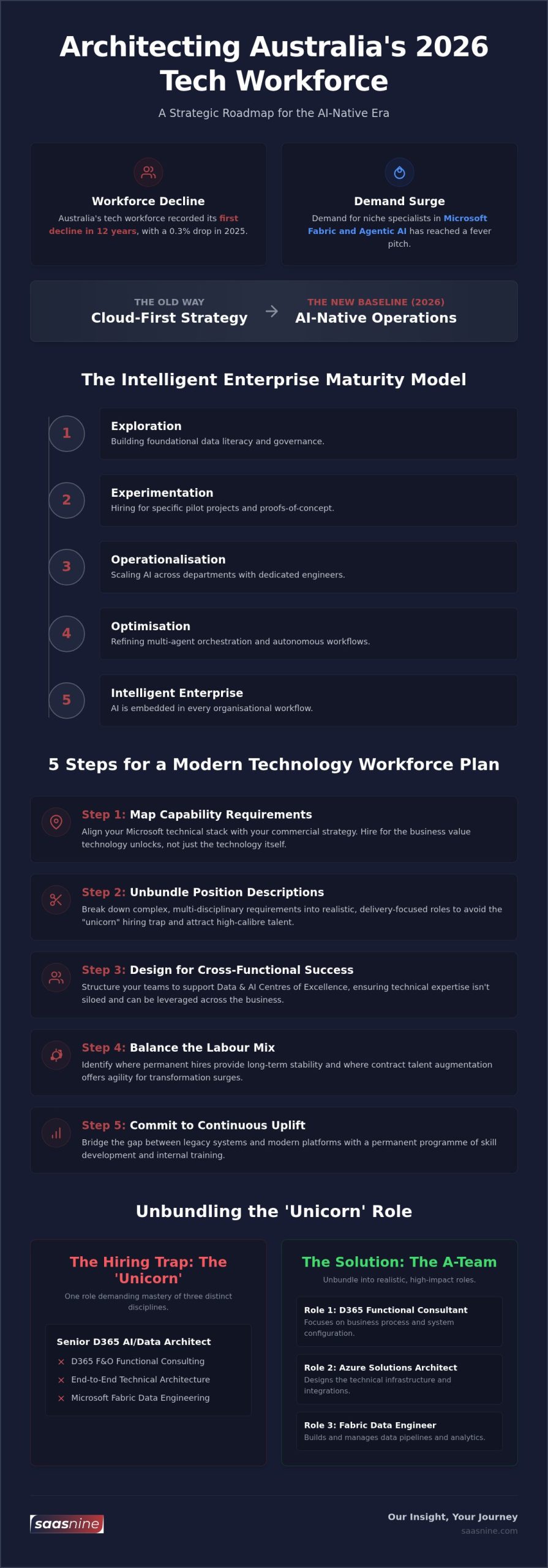
In the current climate, Strategic workforce planning has evolved from a back-office HR function into a critical executive lever. At saas nine, we define technology workforce planning Australia as the deliberate alignment of an organisation’s human capital with its digital transformation objectives, specifically within the Microsoft ecosystem. We’ve moved past the era of ‘Cloud-First’ strategies. As of 2026, we’ve hit a tipping point where ‘AI-Native’ operations are the baseline for competition. This shift requires a total rethink of team structures, moving away from siloed technical roles toward integrated delivery units.
The Australian market presents unique hurdles. With the Australian Computer Society recording a 0.3% decline in the tech workforce in 2025, the scarcity of niche skills in Microsoft Fabric and Agentic AI has reached a premium. Reactive hiring is no longer a viable option. It leads to talent gaps and project delays. Instead, leaders must adopt a proactive capability strategy. This ensures long-term delivery success by identifying the exact technical competencies needed before a project begins. Our insight, your journey begins with moving from headcount tracking to capability mapping.
The Intelligent Enterprise Maturity Model
To navigate this transition, executives must understand where their organisation sits on the maturity curve. This dictates your specific workforce needs:
- Exploration: Building foundational data literacy and governance.
- Experimentation: Hiring for specific pilot projects and proof-of-concepts.
- Operationalisation: Scaling AI across departments with dedicated engineers.
- Optimisation: Refining multi-agent orchestration and autonomous workflows.
- Intelligent Enterprise: AI is embedded in every organisational workflow.
Identifying your current stage allows you to unbundle complex roles. You can then hire for the specific maturity level of your technical stack rather than chasing generalist “unicorns” who may not fit your actual delivery requirements.
5 Steps to Organise a Modern Technology Workforce Plan
Effective technology workforce planning Australia requires a shift from static organisational charts to dynamic capability maps. To build a resilient team for 2026, follow this structured five-step approach:
- Map Capability Requirements: Align your Microsoft technical stack with your commercial strategy. Don’t hire for technology; hire for the business value it unlocks.
- Unbundle Position Descriptions: Break down complex, multi-disciplinary requirements into realistic, delivery-focused roles to avoid the “unicorn” hiring trap.
- Design for Cross-Functional Success: Structure your teams to support Data & AI Centres of Excellence. This ensures technical expertise isn’t siloed.
- Balance the Labour Mix: Identify where permanent hires provide long-term stability and where contract talent augmentation provides the agility needed for transformation surges.
- Commit to Continuous Uplift: Bridging the gap between legacy systems and modern platforms requires a permanent programme of skill development.
This methodology ensures your technology workforce planning Australia remains agile. It allows you to pivot as Microsoft’s “always-on” roadmap introduces new capabilities in Agentic AI and data orchestration.
Unbundling the ‘Unicorn’ Role
Traditional position descriptions often fail in complex transformations because they hunt for “unicorns”, which are candidates who don’t exist in the real world. We see this most often in Dynamics 365 Finance & Operations and Supply Chain projects, where one role is expected to master functional consulting, technical architecture, and data engineering simultaneously. saas nine helps you refine these descriptions into roles that are actually available in the Australian market.
By unbundling these requirements, you reduce hiring risk and improve your chances of securing high-calibre professionals. Our insight, your journey begins with a realistic assessment of what a single human can achieve. If you’re struggling to find the right balance of niche skills, we can help you map your ecosystem capability to ensure your delivery team is structured for success.
Executive Search & Headhunting: Securing Niche Microsoft Capability
Contingent recruitment often focuses on speed and volume, which is insufficient for senior technology leaders. Strategic executive search is a more deliberate, consultative process. In the context of technology workforce planning Australia, this means identifying leaders who don’t just manage teams but architect the future capability of the business. We use deep market mapping to engage passive talent within the Azure and Fabric domains. This ensures you aren’t limited to active job seekers who may lack the niche technical literacy required for 2026 delivery.
Vetting for the ‘Agentic Shift’ is now a commercial necessity. You need leaders who understand AI governance and multi-agent orchestration. A search partner must have the technical literacy to distinguish between those who follow trends and those who can deliver measurable business value. Our insight, your journey is built on this specialised expertise, ensuring your leadership team can navigate the complexities of a modern Microsoft ecosystem.
Vetting for Technical Leadership
Watch for red flags like a lack of hands-on experience with modern data architectures or a failure to articulate the commercial impact of technical choices. When vetting cloud architects and technical leads, we look for a proven ability to drive digital transformation rather than merely maintaining existing infrastructure. Candidates must demonstrate they can lead the transition to autonomous workflows while maintaining strict governance standards. It’s about finding the balance between innovation and operational stability.
Accessing Pre-qualified Microsoft Professionals
A vetted talent pool is a strategic asset that reduces hiring risk and significantly accelerates project kick-offs. saas nine provides rapid access to Microsoft Fabric specialists, ERP program managers, and data architects through our proprietary talent portal. This pre-qualification ensures you aren’t starting from scratch for every new requirement, allowing you to mobilise teams with confidence. If you’re looking to secure senior talent that aligns with your 2026 goals, speak with our specialist advisors to explore your options.
Modernising the Search: The saas nine Agentic Workforce Platform
Traditional hiring workflows are often too slow to keep pace with the 2026 technical landscape. To bridge this gap, saas nine has moved beyond conventional recruitment methods by investing in our proprietary Agentic Workforce Platform. This technology replaces manual, fragmented processes with AI-driven capability discovery. It allows us to match candidates based on deep technical insights and real-world delivery governance rather than just keywords on a CV. We focus on finding the specific competencies required to navigate the continuous update cycles of the Microsoft ecosystem.
By integrating workforce-planning intelligence directly into the search process, we provide a more accurate reflection of the Australian market. The saas nine Talent Portal offers executives real-time visibility into a pool of pre-qualified Microsoft professionals. This enhanced visibility is crucial for mobilising teams quickly when project scopes shift or new platform updates are released. We align this rapid mobilisation with our ‘Our Insight, Your Journey’ philosophy, ensuring every hire is a strategic step toward your long-term goals.
Strategic Advisory and Organisational Design
Effective technology workforce planning Australia is not just about filling seats; it’s about designing a delivery structure that lasts. saas nine acts as a steady hand for executive stakeholders, providing the strategic advisory needed to navigate complex transformations. We leverage market intelligence to help you define the right roles and organisational hierarchies for your specific maturity level. This approach ensures that your technical capability always supports your commercial objectives.
This partnership ensures that your workforce remains a competitive advantage. We focus on practical business value, helping you structure teams that can responsibly adopt and scale AI. By connecting your business strategy with our technical capability mapping, we reduce the friction often found in large-scale Microsoft implementations. Our goal is to provide the clarity and confidence you need to lead your organisation through its next phase of growth. For a deeper exploration of how to transition from static hierarchies to fluid, AI-integrated structures, our guide on organisational design for the agentic workforce in Australia provides a comprehensive roadmap for 2026.
Architecting Your 2026 Capability
The shift toward AI-native operations requires more than just reactive hiring; it demands a fundamental shift in how you structure your technical teams. By moving from simple headcount tracking to a specialised Microsoft Ecosystem Capability Map, you ensure every hire aligns directly with your commercial objectives. We have explored how unbundling realistic roles and leveraging an AI-powered Agentic Workforce Platform can reduce hiring risk while accelerating your project timelines. This approach provides the precision needed to navigate the complexities of technology workforce planning Australia in a competitive environment.
saas nine provides the expert strategic advisory required to act as a steady hand for executive stakeholders during complex transformations. Our insight, your journey begins with a clear roadmap for capability uplift and organisational design that aligns your Microsoft ecosystem investments with the agentic workforce required to execute them. It’s time to move beyond traditional recruitment and embrace a partnership built on technical literacy and genuine market intelligence. Explore the saas nine Talent Portal and mobilise your workforce today to secure the niche skills your organisation needs to thrive. We look forward to supporting your path toward a successful and resilient digital future.
Frequently Asked Questions
What are the core components of a technology workforce plan in Australia?
A comprehensive plan focuses on aligning human capital with digital goals. Key components include a Microsoft Ecosystem Capability Map, an assessment of organisational maturity, and a defined labour mix of permanent and contract staff. It’s about moving from headcount to capability strategy. This ensures your technology workforce planning Australia remains robust against market shifts like the move to AI-native operations and the continuous update cycles of the Microsoft roadmap.
How do I find niche Microsoft Fabric or Agentic AI specialists in a tight market?
Finding niche specialists requires moving beyond traditional job boards to engage passive talent. We use our proprietary Agentic Workforce Platform to discover professionals with specific technical literacy in Microsoft Fabric and multi-agent orchestration. By accessing a pre-qualified pool via the saas nine Talent Portal, you reduce hiring risk and mobilise teams faster. This proactive approach bypasses the typical delays of contingent recruitment in a scarce talent market.
Why is unbundling position descriptions important for Australian tech hiring?
Unbundling is essential because traditional position descriptions often combine too many disparate skills, creating “unicorn” roles that don’t exist in the Australian market. By breaking these down into realistic, delivery-focused roles, you attract high-calibre candidates who actually possess the required competencies. This clarity improves hiring outcomes and ensures your team has the specific expertise needed for successful Microsoft ecosystem transformations rather than just generalist knowledge that misses the mark.
What is the difference between talent augmentation and contingent recruitment?
Contingent recruitment provides rapid access to individual permanent or contract professionals to fill specific gaps. In contrast, talent augmentation involves the provision of individual specialists or entire project teams specifically to support transformation programmes and capability-uplift initiatives. While both models address talent shortages, talent augmentation is often more integrated into the delivery of a specific business outcome or a major technical milestone within the organisation’s long-term journey.
How can saas nine help with executive search for CIO or CTO roles?
We act as a trusted talent advisory partner for executive search, using deep market mapping to identify senior leaders who can drive digital transformation. Our process involves technical vetting to ensure candidates understand AI governance and ecosystem architecture. By connecting your business strategy with technical capability, saas nine ensures your next CIO or CTO is a steady hand capable of navigating complex technical landscapes and organisational design challenges with confidence.