

With 77% of Australian businesses reporting a shortage of the technology talent required to meet their objectives, the risk of a stalled digital transformation is a constant reality. Most organisations struggle not because they lack ambition, but because they fail to define precise ERP implementation team roles that bridge the gap between high-level strategy and technical execution. Vague position descriptions often lead to misaligned hires, especially in a market where specialised Microsoft Dynamics 365 and Power Platform experts are increasingly scarce.
At saas nine, we recognise that your project’s success depends on moving past generic recruitment to a more strategic talent advisory approach. This guide will teach you how to unbundle complex requirements into realistic, high-performing roles that align your technical capability with your commercial goals. We’ll explore the critical differences between functional and technical leads and provide a framework for structuring a team that delivers. By following this path, you can ensure faster mobilisation of vetted professionals who understand the intricacies of the Microsoft ecosystem. Our insight, your journey.
Key Takeaways
- Learn how to structure your team based on influence and change-readiness rather than just seniority to bridge the gap between legacy modernisation and future-state data value.
- Gain clarity on the distinct responsibilities of Functional Leads and Technical Leads to ensure your Solution Architect can effectively guard the system’s long-term integrity.
- Master the process of unbundling vague position descriptions into specific ERP implementation team roles that align your business strategy with the Microsoft ecosystem.
- Discover how to mobilise pre-qualified professionals faster by using saas nine’s Talent Portal and our proprietary Agentic Workforce Model to automate discovery.
The Strategic Architecture of an ERP Implementation Team
Building a team for a digital transformation isn’t just about filling seats; it’s about constructing a bridge between legacy modernisation and future-state data value. In the Australian market, where 72% of CFOs are increasing ERP investments according to recent research, the structure of your delivery team determines the ROI. High-performance ERP implementation team roles require a shift in thinking. Seniority is often a poor metric for selection. Instead, focus on influence and change-readiness.
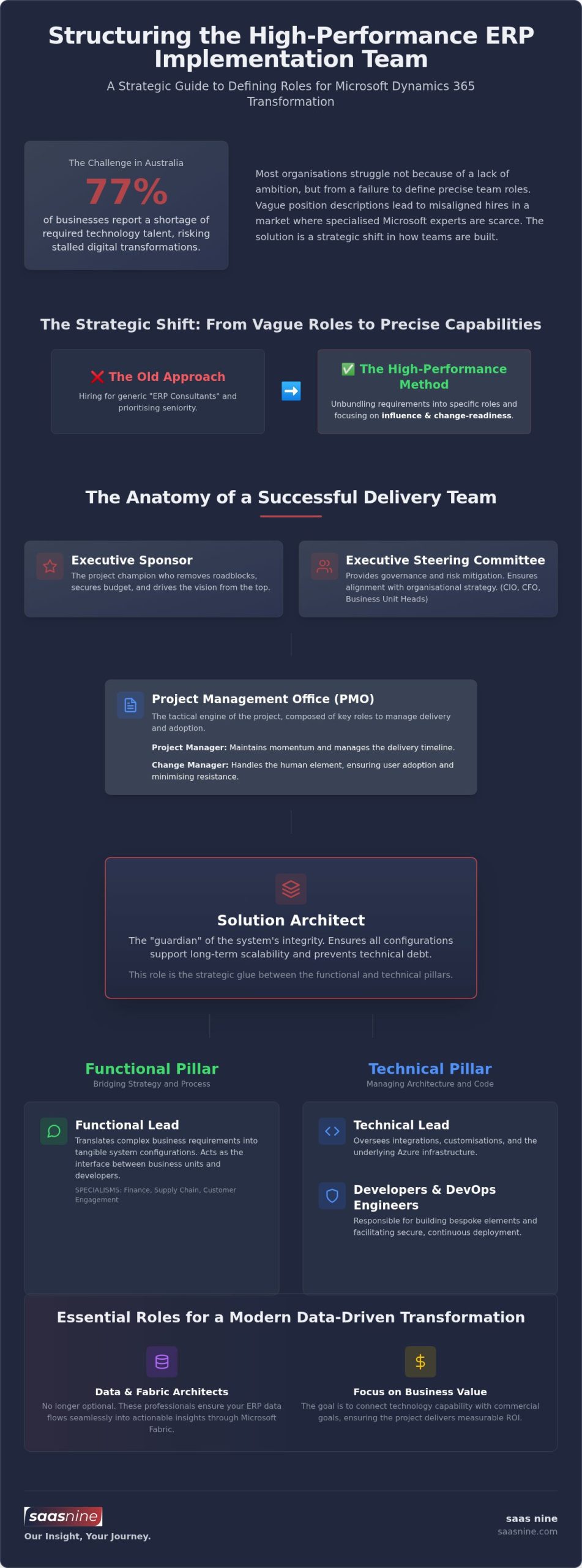
At saas nine, we advocate for unbundling vague position descriptions. A single “ERP Consultant” rarely possesses the depth required for a complex Dynamics 365 rollout. You need specialised capabilities that address specific functional and technical requirements. Central to this is the Executive Sponsor. This leader doesn’t just sign off on invoices; they remove roadblocks and secure the necessary budget to keep the journey on track.
The Executive Steering Committee
This committee typically comprises the CIO, CFO, and Business Unit Heads who own the transformation vision. Their role is one of governance and risk mitigation. They ensure the project remains aligned with the broader organisational design and commercial strategy. By providing a steady hand, they help the project team navigate complex decisions that affect the entire enterprise.
The Project Management Office (PMO)
The Project Manager holds the responsibility for maintaining momentum and managing the delivery timeline. They are the tactical engine of the project. However, technology alone doesn’t guarantee success. A dedicated Change Manager must work alongside the PM to handle the human element of digital transformation, ensuring user adoption and minimising resistance as workflows evolve. Our insight, your journey.
Core Functional vs Technical Roles: Navigating the Microsoft Ecosystem
Success in a Dynamics 365 environment requires a clear distinction between process-driven and architecture-driven responsibilities. While generic hiring often groups these together, high-performance ERP implementation team roles separate these pillars to ensure delivery precision. The Solution Architect serves as the “guardian” of the system’s integrity, ensuring that every customisation or configuration supports long-term scalability rather than immediate convenience. They act as the strategic glue that prevents technical debt from accumulating during the build phase.
At saas nine, we’ve observed a significant shift where Data Architects and Fabric Architects are no longer optional but essential for modern transformation. These professionals ensure your ERP data flows seamlessly into actionable insights through Microsoft Fabric. For a deeper dive into the specific technical requirements for the current market, see our Dynamics 365 Finance & Operations: 2026 Australian Guide.
The Functional Lead: Bridging Strategy and Process
Functional Leads occupy one of the most critical ERP implementation team roles, translating complex business requirements into tangible system configurations. They don’t just know the software; they understand the commercial nuances of specific modules like Finance, Supply Chain, or Customer Engagement. Their value lies in their ability to ensure the technology serves the business process. They act as the primary interface between technical developers and business unit heads, ensuring the final solution delivers actual business value.
The Technical Lead and Developers
Technical Leads manage the “under the hood” elements of the implementation. They oversee complex integrations, bespoke customisations, and the underlying Azure infrastructure. In a modern delivery model, they work closely with DevOps Engineers to facilitate secure, continuous deployment. This technical density ensures that the platform remains robust and secure as your business grows. If you’re struggling to unbundle these requirements for your next project, you can speak with our advisory team for tailored guidance. Our insight, your journey.
Assembling Your Team: A Vetting and Mobilisation Framework
Mobilising the right talent requires a deliberate, step-by-step approach that prioritises precision over sheer speed. To build a team that actually delivers, start by mapping your business strategy to the Microsoft Ecosystem Capability Map. This exercise identifies the exact technical and functional skills required for your specific environment. Don’t settle for generic job descriptions. You must unbundle vague requirements into specific ERP implementation team roles, such as AI Product Owners or Power BI Consultants, to ensure no capability gaps remain.
Once your requirements are clear, evaluate whether permanent placements or contract labour hire best suits your project’s duration and budget. Rigorous vetting is the final safeguard. For a comprehensive technical screening framework, see our guide on vetting cloud architects. This structured approach ensures you secure professionals who can navigate the complexities of a modern rollout.
Strategic Workforce Planning
saas nine provides strategic advisory to help leaders structure their organisational design for long-term success. We look beyond the immediate project to help you build a sustainable capability strategy. Talent augmentation is often the most effective way to scale rapidly during critical implementation phases. It allows you to inject specialised expertise exactly when it’s needed most without the long-term overhead of permanent headcounts. Our insight, your journey.
Market Intelligence and Hiring Outcomes
Using deep market insights reduces hiring risk and improves candidate matching. In the Australian market, where 54% of hiring managers identify attracting candidates with the right industry skills as their biggest challenge, precision is everything. We help you identify professionals with niche technology skills through our specialised talent platform, ensuring a fit for both technical requirements and company culture. If you need to mobilise a vetted team, contact our talent advisory experts to begin your search.
Scaling Capability with the saas nine Agentic Workforce Model
Traditional recruitment methods often move too slowly for the rapid pace of modern cloud transformations. To address this, saas nine has developed the Agentic Workforce Model, a strategic shift that replaces manual, fragmented hiring with automated workflows and enhanced visibility. Central to this approach is our Talent Portal. This AI-powered discovery engine allows organisations to identify pre-qualified professionals who possess the exact technical stack required for your project.
By leveraging this platform, you gain immediate access to a vetted pool of Microsoft specialists. This significantly reduces the risk of misalignment while ensuring faster mobilisation for your ERP implementation team roles. Our commitment remains clear: Our Insight, Your Journey. We guide you through the complexities of organisational design, helping you reach the “Intelligent Enterprise” stage with confidence and precision.
Integrating AI and Human Expertise
We believe that technology works best when balanced with deep industry literacy. saas nine combines AI-driven insights with years of specialised recruitment expertise to produce superior long-term outcomes. This hybrid approach ensures that candidate matching goes beyond keywords to assess cultural fit and strategic capability. As your partner, we also provide guidance on AI Governance and responsible adoption, ensuring your workforce is prepared for the ethical and operational demands of modern technology.
Next Steps for Your ERP Journey
Moving from reactive hiring to proactive workforce capability planning is essential for sustained growth. Instead of waiting for a vacancy to arise, we encourage leaders to map their future requirements today. This foresight ensures your team is ready for the next phase of your digital evolution. You can explore our tailorable engagement models by visiting the saas nine services page. Let’s work together to build a team that doesn’t just implement software, but drives lasting business value.
Securing Your Digital Transformation Future
Building a high-performance delivery team is the most critical step in any digital transformation. By unbundling generic position descriptions into specific ERP implementation team roles, you ensure that every technical and functional requirement is met with precision. We’ve explored how a robust strategic architecture, supported by clear distinctions between process-focused and architecture-focused leads, prevents technical debt and drives long-term value.
Leveraging saas nine’s proprietary Agentic Workforce Platform and our specialised Microsoft Ecosystem Capability Map allows you to bypass the delays of traditional recruitment. Our strategic advisory services are designed to help Australian organisations navigate these complexities with calm assurance. It’s time to move from reactive hiring to proactive workforce capability planning.
Discover pre-qualified Microsoft talent on the saas nine Talent Portal to begin your mobilisation today. We’re ready to support your progress with the intellectual rigour and market intelligence your project deserves. Our insight, your journey.
Frequently Asked Questions
What are the most critical roles for a successful ERP implementation?
Executive Sponsors, Project Managers, Solution Architects, and Functional Leads are non-negotiable for project success. The Executive Sponsor secures budget and removes organisational barriers, while the Solution Architect ensures the platform’s long-term integrity. You also need specific ERP implementation team roles like Data Architects to handle the modern demands of Microsoft Fabric. Identifying these specialised capabilities early prevents the misalignment that often stalls complex digital transformation projects.
How do I distinguish between a Functional Lead and a Technical Lead in Dynamics 365?
Functional Leads focus on business processes and module configuration, translating commercial requirements into system settings. They bridge the gap between end-users and the platform. Technical Leads manage the underlying architecture, customisations, and integrations within the Azure environment. While the Functional Lead ensures the software works for the business, the Technical Lead ensures the system remains robust from a coding and infrastructure perspective. Both are essential for a balanced delivery team.
Why should I consider contract labour hire for my ERP project team?
Contract labour hire provides the flexibility to scale your team rapidly during high-intensity implementation phases without increasing permanent headcount. ERP projects are often finite journeys that require niche expertise, such as Power Platform specialists, for specific durations. Using a contract model allows you to access pre-qualified professionals through saas nine’s Agentic Workforce Platform. This ensures you have the right technical capability exactly when the project timeline demands it.
What is the role of a Change Manager in an ERP rollout?
Change Managers address the human element of digital transformation, ensuring that staff actually adopt the new system. They manage communication, training, and cultural shifts to reduce resistance. Without a dedicated Change Manager, even the most technically perfect ERP implementation can fail if users don’t embrace the new workflows. They are essential for securing the long-term ROI of your technology investment by aligning your people with the new digital process.
How does saas nine assist with vetting Microsoft professionals?
saas nine uses a specialised Microsoft Ecosystem Capability Map and our proprietary Talent Portal to discover and vet talent. We don’t just look at CVs; we perform rigorous technical screenings that match candidates to specific ERP implementation team roles. Our advisory approach ensures that every professional is pre-qualified for their ability to deliver within Dynamics 365 environments, significantly reducing hiring risk and mobilisation time for Australian enterprises.