

Most Australian organisations are currently sitting on a “data swamp” rather than a functional lakehouse, simply because they lacked the specific expertise to structure their ingestion layers correctly. You likely recognise that while Microsoft Fabric has simplified the tech stack, it has simultaneously raised the bar for architectural precision. To successfully hire medallion architecture data engineer australia talent in 2026, you need to look beyond generalist coding skills and find someone who understands the journey from raw ingestion to business-ready insights. At saas nine, we follow the philosophy of “Our Insight, Your Journey” to help you navigate this increasingly competitive talent market.
This guide provides a strategic framework to help you identify and vet these specialised professionals, ensuring your data platform remains governed, scalable, and compliant with the latest Australian Privacy Act reforms. We will explore the specific technical competencies required for the Fabric ecosystem, current market salary benchmarks across the Australian talent landscape, and how to unbundle complex position descriptions to secure the right delivery capability for your digital transformation. For a broader view of the local talent landscape, our guide to hire data engineers in Australia provides a comprehensive strategic framework covering visa thresholds, market conditions, and mobilisation strategies.
Key Takeaways
- Understand how the Medallion design pattern provides a logical structure for data in a Lakehouse environment, preventing “lakehouse sprawl” through defined Bronze, Silver, and Gold layers.
- Identify the core technical competencies, such as PySpark proficiency and Delta Lake governance, required to effectively hire medallion architecture data engineer australia specialists.
- Implement a multi-stage vetting framework that uses scenario-based questions to distinguish between generalist engineers and those capable of managing complex ACID transactions.
- Discover how to leverage the saas nine Talent Portal to access pre-vetted Microsoft professionals and align your technical hiring with long-term business strategy.
Understanding the Medallion Architecture Specialist Role
The Medallion architecture isn’t just a technical configuration; it’s a strategic design pattern used to logically organise data within a data lakehouse architecture. As Australian businesses pivot toward Microsoft Fabric, the complexity of managing data across Bronze, Silver, and Gold layers has increased. You’ll find that a generalist data engineer often lacks the specific expertise required for Delta Lake optimisation and OneLake governance. To successfully hire medallion architecture data engineer australia specialists, you must prioritise candidates who understand how to maintain data integrity throughout its entire lifecycle.
This role is particularly critical in the current Australian regulatory environment. With the 2026 Privacy Act reforms in full effect, “Responsible AI” is no longer a choice but a compliance necessity. A specialist ensures that data lineage is preserved and that automated decision-making systems remain transparent. They bridge the gap between fragmented raw sources and the executive-level insights required for strategic growth, ensuring your lakehouse doesn’t devolve into an unmanaged data swamp.
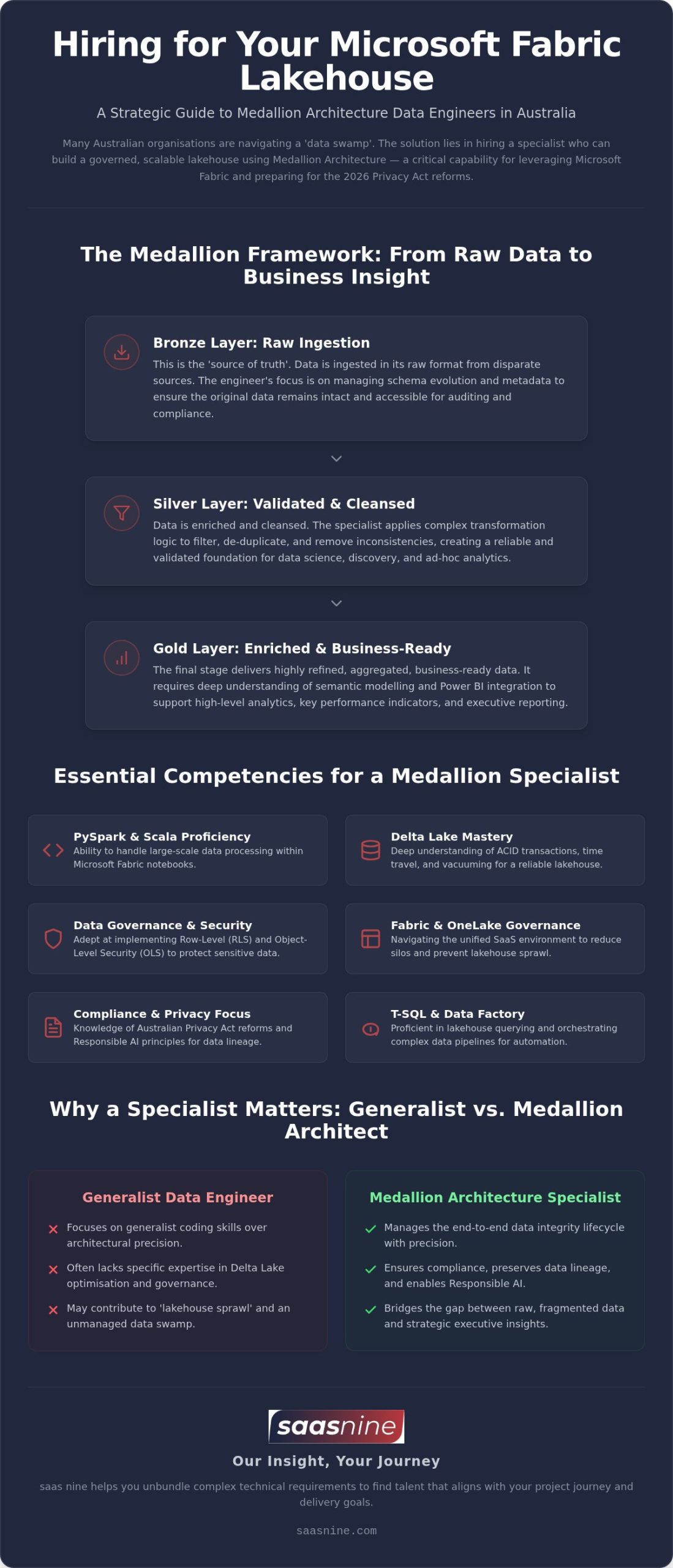
The Bronze, Silver, and Gold Framework
A Medallion specialist manages the progression of data through three distinct stages of refinement, each requiring a different technical lens:
- Bronze (Raw): This layer involves the ingestion of raw data from disparate sources. The engineer must manage schema evolution and metadata to ensure the “source of truth” remains intact and accessible for auditing.
- Silver (Validated): Here, data is enriched and cleansed. Specialists apply complex transformation logic to remove inconsistencies, creating a reliable foundation for data science and discovery.
- Gold (Enriched): This final stage delivers business-ready data. It requires a deep understanding of semantic modelling and Power BI integration to support high-level analytics and executive reporting.
At saas nine, we help you unbundle these technical requirements to find talent that aligns with your specific project journey and delivery goals.
Key Technical Competencies for a Medallion Data Engineer
Identifying the right talent requires a deep dive into specific technical proficiencies. To hire medallion architecture data engineer australia specialists, you must verify their ability to handle large-scale data processing using Apache Spark, particularly within Fabric notebooks using PySpark or Scala. These engineers are responsible for the structural integrity of the Medallion Data Architecture. They must demonstrate a deep understanding of Delta Lake features, such as ACID transactions, time travel, and vacuuming, which are essential for maintaining a healthy and reliable lakehouse environment.
Microsoft Fabric and OneLake Mastery
A qualified engineer must navigate the unified SaaS environment of Microsoft Fabric to effectively reduce data silos. This involves managing OneLake shortcuts and workspace security to ensure a cohesive data landscape. For a detailed breakdown of how these responsibilities differ across the team, refer to our guide on Microsoft Fabric Roles: A Guide for Australian Leaders. Mastery here ensures that organisational design and OneLake governance align with your technical execution, preventing the sprawl that often plagues unmanaged environments.
Data Governance and Security Standards
Security is paramount when building the Gold layer for executive reporting. Your engineer should be adept at implementing Row-Level Security (RLS) and Object-Level Security (OLS) to protect sensitive business information. In the context of the 2026 Privacy Act reforms, these skills are essential for responsible AI adoption and maintaining public trust. They must also be proficient in T-SQL for lakehouse querying and Data Factory for orchestrating complex pipelines. If you are struggling to define these technical requirements for your next project, contact our talent advisory team for a capability mapping session. We help you connect business strategy with the technical capability required for long-term success.
Vetting and Interviewing for Data Engineering Excellence
Finding the right person to build your data platform requires a shift from testing syntax to testing architectural logic. To successfully hire medallion architecture data engineer australia experts, you must implement a multi-stage vetting process. This begins with a technical screening focused on Spark optimisation and partition strategies. You need to ensure they can manage the complexities of the medallion architecture without creating technical debt. Following this, evaluate their proficiency with CI/CD pipelines and Git integration within Microsoft Fabric to ensure delivery is both repeatable and secure.
Scenario-Based Technical Questions
Use specific scenarios to uncover a candidate’s depth of experience. Ask them: “How would you handle a schema change in a source system affecting your Bronze to Silver pipeline?” You should also ask: “Explain your strategy for managing ‘small file’ problems in a Delta Lake environment.” For Spark partition tuning, the ideal candidate will explain that success relies on balancing data distribution to prevent skew while maintaining partition sizes between 128MB and 1GB to maximise throughput. These answers reveal whether an engineer understands the long-term maintenance of a lakehouse.
Assessing Strategic Alignment
Technical skill is only half the journey. A specialist must explain how their architecture supports Power BI Centres of Excellence by providing high-quality, Gold-layer datasets. They should demonstrate the ability to translate technical lakehouse concepts into business value for C-suite stakeholders. If your internal team lacks the time or technical depth to conduct these specialised interviews, contact our talent advisory team to help you secure pre-vetted data engineering capability. We focus on connecting your business strategy with the technical expertise required for a successful data modernisation programme.
Sourcing Pre-qualified Data Talent with saas nine
Finding the right expertise to execute a Microsoft Fabric rollout requires more than a standard search. As a dedicated talent advisory partner, saas nine connects your business strategy with the technical capability needed for success. We move beyond traditional recruitment by helping you unbundle generic position descriptions into realistic, deliverable Medallion architecture roles. This ensures your project isn’t stalled by unrealistic expectations or a mismatch in skills. By using the saas nine Talent Portal, you gain direct access to pre-qualified Microsoft professionals who have already been vetted for their technical depth and delivery track record.
Our guiding philosophy, “Our Insight, Your Journey,” ensures we act as a navigational partner throughout your digital transformation. We understand that to hire medallion architecture data engineer australia specialists in 2026, you need a partner who understands the nuances of the Microsoft ecosystem. For organisations navigating the broader challenge of how to hire data engineers in Australia across multiple Fabric-centric roles, our 2026 strategic buying guide offers essential market intelligence on Skills in Demand visa thresholds and candidate vetting frameworks. We focus on long-term outcomes, ensuring that every hire contributes to a scalable and governed data lakehouse that delivers actual commercial value.
The Agentic Workforce Advantage
We leverage a proprietary Agentic Workforce Platform to reduce hiring risk and mobilise teams faster. This AI-driven capability discovery allows us to match specific technical requirements with the right human expertise with surgical precision. Whether you need an individual specialist to lead a Bronze-layer ingestion project or a full project team for a nationwide Fabric rollout, our platform ensures a seamless match between your technical requirements and candidate capability. This approach significantly reduces the time-to-hire for critical data modernisation projects.
Strategic Advisory and Workforce Planning
A successful hire doesn’t exist in a vacuum. We provide strategic advisory services to help you design an organisational structure where your data engineer fits into a broader Capability Map. This holistic approach ensures your workforce planning aligns with your technology roadmap, preventing the common pitfall of hiring talent that doesn’t align with your long-term architecture. We invite technology leaders to contact saas nine for a tailored engagement model that supports both permanent and contract hiring needs.
Building Your Future-Ready Data Platform
Securing the right talent for your Microsoft Fabric ecosystem is the most critical step in your journey. You must move from a fragmented data swamp to a high-performing lakehouse. By prioritising deep expertise in Delta Lake and Spark optimisation, you ensure your platform delivers business value while remaining compliant with 2026 regulatory standards. To successfully hire medallion architecture data engineer australia specialists, you need a partner who understands these architectural complexities and provides strategic advisory on workforce planning.
At saas nine, we leverage our Talent Portal and deep expertise in Lakehouse and Medallion architectures to connect you with pre-vetted professionals ready to mobilise. Our Insight, Your Journey is about helping you navigate this technical terrain with calm assurance. Secure the specialised data talent your modernisation project requires; contact saas nine today. We look forward to supporting your path toward a more intelligent and data-driven future.
Frequently Asked Questions
What is the difference between a standard data engineer and a Medallion architecture specialist?
A Medallion specialist focuses on the logical refinement of data through Bronze, Silver, and Gold layers within a lakehouse. While a standard engineer might focus on general ETL, the specialist masters Delta Lake features like ACID transactions and schema evolution. They ensure data remains governed and audit-ready, bridging the gap between raw ingestion and the executive-level analytics required for strategic growth.
How much does it cost to hire a Medallion architecture data engineer in Australia in 2026?
Mid-level roles in Sydney typically command base salaries between A$125,000 and A$195,000, while senior specialists often exceed A$180,000. In 2026, contract day rates for senior engineers range from A$950 to A$1,100. These figures exclude the mandatory 12% superannuation guarantee. Specialists with streaming and Fabric-specific skills often command a premium of A$25,000 to A$45,000 over generalists without those specific competencies.
Should I hire a permanent data engineer or a contractor for my Microsoft Fabric implementation?
Contractors are ideal for the initial mobilisation and technical setup of your Fabric environment, providing immediate delivery capability. However, permanent hires ensure long-term governance and platform evolution as your data strategy matures. Many Australian organisations use a hybrid model, leveraging saas nine to secure contractors for the build phase while simultaneously searching for permanent talent to manage the ongoing journey.
What certifications should I look for when vetting Microsoft Fabric data engineers?
Prioritise candidates holding the DP-600 (Microsoft Fabric Analytics Engineer Associate) certification, as it validates specific expertise in the Fabric ecosystem. To hire medallion architecture data engineer australia talent effectively, you should also look for DP-203 (Azure Data Engineer Associate). These certifications demonstrate a foundational understanding of data engineering principles, though hands-on experience with Spark and Delta Lake remains the ultimate indicator of success.
Can a Medallion architecture be implemented without Microsoft Fabric?
Yes, the Medallion pattern is a design principle that can be applied to any data lakehouse environment, including Databricks or Snowflake. However, Microsoft Fabric provides a unified, SaaS-based experience that simplifies the integration of these layers through OneLake. While the architectural logic remains consistent, Fabric reduces the overhead of managing disparate infrastructure, allowing your engineers to focus on data quality and business value.