

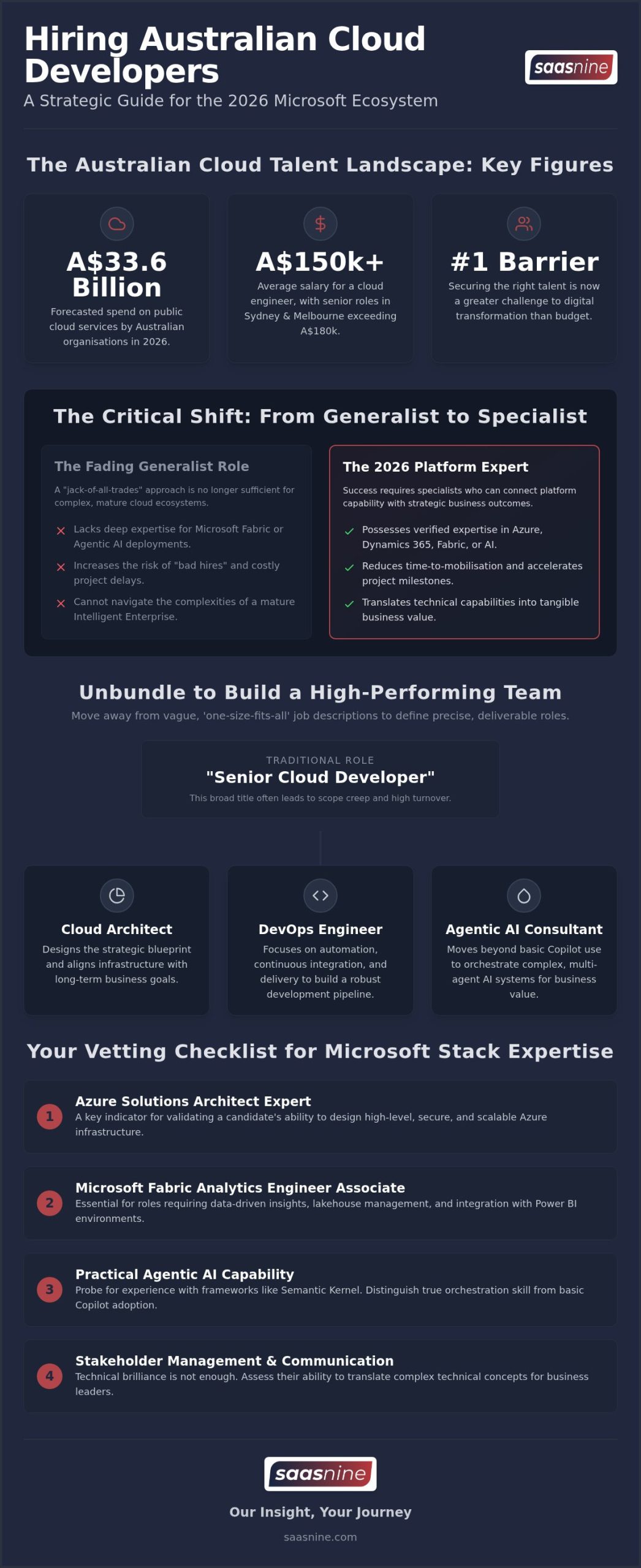
With Australian organisations forecast to spend over A$33.6 billion on public cloud services in 2026, the primary barrier to digital transformation is no longer the budget but the difficulty of securing the right people to lead it. You’ve likely experienced the exhaustion of sifting through hundreds of generalist resumes, only to find that few candidates possess the niche expertise required for Microsoft Fabric or Agentic AI deployments. In a market where the average cloud engineer salary now sits at A$150,000, the financial and strategic cost of a “bad hire” in a critical project is a risk your business cannot ignore. Understanding how to hire cloud developers in this competitive environment requires a shift from reactive recruitment to a structured, capability-led approach.
This guide provides a clear roadmap to navigate the complexities of the Australian cloud market and secure pre-qualified developers who align with your Microsoft ecosystem goals. We will outline a repeatable framework for vetting technical capability and help you decide whether permanent staff or labour hire best suits your current trajectory. By the end of this article, you’ll have the clarity needed to access a dedicated pool of local talent and ensure your workforce strategy matches your technical ambitions.
Key Takeaways
- Identify why the shift from generalist cloud roles to platform-specific experts, such as Azure Platform Engineers, is critical for project success in the 2026 landscape.
- Master how to hire cloud developers by unbundling traditional position descriptions into precise, deliverable roles that align with your specific technical stack.
- Evaluate the long-term ROI of permanent hires versus the agility of contract specialists for time-bound migrations and specialised capability-uplift initiatives.
- Leverage modern AI-driven talent portals to access a pre-qualified pool of Australian professionals and significantly reduce your time-to-mobilisation.
Navigating the Australian Cloud Talent Landscape in 2026
Australian enterprises have reached a critical point of maturity. While the early 2020s were defined by migration, 2026 is the year of the “Intelligent Enterprise.” Organisations are no longer just looking to host data; they’re looking to harness it through Agentic AI and sophisticated data meshes. This shift has fundamentally changed how to hire cloud developers. The generalist who “knows a bit of everything” is being replaced by platform-specific experts, such as Azure Platform Engineers, who can navigate the complexities of a mature cloud computing environment.
Traditional recruitment often fails in this landscape because it treats niche technical capability as a commodity. When your project involves a complex Microsoft Fabric rollout or a Dynamics 365 transformation, a generalist resume won’t suffice. You need a partner who acts as an Expert Guide, connecting your strategic goals with the specific technical pathways required to reach them. This involves unbundling broad position descriptions into realistic, deliverable roles that reflect the current state of the Australian market.
The Specialisation Trend in the Microsoft Ecosystem
Demand for specialised skills in Microsoft Fabric and Dynamics 365 is currently outstripping supply. In 2026, successful projects distinguish between a Functional Lead, who ensures the solution meets business requirements, and a Technical Lead, who manages the architectural integrity. Failing to make this distinction often leads to “bad hires” that stall critical transformation projects. Adopting an Intelligent Enterprise model requires a workforce that understands how these niche components interact within the broader ecosystem.
Understanding Local Market Dynamics
Attracting top-tier Australian talent requires more than just a competitive salary, though the A$150,000 average for cloud engineers remains a significant benchmark. Sydney and Melbourne continue to lead with senior roles often exceeding A$180,000. Beyond the numbers, developers now prioritise “remote-first” or hybrid arrangements that offer flexibility. To avoid overpaying for unvetted talent, you must leverage market intelligence that goes beyond general job boards. Accessing a pre-qualified pool of professionals ensures that the talent you find actually possesses the niche capabilities they claim on paper.
Defining Your Technical Stack and Vetting for Precision
Success in modern recruitment requires unbundling your position descriptions into realistic, deliverable roles. A common pitfall for Australian enterprises is the “one-size-fits-all” job description. This broad approach often leads to high turnover because the role’s scope is too vast for any single professional to master. Learning how to hire cloud developers effectively starts with distinguishing between a Cloud Architect, who designs the strategic blueprint, and a DevOps Engineer, who focuses on continuous delivery. Adding an Agentic AI Consultant into the mix requires even more precision, as this role moves beyond basic implementation to complex orchestration.
Mapping technical capability to your specific business transformation goals prevents the high cost of a bad hire. Instead of seeking a generalist, identify the specific technical milestones your project must hit. This structured approach ensures that every new team member adds immediate value to your Microsoft ecosystem journey.
Vetting for the Microsoft Stack: Azure, Fabric, and AI
Precision vetting requires looking for specific credentials and project experience. Key indicators of expertise include:
- Azure Solutions Architect Expert for high-level infrastructure design.
- Microsoft Fabric Analytics Engineer Associate for data-driven insights and lakehouse management.
- Agentic AI Capability: Look for experience in multi-agent orchestration using frameworks like Semantic Kernel, rather than just basic Copilot adoption.
Watch for technical red flags, such as an inability to explain how Microsoft Fabric integrates with existing Power BI environments or a lack of understanding regarding Azure’s Well-Architected Framework. If you’re unsure how these roles fit your specific transformation, it’s often helpful to discuss your capability strategy with a specialist advisor.
Assessing Soft Skills and Stakeholder Management
Technical brilliance is only half the journey. In cloud-native transformations, communication is as critical as code. Your developers must translate complex technical shifts for non-technical stakeholders to ensure project buy-in. Test for problem-solving ability by presenting scenarios involving hybrid environments or unexpected latency in Azure regions. Cultural alignment with your internal governance frameworks ensures that new hires don’t just build solutions, but build them within your established engineering standards.
Permanent Hires vs. Contract Specialists: The Australian Framework
Deciding between a permanent team and contract specialists is a strategic crossroad that defines the long-term success of your cloud journey. When evaluating how to hire cloud developers in Australia, you must account for local on-costs that go beyond the base salary. Permanent roles require budgeting for superannuation, payroll tax, and workers’ compensation. Conversely, the average day rate for a contract cloud engineer in 2026 sits at A$1,040. While contractors offer immediate agility, permanent staff are the guardians of your institutional IP and core infrastructure. Balancing these two models requires a clear understanding of your project duration and budget constraints.
A structured decision matrix helps clarify the path forward. If you’re building a proprietary platform where security and governance are central, permanent hires provide the stability needed for continuous improvement. If your goal is a time-bound migration or a specialised capability-uplift, contract specialists offer a flexible way to scale without long-term overheads.
Building Institutional Knowledge with Permanent Staff
Permanent roles foster a culture of ownership. These team members don’t just execute tasks; they ensure your cloud environment adheres to long-term governance and security standards. Retaining high-value talent in the competitive Australian market requires more than just meeting the SSIT threshold of A$146,717 for specialist skills. It involves creating a pathway for professional growth. saas nine supports this by sourcing pre-qualified candidates who are specifically vetted for alignment with your long-term Microsoft ecosystem goals.
Leveraging Talent Augmentation for Project Agility
Using daily-rate contractors is an effective way to bridge niche skill gaps, such as during a complex Microsoft Fabric rollout. These specialists bring immediate expertise that might not be required once the initial transformation phase is complete. Managing these specialists effectively involves ensuring a structured handover to your permanent team to prevent knowledge silos. This labour hire model allows you to scale up during peak phases and scale down once the technical milestones are met. To find the right balance for your organisation, contact our strategic advisory team for a tailored workforce capability map.
Streamlining Discovery with a Specialised Talent Portal
Traditional recruitment methods often fall short when speed and precision are paramount for your digital transformation. Sifting through generalist job boards is an inefficient way to manage how to hire cloud developers for specialised Microsoft environments. A searchable talent portal filled with pre-qualified professionals represents the modern alternative. This approach shifts the focus from “vetted” resumes, which are often self-reported, to “verified” profiles where technical capability in Azure or Microsoft Fabric is already established. By using an AI-driven discovery platform, you reduce hiring risk and significantly shorten your time-to-mobilisation.
Verified profiles offer a level of assurance that standard recruitment cannot match. When a candidate’s skills are mapped against actual project delivery standards, you gain a clearer view of their potential impact. This transparency is vital for Australian enterprises navigating the complexities of the 2026 cloud market.
The saas nine Advantage: Beyond Traditional Recruitment
Workforce capability must be inextricably linked to your technical strategy. Our Microsoft Ecosystem Capability Map allows you to define roles with surgical precision before the search even begins. By utilising our proprietary Agentic Workforce Platform, we identify niche talent, like Agentic AI consultants, who are often invisible to standard recruitment firms. This ensures that our focus on “Our Insight, Your Journey” isn’t just a tagline, but a practical commitment to your project’s success. We connect strategy, technology, and workforce capability to ensure your path forward is clear and supported.
Taking the Next Step in Your Hiring Journey
Start your search by accessing a curated pool of professionals who understand the nuances of the Australian enterprise sector. Beyond simple placement, we offer support for strategic advisory, workforce planning, and organisational design to ensure your team structure is built for the future. Moving beyond traditional methods changes the conversation on how to hire cloud developers from a struggle for talent to a strategic selection of capability. If you’re ready to secure the expertise needed for your next transformation, reach out for a consultation at saas nine to bridge your capability gap.
Securing Your Technical Future in the Australian Cloud
Success in the 2026 cloud market requires a departure from traditional, broad recruitment. We’ve explored why unbundling complex roles and vetting for platform-specific expertise, such as Microsoft Fabric or Agentic AI, is essential for project delivery. Mastering how to hire cloud developers involves a strategic balance between the long-term institutional knowledge of permanent staff and the immediate agility offered by contract specialists. By moving beyond general job boards and utilising verified talent portals, you ensure your workforce capability directly supports your technical ambitions.
saas nine acts as your expert guide in this journey. We specialise in Azure, Dynamics 365, and Microsoft Fabric, providing national coverage across Australia. Our proprietary Agentic Workforce Platform allows you to bypass the noise of unqualified resumes and access a pre-qualified pool of professionals ready to execute your vision. Organise a consultation with saas nine to find your next cloud specialist and take the next step toward a more capable, resilient enterprise. Your digital transformation is a shared journey, and the right expertise makes all the difference.
Frequently Asked Questions
How much does it cost to hire a cloud developer in Australia in 2026?
The average salary for a cloud developer in Australia is approximately A$150,000 per year, though this varies significantly by seniority and location. Senior specialists in Sydney or Melbourne often command A$180,000 or more, while entry-level roles start around A$130,000. For those exploring how to hire cloud developers on a contract basis, the average day rate currently sits at A$1,040. These figures reflect the intense competition for niche talent across the national tech landscape.
What is the difference between a cloud developer and a cloud engineer in a Microsoft environment?
Cloud developers focus primarily on building and deploying applications using Azure-native services like App Service, Functions, and Logic Apps. Cloud engineers specialise in the underlying infrastructure, focusing on networking, security, and the governance of the Azure environment. While their skills often overlap, developers are responsible for the application logic, whereas engineers ensure the ecosystem is robust, scalable, and compliant with your internal engineering standards.
Should I hire a permanent cloud architect or a contractor for our Azure migration?
Hire a contract specialist for the high-intensity migration phase and a permanent architect to manage your long-term infrastructure and institutional IP. Contractors provide the immediate, specialised capability required for time-bound transformations without increasing your long-term headcount. Once the initial migration is complete, a permanent architect ensures your cloud strategy remains aligned with evolving business goals and maintains a consistent culture of security and governance.
How do I verify a developer’s certifications in niche areas like Microsoft Fabric or Agentic AI?
Request an official Microsoft Learn transcript or use a specialised talent portal that performs technical vetting on your behalf. For data-centric roles, look for the Microsoft Fabric Analytics Engineer Associate credential. For AI, verify experience with multi-agent orchestration and frameworks like Semantic Kernel. A professional partner ensures these certifications are backed by practical project experience, protecting your business from the high cost of a bad hire.
What are the most in-demand cloud skills in the Australian market right now?
Expertise in Microsoft Fabric, Agentic AI, and FinOps are the most sought-after capabilities in the current market. As Australian organisations shift from AI experimentation to production, developers who can orchestrate multi-agent systems are in high demand. Additionally, Infrastructure-as-a-Service (IaaS) remains a high-growth area, with a projected 24.1% increase in spending this year, driving the need for professionals who can modernise legacy systems efficiently.
How long does it typically take to hire a pre-qualified cloud professional through a talent portal?
Accessing a specialised talent portal can reduce your time-to-mobilisation to just a few weeks, compared to the months often required by traditional recruitment. Because the discovery platform contains a curated pool of vetted professionals, you bypass the need to sift through hundreds of unqualified resumes. This efficiency is a core advantage when learning how to hire cloud developers for critical projects that require immediate technical capability and strategic alignment.