

What if the cloud role you’re trying to fill is really a capability gap across the delivery team? Enterprise cloud talent solutions australia work best when hiring starts with the business outcome, not a template position description. A cloud engineer, architect or Microsoft specialist may each bring valuable expertise, but the right mix depends on what your transformation needs to deliver.
Scarce specialist skills can make planning difficult, particularly when it’s unclear whether to hire permanently, engage a contractor or shape a project team. Start by identifying the work, the expertise it requires and who will be accountable for delivery. This article explains how to translate cloud strategy into realistic roles, assess team capability and align the talent model with the work ahead. It also explores how market intelligence and role design can help clarify requirements for Microsoft-focused talent. saas nine connects workforce decisions with delivery priorities through specialist talent and advisory support.
Key Takeaways
- Start with transformation outcomes and delivery responsibilities to identify the capabilities your organisation needs before defining vacancies.
- Use enterprise cloud talent solutions australia to connect workforce planning and role design with business priorities.
- Choose between permanent hires, contract specialists and project teams based on the work’s duration, continuity needs and delivery scope.
- Explore how saas nine search, saas nine talent and saas nine advisory can support Microsoft-focused capability planning and hiring.
Why enterprise cloud talent solutions in Australia need a capability-first approach
Enterprise cloud talent solutions coordinate specialist skills around business delivery. For Australian organisations, enterprise cloud talent solutions australia should begin with the transformation outcome, operating needs and capability gaps, not a list of vacancies. Cloud technology provides a foundation, but value depends on clear responsibilities and accountability for delivery.
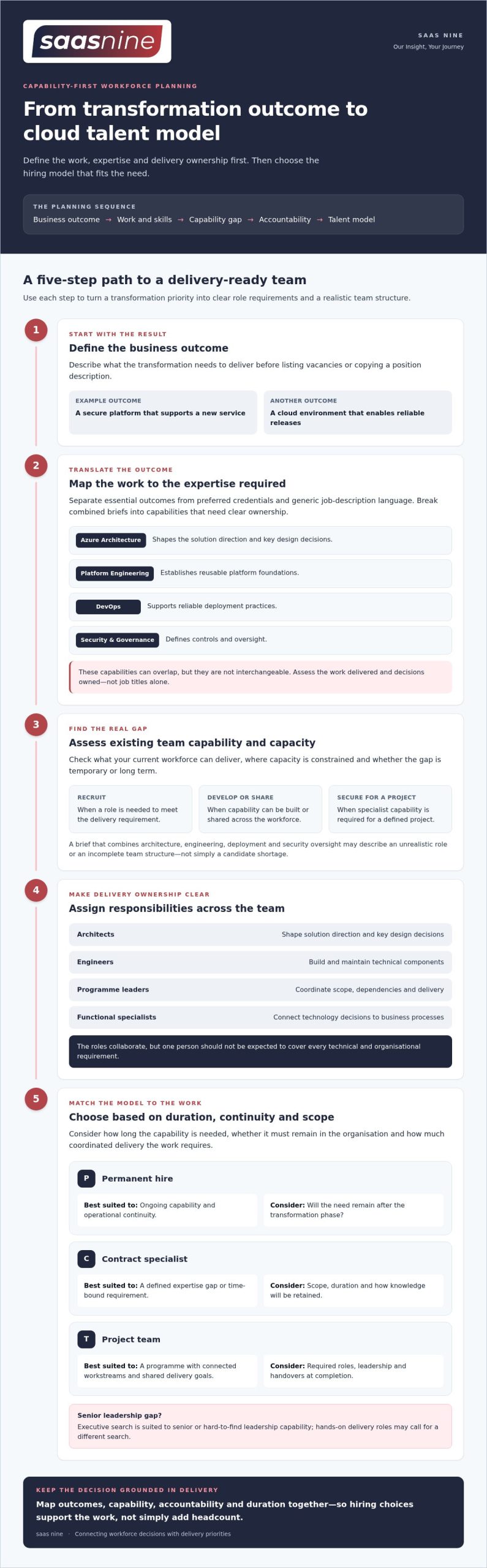
Start by defining the intended result, such as a secure platform that supports a new service or a cloud environment that enables teams to release changes reliably. Then map the work, decision-making responsibilities and expertise required to achieve it. This helps distinguish a genuine skills shortage from a role-design problem. If one position combines architecture, engineering, deployment and security oversight, the brief may describe an unrealistic role or an incomplete team structure rather than a lack of candidates.
What capability-first cloud hiring changes
Outcome-led role definition makes scope and accountability clearer. A single job description can conceal distinct responsibilities: designing the target architecture, building platform foundations, automating releases and managing security controls. Break the brief into these capabilities, then decide which require dedicated ownership and which can be shared across the team. saas nine’s Microsoft talent services connect role design with access to pre-qualified professionals.
Where Microsoft cloud capability fits
Map each outcome to the relevant Microsoft expertise. Azure Architecture may shape the solution; Platform Engineering establishes reusable foundations; DevOps supports reliable deployment practices; and Security & Governance defines controls and oversight. These capabilities can overlap, but they are not interchangeable. When assessing candidates, examine the work they have delivered and the decisions they have owned, not just their job titles. A Cloud computing overview offers useful context, while role criteria should reflect your organisation’s delivery environment.
How enterprise cloud talent solutions connect strategy, skills and delivery
Turn a transformation priority into a capability plan before opening a role. For each intended business outcome, define the work required, the expertise needed, the level of decision-making authority and who owns delivery. This makes enterprise cloud talent solutions australia a workforce-planning exercise, not simply a recruitment brief.
Turn transformation priorities into role requirements
Separate essential outcomes from preferred credentials and generic job-description language. For a Microsoft Fabric initiative, specify the data capabilities and delivery responsibilities required. A Dynamics 365 programme may need functional expertise to align business processes with the platform, while a Power Platform initiative may require capability to guide solution use and governance. These are distinct needs, even if they sit within one transformation portfolio.
Assess what your current workforce can deliver, where capacity is constrained and whether the gap is temporary or long term. This helps distinguish a role to recruit from a capability to develop, share or secure for a defined project. Workforce planning and capability advice can also connect organisational design with future technology needs.
Connect specialist skills with delivery accountability
Assign responsibilities clearly. Architects shape solution direction and key design decisions; engineers build and maintain technical components; programme leaders coordinate scope, dependencies and delivery; functional specialists connect technology decisions to business processes. These roles collaborate, but one person should not be expected to cover every technical and organisational requirement.
Use the delivery horizon to select the talent model. An ongoing operational need may call for a permanent capability; a defined specialist gap may suit a contract hire; and a broad transformation with interdependent workstreams may need a project team. Senior leadership gaps call for a different search from hands-on delivery roles. Map outcomes, capability, accountability and duration together so hiring choices support delivery rather than simply add headcount.
Choose an enterprise cloud talent model that fits your Australian organisation
The right model depends on how long the capability is needed, whether it must remain in the organisation and how much coordinated delivery the work requires. Enterprise cloud talent solutions australia should match the hiring approach to the programme, rather than defaulting to a permanent vacancy for every gap.
When permanent, contract or project-team hiring fits
Use this comparison to frame the decision:
| Talent model | Best suited to | Consider |
|---|---|---|
| Permanent hire | Ongoing capability and operational continuity | Whether the need will remain after the transformation phase |
| Contract specialist | A defined expertise gap or time-bound requirement | Scope, duration and how knowledge will be retained |
| Project team | A programme with connected workstreams and shared delivery goals | Required roles, leadership and handovers at completion |
For example, a continuing need to manage a cloud environment may support a permanent role, while a discrete architecture requirement could suit a contract specialist. Where delivery depends on several disciplines working together, a project team can align responsibilities with the programme’s scope. Executive search is suited to senior or hard-to-find leadership capability, while other specialist roles may call for a different sourcing approach.
Use market intelligence to refine the brief
Before recruiting, review the role’s essential outcomes, decision-making authority and must-have expertise. Market mapping can show how relevant capability is represented in the talent market. Salary benchmarking can help calibrate expectations, while position design can separate an overloaded brief into realistic responsibilities. Together, these inputs help identify where requirements may need refining.
saas nine brings workforce advice and Microsoft-focused talent sourcing together. If you’re weighing permanent, contract or project-team options, discuss your talent requirements with saas nine.
How saas nine supports enterprise cloud talent solutions across Australia
Connecting business priorities to Microsoft capability takes more than filling vacancies. saas nine works as a talent and advisory partner, bringing workforce planning, position design and specialist sourcing together to help organisations shape teams around delivery needs. This approach supports enterprise cloud talent solutions australia by aligning workforce decisions with the transformation, whether the requirement is leadership, specialist expertise or ongoing capability.
Combine specialist search, the Talent Portal and advisory
saas nine search supports executive, leadership and hard-to-find technology recruitment across Microsoft Data, AI and Business Applications. saas nine talent provides access to pre-qualified professionals through its Talent Portal, which includes real-time candidate status updates. Hiring teams can save and share profiles, request CVs and arrange interviews through the portal. Learn more about the Microsoft specialist Talent Portal.
The talent pool includes 7,000+ qualified professionals, 300+ new talent registered, 100+ skilled talent available and 50+ registered clients. These figures indicate the breadth of the network; the right shortlist still depends on the role requirements, delivery context and relevant expertise.
Move from capability definition to a practical next step
saas nine advisory supports workforce planning, position design and salary benchmarking. These services help leaders clarify required capabilities, shape realistic roles and understand how requirements align with the market. Combined with specialist sourcing, they provide a practical way to move from identifying a capability gap to choosing how to address it through permanent or contract hiring.
Start with the delivery outcome, then identify the capability, accountability and engagement model that best support it. saas nine brings strategic advice and talent expertise together: “Our Insight, Your Journey”. If you’re planning a Microsoft-focused transformation or refining your workforce requirements, contact saas nine to discuss your talent needs.
Set your next capability decision in motion
Turn your strategy into a decision your leadership team can act on. Choose an upcoming delivery milestone and identify which capability decisions need to be settled beforehand: who owns the outcome, what expertise is required and when that capability must be in place. This gives enterprise cloud talent solutions australia a practical starting point without treating every uncertainty as a new vacancy.
Bring technology, delivery and people leaders into the same conversation. A shared view of priorities can help distinguish immediate requirements from longer-term workforce choices and give hiring decisions a clearer basis. saas nine can support that discussion as a Microsoft technology talent and advisory partner, connecting business direction with workforce capability.
If you’re ready to shape the next step for your organisation, plan your capability requirements with saas nine. Start a conversation with saas nine about the capabilities your delivery priorities require.
Frequently Asked Questions
What are enterprise cloud talent solutions?
They help organisations connect cloud roadmaps with the people and team structures needed to deliver them. Before a migration, for example, leaders can identify design, integration, security and operational handover needs, then decide how each should be resourced. Enterprise cloud talent solutions australia provide a practical planning framework that links capability decisions to the sequence and ownership of delivery work.
How do Australian organisations choose between permanent and contract cloud talent?
Assess how long the work will continue and whether the organisation needs to retain the capability afterwards. A permanent hire may suit an ongoing operational responsibility, while a contract professional may be appropriate for a defined specialist requirement. For a programme with several connected workstreams, consider whether a broader team is needed. Compare the options with the expected work and continuity requirements, rather than relying on a default preference.
What roles can enterprise cloud talent solutions help organisations find?
Depending on the programme, organisations may need Cloud Engineers, Integration specialists, Security professionals or programme leadership. A data modernisation initiative may call for Data Engineers or Fabric Architects, while a business applications programme could require Dynamics 365 specialists. These roles have different accountabilities. Specify the systems, decisions and delivery outcomes each person will own so you can assess team coverage beyond job titles.
How can a Talent Portal support enterprise cloud hiring?
A Talent Portal helps hiring teams organise candidate information for review and selection. With saas nine talent, teams can save and share profiles, request CVs and arrange interviews. The portal also provides real-time candidate status updates and multi-location talent tracking, supporting coordination among stakeholders. Access to permanent and contract talent gives hiring teams options to assess against the role’s requirements.
Can a talent partner help define cloud roles before recruitment starts?
Yes. A talent partner can help clarify which capabilities are essential at appointment and which could be developed after someone joins. saas nine advisory can review training and certification requirements as part of that assessment, helping hiring teams distinguish genuine role prerequisites from preferences that may unnecessarily narrow the brief. This gives interviewers a clearer basis for assessing relevant experience and deciding what capability must already be in place.
saas nine recruits across Microsoft Data, AI & Business Applications. See our Microsoft recruitment services, or search the Talent Portal.