

By 2026, the distinction between a standard data engineer and a true Fabric architect will be the difference between a failed digital transformation and a scalable, AI-ready ecosystem. You’ve likely felt the frustration of a talent market that can’t keep pace with the rapid evolution of the Microsoft stack. It’s difficult to distinguish between those who’ve simply completed a certification and those who can navigate the complexities of a unified data lakehouse. When you need to hire Microsoft Fabric developer Australia talent, the stakes are high because poor architectural decisions at the foundation can stall your progress for years.
This executive guide outlines how to identify elite capability and reduce hiring risk through a structured talent advisory lens. We’ll show you how saas nine helps organisations move beyond tactical staffing to secure the strategic expertise needed for faster time-to-value. Our insight, your journey starts with understanding exactly what makes a Fabric specialist world-class and how to attract them to your mission.
Key Takeaways
- Recognise the strategic shift from fragmented data silos to a unified OneLake environment to streamline governance and eliminate unnecessary data movement.
- Identify the specific technical competencies needed to hire Microsoft Fabric developer Australia specialists, prioritising Medallion architectures and Lakehouse design over traditional engineering roles.
- Implement a structured vetting framework that validates architectural mastery of security protocols and high-performance DevOps patterns within the Fabric ecosystem.
- Leverage the saas nine Talent Portal and Agentic Workforce Platform to bridge the capability gap and accelerate time-to-value for your data transformation.
The Shift to Microsoft Fabric: Why Australian Organisations are Reorganising Data Teams
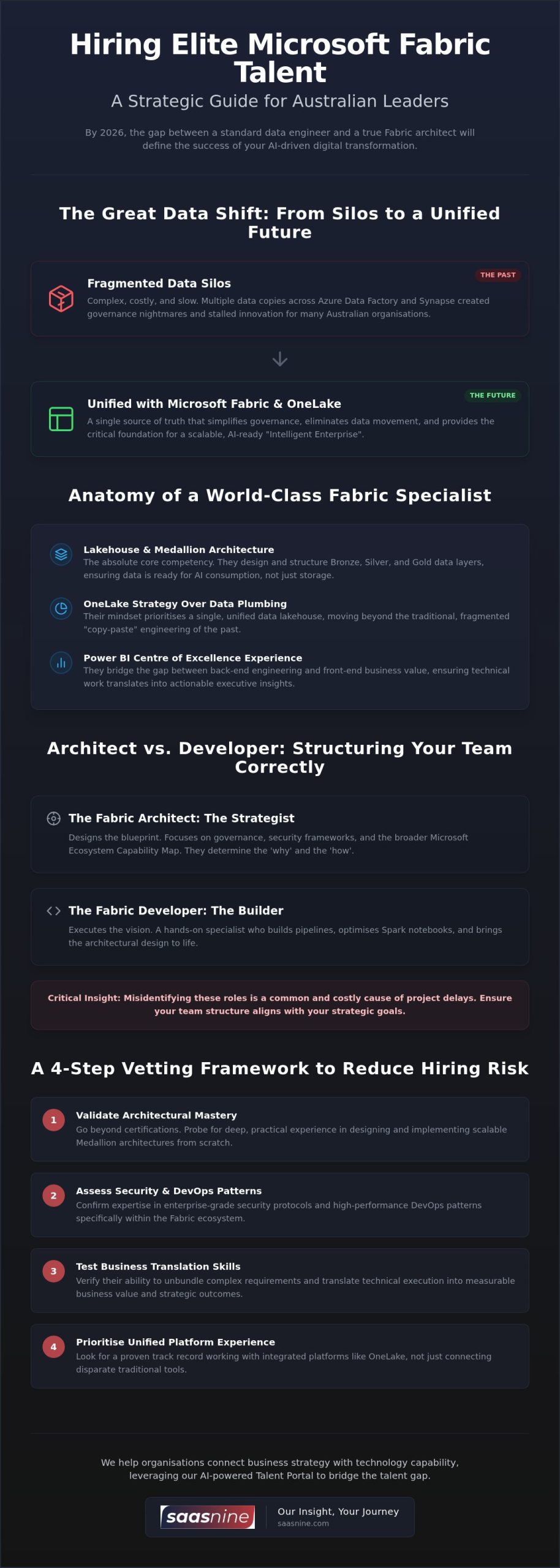
The landscape of data architecture in Australia is undergoing a fundamental transformation. Many organisations are currently dismantling the complex, fragmented silos of Azure Data Factory and Synapse to move toward a single, cohesive environment. This transition is largely driven by the arrival of OneLake, which simplifies data governance by providing a single source of truth. As detailed in this Microsoft Fabric Overview, the platform integrates disparate services into a unified experience, effectively ending the era of excessive data movement and “copy-paste” engineering.
This shift is essential for any business aiming to reach the maturity of an “Intelligent Enterprise.” Fabric serves as the critical foundation for Agentic AI, where autonomous agents require real-time access to high-quality, governed data. However, the pressure to modernise legacy platforms often clashes with a severe market deficit. To successfully bridge this gap, leaders must look beyond traditional job descriptions when they seek to hire Microsoft Fabric developer Australia specialists who can navigate this new paradigm.
The Problem with Traditional Data Engineering Roles
A background in standard SQL or Python is no longer the sole benchmark for success. While these skills remain foundational, Fabric delivery requires a deeper understanding of Lakehouse design and Medallion architectures. Traditional “plumbing” roles are being replaced by a need for architects who can structure Bronze, Silver, and Gold layers to ensure data is ready for AI consumption. At saas nine, we observe that the most successful teams are those that unbundle these complex roles to find true specialists. When you hire Microsoft Fabric developer Australia experts, you aren’t just filling a seat; you’re securing your data’s future. Our insight, your journey involves moving from simple data movement to strategic capability building.
Defining the Microsoft Fabric Developer Persona
The 2026 market demands more than a generic data engineer with a passing interest in the Microsoft stack. To truly extract value, you need a specialist persona that understands the nuances of the unified environment. When you hire Microsoft Fabric developer Australia specialists, you are looking for individuals who prioritise OneLake strategy and Lakehouse design over simple data ingestion. They must be experts in Medallion architectures, ensuring that data flows seamlessly from Bronze to Gold layers in a way that is ready for Agentic AI consumption.
A high-performing Fabric developer also bridges the gap between engineering and predictive analytics. They enable data science by structuring data so that models can be trained without the typical friction of manual preparation. Experience with a Power BI Centre of Excellence is equally vital. This ensures that the technical work translates into actionable business insights at the executive level. The soft skills required for this role have also evolved; elite talent can unbundle complex, unrealistic position descriptions into structured delivery goals that align with your strategy. This ability to translate high-level business value into technical execution is a hallmark of the saas nine vetting process.
Fabric Architect vs. Fabric Developer: Knowing the Difference
Strategic success depends on knowing when to hire for leadership versus execution. A Fabric Architect focuses on governance, security frameworks, and the broader Microsoft Ecosystem Capability Map. In contrast, a Fabric Developer is the hands-on specialist who builds the pipelines and optimises Spark notebooks. Misidentifying these roles is a common cause of project delay. If you are unsure how to structure your team for 2026, we invite you to connect with our talent advisors to map your requirements to the right talent. Our insight, your journey begins with the right people in the right seats.
A Vetting Framework for Hiring Microsoft Fabric Developers in Australia
Securing elite talent in a competitive market requires a structured approach that separates surface-level knowledge from architectural mastery. To successfully hire Microsoft Fabric developer Australia talent, you must implement a vetting framework that prioritises strategic delivery over simple coding proficiency. This process ensures your investment translates into a robust, scalable data platform rather than a collection of disconnected pipelines.
Our recommended vetting framework follows four critical steps:
- Validate OneLake Governance: Ensure the candidate understands security inheritance and domain-based governance within OneLake. This is the bedrock of a secure, compliant data ecosystem.
- Screen for DevOps Maturity: Evaluate their experience with CI/CD patterns specifically tailored for Fabric items, such as Data Pipelines, Spark Notebooks, and Lakehouses.
- Assess Responsible AI Integration: Candidates must demonstrate how they build data layers that support ethical AI outcomes, ensuring that data quality and lineage are maintained for downstream autonomous agents.
- Benchmark via Market Intelligence: Use real-world data to compare candidate capability against national Australian standards. This prevents the common mistake of overpaying for traditional engineers who lack specific Fabric expertise.
Technical Red Flags in Fabric Interviews
During the screening process, watch for an over-reliance on traditional ETL patterns. Fabric is designed to minimise data movement through “shortcuts” and Direct Lake mode. If a developer insists on copying data between every layer, they haven’t embraced the platform’s core philosophy. Another significant red flag is a lack of understanding regarding capacity management. A true specialist should be able to discuss F-SKU optimisation and how to manage compute costs effectively to prevent budget blowouts. When you hire Microsoft Fabric developer Australia professionals through our network, these competencies are pre-validated. If you need assistance in qualifying these high-level skills, you can contact our talent advisory team to access our pre-vetted specialist network. Our insight, your journey is built on the confidence that your technical foundation is sound.
Navigating the Talent Gap with saas nine
saas nine operates as a strategic talent advisory business, bridging the gap between your technology roadmap and the workforce capability required to execute it. We’ve seen that the decision to hire Microsoft Fabric developer Australia specialists is often fraught with risk due to the niche nature of the platform. To mitigate this, we utilise our proprietary Agentic Workforce Platform for capability discovery. This tool allows us to mobilise pre-qualified and vetted Microsoft professionals with precision, ensuring your project momentum remains uninterrupted while maintaining a focus on responsible AI adoption.
Our delivery models are designed for maximum flexibility, supporting both permanent and contract hiring. Whether you’re looking for a single architect to lead a transformation programme or need to hire Microsoft Fabric developer Australia talent for a full team, our saas nine Talent Portal provides immediate visibility into a network of verified specialists. We prioritise market intelligence over technology hype to ensure the talent you secure is capable of delivering tangible business value. This approach reduces the risk of project failure and accelerates your time-to-value.
Beyond Recruitment: Strategic Advisory for Data Teams
We provide more than candidates. Our team offers strategic advisory services to help Australian leaders organise and define the right roles, unbundling unrealistic position descriptions into achievable delivery goals. This is particularly critical in the 2026 market. Workforce-planning intelligence is the primary differentiator for successful enterprises. By connecting your business strategy with technology capability, we ensure your data journey is structured for long-term success rather than short-term gains. Our insight, your journey.
Securing Your Data Future in the Fabric Era
Transitioning to a unified data ecosystem requires more than technical migration; it demands a strategic shift in workforce capability. As we’ve explored, the move toward OneLake and Medallion architectures necessitates a specialist persona that traditional data engineering roles simply don’t cover. Vetting for these specific architectural competencies is the only way to ensure your digital transformation delivers long-term ROI. When you choose to hire Microsoft Fabric developer Australia experts, you are investing in the very foundation of your organisation’s AI maturity.
As a specialised Microsoft Fabric recruitment partner, saas nine bridges the gap between your strategy and execution. We use our Agentic Workforce Platform to provide AI-powered candidate matching, ensuring you access pre-vetted professionals who are trusted by leading Australian CIOs. Our insight, your journey is about more than just filling roles; it’s about building successful delivery teams that last. To begin your search for elite talent, discover pre-qualified Microsoft Fabric talent on the saas nine Talent Portal today. We look forward to supporting your transformation.
Frequently Asked Questions
What is the average salary for a Microsoft Fabric Developer in Australia in 2026?
Market rates for Fabric specialists in Australia are currently driven by a significant talent shortage for niche Microsoft skills. While we don’t publish fixed salary brackets, we observe that architects with deep OneLake expertise command higher rates than traditional data engineers. Using market intelligence is essential for accurate benchmarking in 2026. At saas nine, we help leaders navigate these costs by providing workforce-planning intelligence that aligns with current national standards and project complexity.
Can I retrain my Azure Data Engineers to use Microsoft Fabric?
Retraining your internal team is a practical strategy for long-term capability, but it requires a structured approach to learning. Your engineers must transition from managing fragmented silos to architecting unified Lakehouse structures. While their existing SQL and Python knowledge is valuable, the shift to Fabric involves new governance and security paradigms. Many organisations choose to hire Microsoft Fabric developer Australia specialists to act as mentors, accelerating the capability-uplift and reducing implementation risks.
Should I hire a permanent Fabric Developer or a contract specialist for my implementation?
Contract specialists are generally preferred for the initial implementation phase to provide rapid mobilisation and niche technical expertise. Once your Fabric environment is established, permanent hires can focus on long-term governance and driving continuous business value. saas nine supports both models through our contingent recruitment and talent augmentation services. We help you define the right roles and unbundle position descriptions to ensure you secure the specific expertise needed for your current journey.
How does Microsoft Fabric integrate with Copilot and AI Product Delivery?
Fabric acts as the essential data layer that powers Copilot and enables successful AI product delivery. By consolidating data into OneLake, it provides the governed, real-time information that autonomous agents need to operate reliably. This integration is a core component of the “Intelligent Enterprise” maturity model. When you hire Microsoft Fabric developer Australia talent, you ensure your data architecture is ready for responsible AI adoption and multi-agent orchestration across your organisation.
What certifications should I look for when vetting Fabric talent?
The DP-600 Microsoft Fabric Analytics Engineer Associate certification is the primary credential to look for in 2026. Beyond this, you should prioritise candidates with proven experience in Medallion architectures and high-performance DevOps patterns. Certifications prove technical literacy, but architectural mastery is discovered through deep vetting. Our Agentic Workforce Platform automates this discovery process, matching you with pre-qualified professionals who possess both the formal credentials and the practical delivery experience you require.