

If 69% of Australian organisations are already deploying autonomous AI agents, why does the traditional corporate hierarchy still feel so rigid? Most leaders recognise that legacy structures have become the primary bottleneck for cloud adoption and digital agility. It’s a common frustration; your technology moves at lightspeed, but your reporting lines remain anchored in the past. At saas nine, we believe that modern organisational design is the essential bridge between a bold technology strategy and the agentic workforce required to execute it.
You’ll discover how to transition from static hierarchies to fluid, AI-integrated structures that finally align your Microsoft ecosystem investments with human capability. We’ll provide a clear roadmap for building an “Intelligent Enterprise” while addressing the critical need to unbundle legacy roles into realistic, modern requirements. This guide explores how to improve workforce visibility and delivery speed, ensuring your business stays ahead of the 2026 regulatory curve. Our insight, your journey starts with rethinking how your teams actually function in a data-heavy world.
Key Takeaways
- Learn how to move beyond static charts toward a dynamic organisational design that integrates autonomous AI agents into your core business workflows.
- Understand the saas nine philosophy of unbundling position descriptions to create realistic, specialised roles that attract high-calibre Microsoft ecosystem talent.
- Identify the specific capabilities required for the agentic workforce, including the emergence of critical new roles like AI Architects and Data Consultants.
- Follow a practical roadmap for mobilising your transformation strategy by connecting high-level business goals with specific technology capabilities.
Defining Organisational Design for the Modern Australian Enterprise
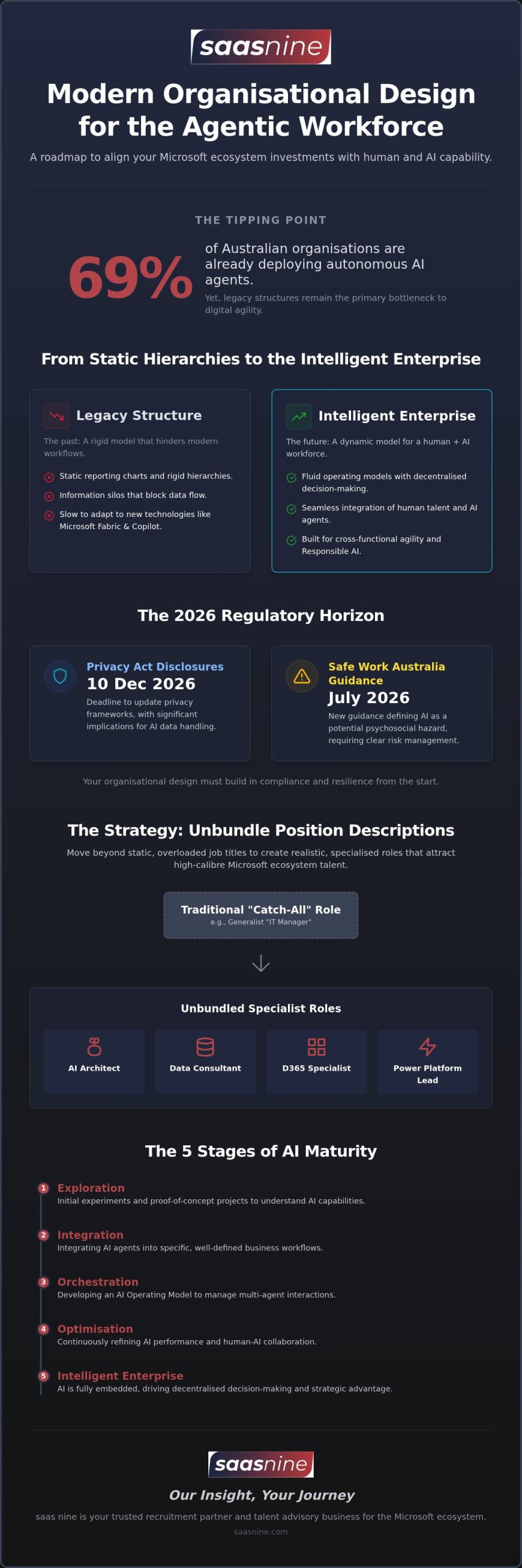
In the current Australian market, organisational design is far more than a static reporting chart. It’s the active administration and execution of your strategic plan within a tech-centric environment. While many leaders view a structural chart as the end goal, 2026 requires a shift toward dynamic operating models that accommodate both human talent and digital agents. We call this the “Intelligent Enterprise,” where data flows seamlessly and decision-making is decentralised.
Achieving this state demands a commitment to “Responsible AI” within the very fabric of your team. With the 10 December 2026 deadline for Privacy Act disclosures approaching, and Safe Work Australia’s July 2026 guidance defining AI as a psychosocial hazard, your organisational design must include clear governance frameworks. It’s no longer just about efficiency; it’s about building a compliant and resilient workforce.
Design vs Development: The 2026 Distinction
Understanding the distinction between design and development is vital for long-term success. Design serves as the architectural blueprint, whereas development is the continuous optimisation of that structure. Many Australian businesses attempt to “patch” legacy platforms with new software. These systems often require a fundamental design rethink to remain viable. A well-constructed design ensures that your infrastructure supports your goals rather than hindering them through outdated, rigid hierarchies.
The Impact of the Microsoft Ecosystem
The rapid adoption of technologies like Microsoft Fabric and Copilot necessitates entirely new reporting lines. These platforms demand high levels of data literacy and cross-functional agility that traditional structures simply can’t support. At saas nine, we specialise in bridging the gap between high-level business strategy and the technical capability required to deliver results. Our insight, your journey involves navigating these complexities to ensure your team structure is built for the agentic era.
The Shift Toward Agentic AI and Intelligent Operating Models
The transition from “human-only” teams to an agentic workforce marks a fundamental change in how we perceive productivity. According to Deloitte Australia, 69% of organisations are already using autonomous AI agents that take action rather than just providing insights. This shift requires a robust framework for organization design that treats AI agents as active participants in the workforce.
Modern structures now incorporate specialised roles such as AI Architects and Agentic AI Consultants. These professionals ensure that technology isn’t just an add-on but is deeply integrated into the business logic. Successful implementation follows five progressive stages of AI maturity, moving from initial exploration to the fully realised “Intelligent Enterprise”. Moving through these stages is a core component of modern organisational design. To maintain oversight, many leaders establish an AI Centre of Excellence (CoE) to act as the central hub for governance.
Designing for Multi-Agent Orchestration
Creating teams where humans and AI agents interact seamlessly is the next frontier of organisational design. It’s not enough to deploy software; you must build an AI Operating Model that manages multi-agent orchestration. This ensures that workflows remain transparent and that human oversight remains effective even as agents handle complex, multi-step processes.
Workforce Visibility and Discovery
You can’t redesign what you don’t understand. Mapping existing internal capability is essential for identifying where AI can provide the most value. Utilising the saas nine talent portal allows for sophisticated capability discovery, providing the visibility needed to transition from legacy roles to modern requirements. This data-driven approach helps you avoid “Role Inflation” while ensuring your team is ready for the future. If you’re interested in discussing your workforce strategy, saas nine can help align your structure with your long-term goals. Our insight, your journey begins with a clear understanding of your current capability.
Unbundling the Position Description: A Practical Role Design Strategy
Traditional position descriptions often fail because they attempt to capture a static snapshot of an evolving role. At saas nine, we advocate for unbundling these descriptions into realistic, high-delivery functions. Effective organisational design requires moving away from simple “Job Filling” toward a comprehensive Capability Strategy. This ensures your delivery teams are grouped by specific technical competencies rather than vague, overreaching expectations that no single person can meet.
In Dynamics 365 and Azure transformations, “Role Inflation” creates significant project risk. When a single role description demands deep expertise across ERP, data architecture, and AI governance, the vacancy often remains unfilled for months. With Australian tech vacancies hitting a 31.8% unfilled rate in March 2026, unrealistic requirements are a luxury few businesses can afford. We help you identify these bottlenecks by breaking down bloated PDs into manageable, specialised roles.
The End of the “Unicorn” Tech Lead
Projects often falter when leaders search for a “unicorn” who can master Azure, Data, and AI simultaneously. Splitting these complex requirements into manageable roles improves delivery speed and reduces burnout. By unbundling these needs, you create a structure where specialists focus on their core strengths. Whether it’s Microsoft Fabric architecture or Copilot implementation, clarity in role design leads to faster mobilisation and better project outcomes.
Mapping Capability to Business Strategy
Strategic alignment requires a clear framework. We use the Microsoft Ecosystem Capability Map to help organisations visualise where their talent gaps actually lie. This process is a vital part of Technology Workforce Planning Australia 2026, allowing you to design roles that serve the business’s long-term vision. Our insight, your journey involves ensuring every hire contributes directly to your transformation goals. If you’re ready to define a more realistic workforce structure, contact saas nine for a strategic advisory session.
Executing Your Design: Connecting Strategy with Technology Capability
Mobilisation is the critical bridge where theory meets reality. A sophisticated organisational design remains a paper exercise until you place the right capability in the right seats. Strategy requires talent. For C-suite leaders, this involves a shift from abstract diagrams to tangible workforce planning. Our technology leadership advisory services provide a steady hand, ensuring executive stakeholders move beyond structural charts to build delivery capability that matches their technological ambitions. We focus on the practical business value of every role, ensuring your structure supports long-term outcomes rather than short-term convenience.
Talent Augmentation and Project Delivery
Utilising saas nine services offers a pathway for talent augmentation that does more than just fill gaps. We help you deploy specialised project teams to uplift your internal capability during critical transitions, such as migrating to Microsoft Fabric or Azure. Balancing a core permanent headcount with agile contingent labour allows for project-based agility. This approach ensures you maintain the flexibility needed for complex ERP transformations without the burden of excessive long-term fixed costs.
Measuring Design Effectiveness
Evaluating the success of a modern organisational design involves tracking metrics that reflect real-world agility. Key performance indicators should focus on delivery velocity, AI adoption rates, and workforce retention. saas nine uses deep market intelligence to improve hiring outcomes, ensuring your structure remains resilient against the projected tech worker shortfall of 259,000 professionals over the next decade. By grounding your design in market reality, you reduce the risk of project failure and increase speed to value.
Successful transformation is a shared journey. By aligning your technology strategy with a human-centric capability map, you create an Intelligent Enterprise ready for the agentic era. Our insight, your journey is the commitment we bring to every partnership as we help you architect the future of work.
Architecting Your Future Workforce
Modernising your business for the agentic era requires a departure from traditional, rigid structures. We’ve explored how a dynamic approach to organisational design allows Australian enterprises to integrate AI agents while solving the talent crisis through role unbundling. Success in 2026 isn’t just about adopting new software; it’s about aligning your technology strategy with a realistic capability map that your team can actually execute.
At saas nine, we provide the steady hand needed to navigate these complexities. From our specialist Microsoft Ecosystem Capability Map to our AI-powered Agentic Workforce Platform, we offer the tools and trusted Australian Strategic Advisory required to mobilise your vision. Transitioning to an Intelligent Enterprise is a sophisticated process, but you don’t have to walk the path alone. Our insight, your journey ensures you have a partner committed to your long-term success.
Discover how saas nine can modernise your workforce structure and help you build a resilient, future-ready team.
Frequently Asked Questions
What is the difference between organisational design and organisational development?
Organisational design focuses on the structural blueprint of your business, including reporting lines, role definitions, and decision-making frameworks. In contrast, organisational development is the ongoing process of improving team culture, employee engagement, and overall effectiveness. While design provides the architectural foundation, development ensures that the people within that structure can perform at their peak through continuous learning and cultural alignment. Both are essential for navigating complex digital transformations successfully.
How does saas nine help with organisational design for Microsoft transformations?
saas nine provides Strategic Advisory services that bridge the gap between technology strategy and workforce capability. We help leaders unbundle position descriptions into realistic roles, ensuring your team structure aligns with specific Microsoft ecosystem requirements. By using our Microsoft Ecosystem Capability Map, we identify talent gaps and design delivery models that support complex transformations. This ensures your operating model is built specifically to handle modern platforms like Fabric and Copilot.
What are the key principles of organisational design in 2026?
Modern principles focus on agility, multi-agent orchestration, and responsible AI adoption. In 2026, structures must move from static hierarchies to fluid operating models that treat AI agents as active participants. This involves designing roles around specific technical competencies rather than traditional job titles. Compliance with Australian regulatory updates, such as the Privacy Act disclosure requirements, is also a foundational principle for any resilient organisational design.
How do I know if my current organisational structure is hindering AI adoption?
Your structure may be a bottleneck if decision-making is slow or if rigid silos prevent data from flowing across departments. If you struggle to fill “unicorn” roles that require impossible combinations of skills, your design is likely outdated. Slow adoption often stems from a lack of clear governance or reporting lines for AI initiatives. A well-designed structure empowers cross-functional teams to experiment and deploy AI solutions with speed.
Can organisational design help reduce recruitment costs and time-to-hire?
Strategic workforce planning directly reduces costs by creating realistic role requirements that are easier to fill. By unbundling bloated position descriptions, you avoid the lengthy search for non-existent “unicorns.” This clarity improves candidate matching and reduces hiring risk. Additionally, using a capability-led strategy allows you to leverage contingent labour more effectively, ensuring you only pay for specific expertise when it’s required for project-based delivery and transition phases.